























By Odunayo Babalola Ago – Iwoye
The Senior Staff Association of Nigerian Universities (SSANU) has raised concerns over what it described as the Federal Government’s prolonged delay in signing the renegotiated 2009 agreement, warning that growing frustration among members could trigger fresh tensions in Nigeria’s public university system.
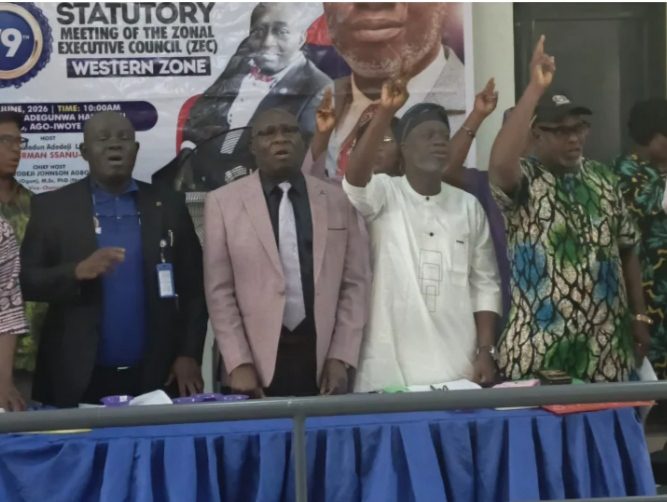
The warning was issued on Thursday at the 79th Zonal Executive Council (ZEC) meeting of the SSANU Western Zone held at Olabisi Onabanjo University (OOU), Ago-Iwoye, Ogun State.
The meeting, attended by SSANU leaders and representatives from universities across the South-West, focused on key issues affecting non-teaching staff, including the unresolved renegotiation of the 2009 agreement, career progression and workers’ welfare.
Addressing newsmen after the meeting, the National Vice President of SSANU and Chairman of the Western Zone, Comrade Abdussobur Olaiwola Salaam, said the prolonged delay in concluding the agreement was fueling discontent among union members nationwide.
“Our major concern is the renegotiation of the 2009 agreement, which has taken far too long to conclude. Our members are becoming increasingly restless over the delay in signing the agreement.
“We are calling on the Federal Government to finalise all necessary arrangements and ensure the agreement is signed as quickly as possible,” Salaam said.
Despite the mounting concerns, he maintained that the union remained committed to dialogue and constructive engagement rather than immediate industrial action.
“SSANU is a trade union, and the fact that we are not belligerent does not mean we are weak. We believe in exhausting all peaceful mechanisms of engagement before resorting to industrial action.
“We are not a strike-happy union, nor are we eager to shut down universities at the slightest provocation. We believe many of the issues affecting the university system can be resolved amicably when all stakeholders act responsibly,” he added.
Salaam also urged President Bola Tinubu’s administration to take urgent steps to cushion the impact of economic hardship on Nigerians, noting that the removal of fuel subsidy had significantly increased the cost of living.
“We are not faulting the idea behind subsidy removal, but government must find practical ways to ease the suffering Nigerians are currently facing. The cost of transportation, feeding and living generally has become extremely high,” he stated.
Warning about the implications of worsening living conditions, he said: “I do not believe it is the desire of any government to govern dead citizens. The goal should be to govern healthy and productive citizens. Sadly, many Nigerians can no longer meet their basic needs.”
On staff welfare, Salaam praised the management of Olabisi Onabanjo University for implementing CONTISS 15 for non-teaching staff, describing the development as a major milestone in addressing long-standing career stagnation within the system.
“For years, many non-teaching staff stagnated on CONTISS 14, sometimes for over a decade, not because they lacked competence, but because there was no opportunity for progression.
“We commend Olabisi Onabanjo University for opening the pathway to CONTISS 15. This will enhance career fulfilment and motivate our members,” he said.
Also speaking, the Chairman of SSANU at OOU, Comrade Adedeji Lamina, said the union’s call for the immediate signing of the agreement was aimed at preventing avoidable disruptions in the university system.
“The major takeaway from this meeting is our appeal to the Federal Government to urgently conclude the renegotiation of our agreement. Other university unions have had their agreements signed, and we are asking the government to do the same for us in order to avert a crisis in the university system,” Lamina said.
He further commended the cordial relationship between the union and the university management, noting that several issues raised by SSANU had received positive attention, including the recent approval of CONTISS 15 for non-teaching staff.
According to him, the collaborative relationship between both parties has helped maintain industrial peace and stability within the institution.