

























Survivors of the Niger State detention tragedy have recounted harrowing details of how 37 young men allegedly suffocated to death inside a severely overcrowded cell at a Nigeria Security and Civil Defence Corps (NSCDC) facility in Minna.
The survivors spoke during a BBC News report by correspondent Madina Maishanu, who visited the detention centre and inspected the cell where more than 50 detainees were reportedly held.
According to the survivors, detainees endured extreme heat, poor ventilation, severe overcrowding and a lack of drinking water. They said the conditions became so desperate that some detainees resorted to drinking urine and squeezing sweat from their clothes to relieve their thirst.
One survivor described the heat inside the cell as unlike anything he had experienced before.
“I felt a kind of heat that I have never felt before in my entire life. Even if a fellow detainee touched your body, it felt as though fire was being applied to your skin.”
The victims were among more than 50 young men arrested by the NSCDC over allegations of illegal mining in Niger State.
Another survivor, Usman Muhammad, described the desperate attempts by detainees to get help after one of the men collapsed.
According to Usman, inmates began banging on the cell door and pleading with an NSCDC officer to provide water after a detainee started fainting.
“There was one person who started fainting, so we began banging on this door. One of the [NSCDC officers] came over, and we pleaded, ‘For God’s sake, please give us water, our companion has fainted.’”
Usman said the officer used a flashlight to look inside the cell and saw the unconscious man lying on top of other detainees, but allegedly left without providing assistance.
“When he shone his flashlight and saw him lying on top of people, he simply snatched the door handle, turned the light on, switched it back off, and walked away.”
He added that the situation soon became fatal. 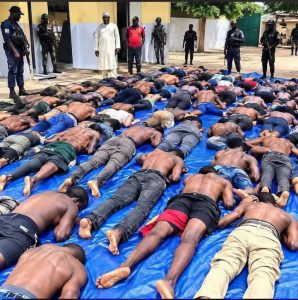
“Aka fara mutuwa daya bayan daya…”
The Hausa phrase means: “Then people started dying, one after another.”
‘How Could More Than 50 People Survive Here?’
During her visit to the facility, BBC correspondent Madina Maishanu described the cell as extremely small and poorly ventilated.
She said the room had only one window through which very little air could enter and a single toilet for the large number of detainees reportedly held there.
Maishanu also described feeling intense heat and detecting the smell of urine and decomposing bodies inside the facility.
She questioned how more than 50 people could have been expected to live in such confined conditions with inadequate airflow and only one toilet.
Usman said the overcrowding eventually left detainees convinced that they might not survive.
“At that point, we gave up all hope of surviving because we were so crowded.”
He described seeing detainees crying out from thirst and said some were forced to drink urine or squeeze sweat from their clothes in an attempt to stay hydrated.
Usman also alleged that the bodies of those who died showed signs of severe deterioration.
“Whenever you touched the bodies of those who had died, you could see their skin peeling off.”
The Daily Crucible had earlier reported that 37 people died while in NSCDC custody after being arrested over alleged illegal mining, citing the Niger State Government.
The state government has said an investigation is underway to establish the circumstances and exact cause of the deaths.
Following the tragedy, President Bola Tinubu ordered a Presidential Independent Investigation Committee to investigate the incident.
The Minister of Interior, Dr Olubunmi Tunji-Ojo, also suspended the Niger State NSCDC Commandant, Suberu Siyaka Aniviye, along with 23 other personnel.
Meanwhile, NSCDC Commandant-General, Prof. Ahmed Abubakar Audi, ordered that the agency’s flag be flown at half-mast for three days across all its formations in honour of those who died.
The deaths have generated widespread outrage in Niger State and beyond, with calls for accountability and a thorough investigation into the circumstances surrounding the detention, the conditions inside the cell and the deaths of the detainees.
The survivors’ accounts have added a deeply disturbing dimension to the tragedy, raising questions about the number of people held in the facility, the conditions under which they were detained and whether adequate measures were taken to respond to the detainees’ pleas for water and medical assistance.