





















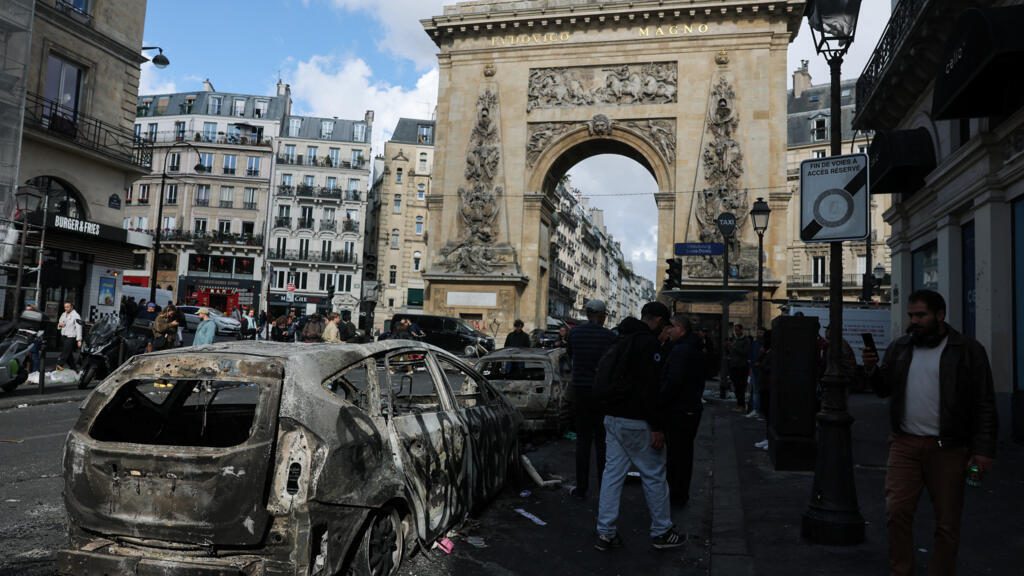
The destruction of a 143-year-old town hall in Limoges and attacks on public buildings and commercial premises across France have highlighted the devastating property losses caused by the country’s escalating protests over the cost of living and public services.
France is facing a mounting property and heritage crisis after violent protests swept across several cities, leaving historic landmarks damaged, municipal buildings vandalised, shops looted and businesses counting the cost of widespread destruction.
The most significant loss occurred in Limoges, where masked protesters reportedly set fire to the historic town hall on Saturday night, destroying much of the 19th-century landmark that had survived two World Wars.
The building, inaugurated in 1883 and modelled after Paris City Hall, was engulfed in flames before its bell tower and roof collapsed, according to footage of the incident.
The destruction has raised fresh concerns about the vulnerability of France’s historic building stock, particularly public properties that serve as administrative centres and symbols of local heritage.
According to the Haute-Vienne prefecture, approximately 2,000 demonstrators gathered in Limoges, with a group reportedly forcing its way into the town hall at about 6 p.m. A police vehicle was set ablaze outside before windows were smashed and a fire started inside the building.
Haute-Vienne Prefect Maurice Barate, quoted by AFP, said the roof had collapsed onto the lower floors, except in the west wing, while about two-thirds of the building’s exterior had already disappeared.
He described the incident as a catastrophe for French heritage and blamed what he called a deliberate act of vandalism.
The full cost of restoring or rebuilding the property was not immediately available. However, the extensive structural damage and loss of historic architectural features could make the project significantly more complex than an ordinary municipal building repair.
Limoges Mayor Guillaume Guérin condemned the attack, describing the destruction as a major failure of the state’s response to the unrest. He also warned that he could resign if government funding was not provided to repair the damage.
The destruction in Limoges was part of a broader wave of attacks on public and commercial properties in several French cities.
In Lyon, protesters set fire to the historic tourist office on Place Bellecour, damaging a prominent property associated with the city’s tourism industry.
In Marseille, masked rioters stormed the city hall, overturned furniture and toppled a bust of Marianne, the symbolic female representation of the French Republic. A municipal police station was also surrounded.
In Bordeaux, protesters reportedly broke into and ransacked the official residence of the prefect of Gironde before starting a fire in the courtyard. Authorities subsequently deployed the elite RAID police unit.
Municipal buildings were also targeted in Lille, while attempted incursions into town halls were reported in Calais and Brest.
In Grenoble, the city hall sustained damage, prompting senior government officials to warn that public buildings had become deliberate targets in several urban centres.
The incidents have exposed the risks facing publicly owned real estate during periods of civil unrest, with municipal offices, historic buildings and administrative facilities bearing the brunt of the destruction.
Apart from their immediate repair costs, such properties can carry substantial cultural, architectural and civic value that cannot easily be replaced.
Commercial properties have also suffered extensive damage, with shopkeepers and retailers reporting smashed windows, looting and vandalism.
Traders’ unions said more than 1,500 shops had been ransacked, with losses estimated to run into tens of millions of euros.
Carrefour’s chief executive said 50 of the retailer’s outlets had been damaged, including 20 that were looted.
The scale of the destruction threatens to increase repair bills for commercial landlords and tenants, while leaving affected businesses facing possible interruptions to trading, damaged stock and additional security costs.
For property owners, the financial implications extend beyond the immediate cost of replacing broken windows, repairing entrances and restoring damaged interiors. Depending on the extent of the damage, some premises could require extensive refurbishment before reopening.
Businesses may also face uncertainty over insurance claims, loss-of-income protection and the time required to complete repairs. The extent of any recovery will depend on the terms of individual insurance policies and the findings of property assessments.
The damage could also place additional pressure on retail operators already contending with higher operating costs and weaker consumer purchasing power.
Protests Escalate From Public Grievances to Property Destruction
The unrest began last month as a student-led protest over conditions in the education system, including staff shortages, deteriorating classrooms, long school hours and concerns about university admissions.
Over four weeks, students staged demonstrations and barricaded schools, arguing that the government had failed to address longstanding problems in public education.
The movement subsequently expanded, attracting parents, teachers, pensioners, workers and members of the General Confederation of Labour (CGT).
Rising fuel prices, amid the conflict involving Israel, the United States and Iran and disruption around the Strait of Hormuz, also fuelled public anger.
While tens of thousands of people reportedly marched peacefully in Paris, separate groups of masked protesters engaged in violent confrontations with police, burned barricades and attacked buildings and businesses.
The resulting property damage has become a major economic consequence of the unrest, shifting attention from the demonstrators’ original demands to the costs of restoring damaged public infrastructure and commercial premises.
The French government has entered crisis talks following the violence, which left hundreds of shops damaged and public buildings across the country affected.
Interior Minister Laurent Nuñez said more than 600 police officers, firefighters and paramedics had been injured, while more than 2,000 people had been arrested. Police reported 855 arrests in Paris alone.
The unrest also resulted in serious injuries and at least one reported death. In Saint-Étienne, a 17-year-old boy reportedly lost his right hand after a crowd-control grenade exploded.
The scale of the damage has prompted questions about the authorities’ preparedness, policing tactics and ability to protect public infrastructure.
In Limoges, Guérin said municipal police had struggled to contain the violence after running out of ammunition. He warned that the destruction could not be addressed adequately without financial support from the government.
The demand for public funding places additional pressure on authorities to determine how reconstruction costs will be shared between municipal budgets and the national government.
For local administrations, the challenge extends beyond restoring damaged buildings. Funds allocated to emergency repairs may compete with other public spending priorities, including education, housing, infrastructure maintenance and social services.
French President Emmanuel Macron condemned the violence, insisting that legitimate grievances could not justify attacks on public buildings and private businesses.
He said those responsible for looting, vandalism and attacks on administrative offices would be prosecuted and punished.
“Those who looted will have to pay back for the damage, and those who sought to bring down the Republic will be held accountable,” Macron said.
The president also called on political organisations to condemn the violence, while his government blamed radical-left groups and criminal elements for contributing to the unrest.
Prime Minister Sébastien Lecornu said the government would not be intimidated by violence, while radical-left leader Jean-Luc Mélenchon accused the authorities of organisational failures that had allowed the situation to deteriorate.
The political dispute has intensified pressure on the government to restore order and provide a credible plan for repairing damaged properties.
The destruction of Limoges town hall has emerged as the most prominent example of the damage inflicted on France’s built environment during the protests.
Unlike ordinary commercial premises, historic buildings can require specialist conservation work, traditional materials and detailed architectural assessments before restoration can begin.
Where fire has compromised roofs, floors and load-bearing structures, engineers must first establish whether the remaining building can be stabilised and repaired safely.
The loss of original architectural features can also complicate restoration, particularly when historic materials are no longer readily available or surviving records are insufficient to guide reconstruction.
For local authorities, the financial burden could therefore extend well beyond emergency clearance and basic structural repairs.
The destruction of the town hall also represents a loss to the city’s architectural identity, potentially affecting the surrounding urban environment and the historic character that attracts visitors.
Meanwhile, damaged shops and other commercial properties must be assessed and restored before normal business activity can resume.
As France grapples with the aftermath of the unrest, the immediate priority will be to secure damaged buildings, assess structural safety, support affected businesses and establish the funding required for reconstruction.
The longer-term challenge will be ensuring that historic landmarks and commercial properties can be protected against further violence, while addressing the social and economic grievances that fuelled the demonstrations.
For property owners, businesses and local governments, the events have delivered a stark reminder that civil unrest can generate extensive real estate losses, disrupt commercial activity and place an unexpected financial burden on already stretched public resources.