




















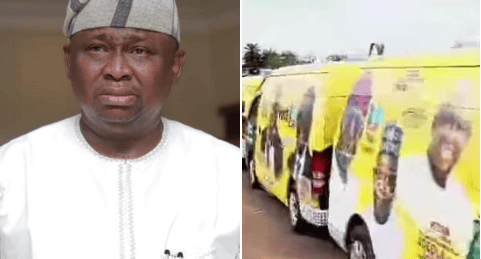
A fresh campaign-finance controversy has emerged in Ogun State ahead of the 2027 governorship election following the submission of a petition to the Economic and Financial Crimes Commission (EFCC) seeking an investigation into the 119 vehicles publicly acknowledged as donations to the campaign of the All Progressives Congress (APC) governorship candidate, Senator Solomon Olamilekan Adeola, popularly known as Yayi.
The petition, dated September 30, 2026, and addressed to the Zonal Director of the EFCC, Ibadan Zonal Directorate, was submitted by a prominent politician, Adekunle Shomorin, who described himself as a concerned citizen resident in Ogun State.
Shomorin asked the anti-graft agency to investigate the identity, ownership, acquisition, valuation and sources of funds relating to the vehicles, as well as determine whether the donations complied with applicable provisions of the Electoral Act 2026 and the Money Laundering (Prevention and Prohibition) Act 2022.
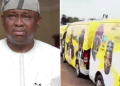
The petition followed a statement issued by Adeola on 28th September, 2026 in which he publicly expressed appreciation to 22 individuals, companies and groups for providing a combined 119 vehicles, comprising buses and other vehicles, to support his campaign and grassroots mobilisation.
Adeola’s published list identifies a businessman, Mr Akintunde Armstrong as the largest single contributor, with 26 buses, just as another business baron, Alhaji IBD Dende was credited with seven buses and an ambulance, while Zacobass Oil & Gas, Stonebridge Engineering Services Ltd, Elele Ijebu, Amazon Luxury Apartments, Mr Osho and Polanco were each listed as contributors of 10 buses.
A major plank of the petition concerns the 26 buses attributed to Armstrong.
Using an 18-seater Toyota Hiace as a benchmark, the petitioner estimated the value of the 26 vehicles at about N728 million if valued at N28 million each, while higher estimates based on foreign-used or new vehicles put their possible aggregate value considerably higher.
On that basis, the petitioner contends that the alleged value of the contribution could exceed the N500 million individual/entity donation ceiling under Section 92(8) of the Electoral Act 2026.
The new Electoral Act indeed provides that an individual or other entity shall not donate more than N500 million to a candidate. The same section places the maximum election expenditure for a governorship candidate at N3 billion.
However, the petitioner’s valuation is an allegation for investigation; the actual value of the vehicles, their ownership arrangements, acquisition costs and the legal character of the donations would have to be established by the relevant authorities.
The petitioner also drew attention to several other donors credited with 10 buses each, arguing that the cumulative value of their contributions should similarly be subjected to verification.
Another issue raised in the petition is the identification of some contributors by what the petitioner describes as nicknames or pseudonyms.
Names appearing on Adeola’s published list include ‘Citiside Brother,’ ‘Sanusi Friend,’ ‘Olafem Citi Friend,’ ‘Onaolapo Brother,’ ‘OJ,’ ‘Polanco,’ ‘Elele Ijebu’ and ‘Nafiu Abimbola & Friend.’
The petitioner argues that the identities and addresses of such contributors should be established as part of any investigation.
The petition specifically asks the EFCC to determine the beneficial ownership of the vehicles, establish who actually financed their acquisition and examine whether any of the transactions involved undisclosed or unlawful sources of funds.
The Money Laundering (Prevention and Prohibition) Act 2022 is part of Nigeria’s existing anti-money-laundering framework, with the EFCC’s Special Control Unit Against Money Laundering (SCUML) responsible for AML/CFT monitoring and supervision of designated non-financial businesses, including automobile dealers.
Beyond individual donations, the petitioner questioned whether the total value of the vehicles could have implications for the statutory campaign expenditure ceiling.
The 2026 Electoral Act sets the maximum election expenditure for a governorship candidate at N3 billion. The Act also recognises campaign expenditure and contributions in monetary and other forms, with reporting and disclosure obligations applying to political parties.
The petitioner’s calculation puts the 119 vehicles at approximately N3.33 billion even using his lower benchmark of N28 million per vehicle, while a N90 million-per-vehicle benchmark would produce a much higher figure.
The petition therefore asks the EFCC to establish the actual commercial value of the vehicles rather than relying on estimates.
The petitioner specifically asks the EFCC to investigate whether the transactions breached campaign-finance laws or anti-money-laundering provisions.
Adeola, in his September 28 appreciation message, described the vehicle donations as voluntary contributions by supporters and associates and said the vehicles had already been deployed for grassroots mobilisation and outreach across Ogun State.
As of the filing of the petition, there was no indication in the material provided that the EFCC had announced the commencement of an investigation or made any finding against Adeola or the donors.
The development nevertheless places the unusually large fleet of campaign vehicles under formal scrutiny and adds a new dimension to the increasingly active political contest in Ogun State ahead of the 2027 governorship election.