

















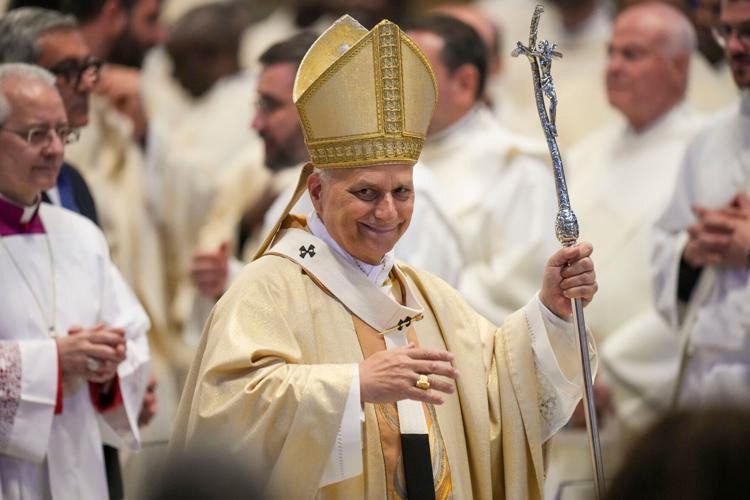
Pope Leo XIV has sharply rebuked global leaders who fuel wars and exploit the environment, branding them as “thieves” stealing humanity’s chance at a peaceful and secure future.
Speaking during his weekly Angelus address on Sunday, the pontiff warned that those who drive violent conflicts and squander the planet’s resources are effectively robbing future generations of stability and security.
Marking the 40th anniversary of the Chernobyl nuclear disaster, he described the 1986 catastrophe as a lasting warning to the world—particularly about the dangers facing nuclear facilities amid ongoing conflicts.
“I hope that at all decision-making levels, wisdom and responsibility always prevail, so that atomic power can always be used to support life and peace,” he said.
Referencing the day’s Gospel, the Pope broadened his message to condemn consumerism and entrenched prejudice, arguing that alongside war, they remain major forces undermining global stability.
Meanwhile, Pope Leo XIV has vowed to continue working to overcome differences with the worldwide Anglican Communion during a meeting with its first female leader, the Archbishop of Canterbury, Sarah Mullally, on Monday.
According to report by Daily Excelsior, Leo acknowledged that “new problems” have been added to “historically divisive issues” in their relationship. Nevertheless, he pledged to continue the efforts of past popes to reunite the churches, deepen bonds of communion, affirm a shared witness, and encourage ongoing collaboration at both global and local levels.
Anglicans split from Rome in 1534 when English King Henry VIII was refused a marriage annulment. Despite a formal theological dialogue that began in the 1960s, significant differences remain, especially over the Church of England’s decision to ordain women. The Roman Catholic Church reserves the priesthood for men.
Mullally prayed with Pope Leo XIV at the Vatican on Monday, marking an encounter between Christianity’s two most prominent religious figures—one that would have been unthinkable just a few years ago, given divisions over women’s ordination and her historic appointment.
She thanked Leo for welcoming her on her first foreign visit since her installation last month as the first woman to lead the Church of England and serve as the spiritual leader of millions of Anglicans worldwide.
Mullally, whose appointment has deepened divisions within the Anglican Communion, arrived early to meet Leo in his library. The two then prayed together in the Urban VIII Chapel inside the Apostolic Palace, in what the Vatican described as a “moment of prayer.”
In her remarks, Mullally said both leaders were called to preach the Gospel with “renewed clarity.”
“In the face of inhuman violence, deep division, and rapid societal change, we must keep telling a more hopeful story: that every human life has infinite value because we are precious children of God; that the human family is called to live as sisters and brothers,” she said.
“We must therefore work together for the common good—always building bridges, never walls—and remember that the poorest among us are closest to the heart of God.”
The Vatican did not immediately release the text of Leo’s remarks.
However, Mullally is on what she has described as a four-day pilgrimage to Rome, which has included visits to the main pontifical basilicas. She prayed at the tombs of Saints Peter and Paul and met with senior Vatican officials.
Lambeth Palace said her visit is intended “to strengthen Anglican–Roman Catholic relations through prayer, personal encounter, and formal theological dialogue.
“It aims to deepen bonds of communion, affirm a shared witness, and encourage ongoing collaboration at both global and local levels.”
Anglicans split from Rome in 1534 when King Henry VIII was denied marriage annulment. Despite decades of dialogue, major differences persist, particularly over the ordination of women. The Roman Catholic Church continues to reserve the priesthood for men.
The first female Anglican priests were ordained in 1994, the first female bishop in 2015, and Mullally now becomes the first female Archbishop of Canterbury.
Leo and Mullally have already exchanged greetings, with the pope congratulating her on her installation while acknowledging she was assuming the role at a “challenging” time and that differences remain.
“We also know that the ecumenical journey has not always been smooth,” Leo wrote. “Despite much progress, our immediate predecessors, Pope Francis and Archbishop Justin Welby, acknowledged frankly that new circumstances have presented new disagreements among us.”
He nevertheless pledged to continue dialogue. In October, Leo welcomed King Charles III and Queen Camilla to the Vatican, where they prayed in the Sistine Chapel. Charles is the titular head of the Church of England.
That event, on October 25, marked the first time since the Reformation that the heads of the two churches had prayed together.
This year marks the 60th anniversary of the first formal ecumenical statement between the Anglican and Roman Catholic Churches, signed in 1966 at St. Paul’s Outside the Walls Basilica by Archbishop Michael Ramsey and Pope Paul VI.
Mullally has also expressed support for Leo’s message of peace after the American-born pope faced criticism from U.S. President Donald Trump for his stance on Iran.
George Gross, an expert on theology and the monarchy at King’s College London, described the meeting as historic, particularly given that the Vatican does not recognise the female priesthood.
“If we were to go back several hundred years, it would be unthinkable,” he said. “The fact that the pope is willing to meet her shows both openness and the continuing gap.”
Gross said the joint prayer signalled unity, especially in the face of global conflicts, and echoed the symbolism of the king’s visit to the Vatican in October.
“It’s a doubling down on togetherness,” he said.
An appointment that divides the Anglican Communion
Mullally’s appointment has nevertheless deepened divisions within the Anglican Communion, whose 100 million members across 165 countries remain split over issues such as the role of women and LGBTQ+ inclusion.
Many in England and other Western countries have hailed her appointment as a historic breakthrough.
However, the communion’s largest and fastest-growing churches in Africa belong to the conservative Global Anglican Future Conference (Gafcon), which has strongly criticised her appointment and threatened a formal break.
In the United States, the Anglican Church in North America—formed after breaking away from more liberal Episcopal churches—has aligned with Gafcon in opposing Mullally’s appointment. (AP)