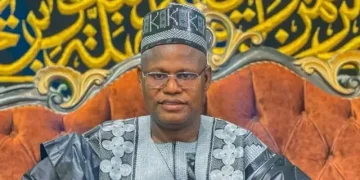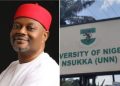












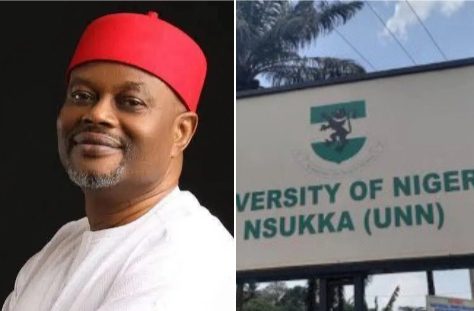
An investigator with the Independent Corrupt Practices and Other Related Offences Commission, ICPC, has told a Federal High Court in Abuja that the University of Nigeria, Nsukka, UNN, and the National Youth Service Corps, NYSC, disowned the degree and discharge certificates presented by former Minister of Innovation, Science and Technology, Uche Nnaji.
Yakubu Ibrahim, a Superintendent of Police, testified on Monday as the first prosecution witness in the trial of Nnaji, who is facing a six-count charge marked FHC/ABJ/CR/389/2026, bordering on alleged corruption, fraud and presentation of forged certificates.
Led in evidence by prosecution counsel J.A. Mumini, SAN, Ibrahim said he was part of the ICPC team that investigated two petitions alleging certificate forgery against the former minister.
He said the investigation was ordered by the Chairman of the Special Task Force, after which the Commission wrote to the National Assembly, the Office of the Secretary to the Government of the Federation, UNN and NYSC for authentication.
According to him, UNN responded that it did not issue the Bachelor of Science certificate in Microbiology/Biochemistry allegedly submitted by Nnaji to the Senate for his ministerial screening in 2023.
He said NYSC also disowned the discharge certificate dated May 15, 1986, purportedly belonging to Nnaji.
Ibrahim said UNN also forwarded the defendant’s academic records, including a notice of withdrawal issued to him for failing to obtain the required grade in a course.
When shown copies of correspondence between the ICPC and the two institutions, the witness identified them and the prosecution tendered them in evidence.
Defence counsel, Wole Olanipekun, SAN, said he would allow the documents to be admitted at that stage but reserved his objection.
On efforts to get Nnaji’s response, Ibrahim said the team could not locate his physical address and later sent an invitation dated May 5, 2026, to his email and WhatsApp. He said Nnaji failed to honour the invitation, prompting the ICPC to liaise with the Economic and Financial Crimes Commission, EFCC, to arrest him on July 1. He was subsequently questioned and made statements on July 1 and 2.
Under cross-examination by Olanipekun, Ibrahim admitted he did not visit UNN and did not know the faculty to which Nnaji was admitted, but said the team interviewed the university’s Registrar.
Asked where the alleged certificates were forged, he said he did not know. He also said Nnaji made no comment on the allegations during interrogation.
The witness said the team did not investigate where Nnaji did his national service because NYSC had already stated it did not issue the certificate.
“The NYSC said the certificate was not issued by it, which was why we didn’t inquire where he served,” he said.
He identified Exhibit C, a withdrawal notice dated November 7, 1984, supplied by UNN, and said the university explained that a student who failed a course four times would not be qualified for a certificate. He said Nnaji failed twice, missed the third attempt for medical reasons, and later wrote a supplementary examination for which he did not register.
He confirmed that UNN stated the BSc certificate in Microbiology and Biochemistry was not issued by it.
Olanipekun suggested that a letter dated March 18, 1985, rescinded the withdrawal notice. Ibrahim agreed, adding that the withdrawal related to a course in General Microbiology.
The witness said the investigators did not establish the number of years required to study Microbiology at the university.
Justice Joyce Abdulmalik discharged the witness and adjourned the case to November 3.
Nnaji, who resigned as minister following the scandal, did not include the controversial degree in his filing with the Independent National Electoral Commission, INEC, as PDP governorship candidate in Enugu State for the 2027 election.