























By Mick Oseji, Asaba
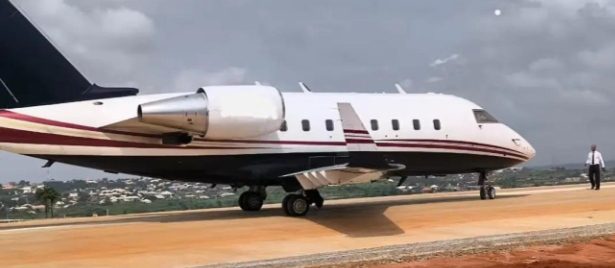
The Nigerian Civil Aviation Authority (NCAA) has announced plans to sanction the pilot of a private aircraft that landed on a road in Ogwashi-Uku, Delta State, before taking off again without obtaining the required clearance.
The aircraft, bearing registration number N989BC, made headlines after it reportedly landed on a newly constructed road in the area and subsequently departed without authorization from aviation authorities.
Speaking on News Night, an Arise Television programme, the NCAA, through its Director of Operations, Licensing and Training, Capt. Don Spiff, condemned the pilot’s decision to take off from the road, describing the action as unauthorized and reckless.
“For him to have taken off, it was not allowed because he did not obtain any clearance for takeoff. He did a kamikaze (suicide mission) action. There will be penalties. So far, the NCAA has suspended their commercial certificate, which is called a PNCF,” Spiff said.
Despite the incident, the aviation regulator insisted that Nigeria’s airspace remains safe, stressing that the occurrence was an isolated case and should not be used to question the country’s aviation safety record.
“I must say at this point that for one incident to have happened in so many months and years should not question the safety of Nigerian airspace. The Nigerian airspace is very safe. This was an isolated incident,” he added.
Providing details about the crew, Spiff disclosed that the pilot is 75 years old while the co-pilot is 70. Both men hold American aviation licences and operate under United States Federal Aviation Administration (FAA) regulations.
He noted that neither pilot is considered overaged under the rules governing their licences and operations.
According to him, the aircraft is registered in the United States and operates under FAA Part 91 and Part 135 regulations, making the crew subject to American licensing standards rather than Nigerian commercial pilot age restrictions.
“In Nigeria, it is 65. Once you are 65, you stop flying commercial aircraft. However, our regulations are being reviewed.
Aviation is dynamic, and there are ongoing efforts to allow Nigerian pilots above 65 to fly privately, provided they pass the required first-class medical examinations,” he explained.
Spiff revealed that investigations into the incident have already commenced, led by the Nigerian Safety Investigation Bureau (NSIB), which is responsible for probing serious aviation accidents and incidents.
“Before I say anything, I must remind you that investigations have already started on this incident. The NSIB is already on it. If it determines that it is not a serious incident, the case will be handed over to the NCAA,” he said.
He further clarified that the flight had a valid flight plan from Lagos to Asaba and that the pilot had attempted to land at Asaba Airport before executing a go-around.
“It is not a breach. This aeroplane had a flight plan filed from Lagos to Asaba. That was his destination. He did go to Asaba and made an approach in Asaba. He could not land and executed a go-around. How he ended up landing on a strip or a road, a newly constructed road, only the pilot and his God could determine. The investigation will reveal whether there was any ulterior motive,” Spiff stated.
The NCAA also identified VMO Aero, a Nigerian company, as the operator of the aircraft, although it noted that the operator may be different from the aircraft’s actual owner.
The outcome of the ongoing investigation is expected to determine the circumstances surrounding the unusual landing and the regulatory violations that may have occurred.