






















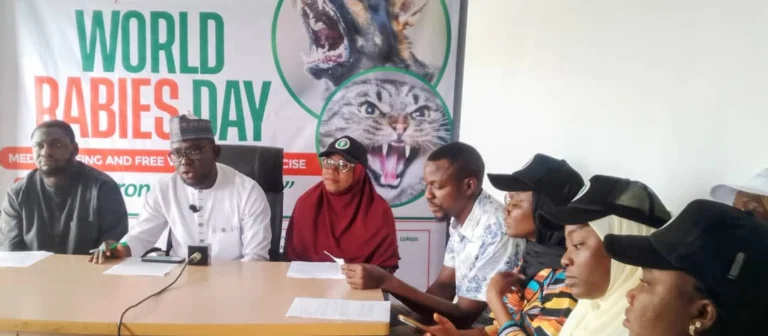
The Kogi chapter of the Nigerian Veterinary Medical Association (NVMA) has called on the state government to employ at least two veterinary doctors in each of the state’s 21 Local Government Areas (LGAs) to strengthen rabies surveillance and the One Health response.
The state Chairman of the association, Dr Tolu Omotugba, made the call on Monday in Lokoja at a news conference to commemorate the 2026 World Rabies Day, observed annually on September 28.
Omotugba said Kogi’s large dog population, including dogs used for hunting and security, as well as its porous borders, made stronger rabies surveillance and prevention measures necessary.
He described rabies as a disease that is almost invariably fatal once clinical symptoms appear but is preventable through timely vaccination and post-exposure care.
According to him, the number of veterinary officers in the Kogi State civil service remains inadequate to effectively monitor and report diseases of public health importance.
“We have about 28 to 30 veterinary officers currently in the Kogi civil service, which is not enough. Some LGAs do not even have the presence of a veterinary officer,” he said.
Omotugba noted that some states had significantly larger numbers of veterinary personnel and recommended a minimum of two veterinary doctors per LGA in Kogi.
“We are suggesting a minimum of two per LGA so that they can, at least, do disease reporting, especially for diseases of public health concern,” he said.
He added that the number could be increased to five veterinary doctors per LGA if the state had the resources.
The NVMA chairman also expressed concern over the underreporting of rabies cases in Kogi and Nigeria, recalling a 2025 incident in Bassa Local Government Area of Plateau State in which 12 people reportedly died from rabies, including three members of the same family.
“A single dog bite, a single scratch, can end a family,” he warned.
He said the 2026 World Rabies Day theme, “Stronger Together,” highlighted the need for collaboration among the Ministries of Health, Environment, Education and Livestock, as well as veterinary and medical professionals, environmental health officers and community leaders.
Omotugba commended the Federal Government, through the Federal Ministry of Livestock Development, led by Minister Idi Mukhtar Maiha, for its efforts to expand dog vaccination.
He said the ministry was targeting 70 per cent annual dog vaccination coverage and zero human deaths from rabies by 2030.
According to him, 26,000 vaccine doses were deployed to eight high-risk states in 2025, while the Federal Capital Territory recently launched a vaccination campaign targeting 20,000 dogs.
Omotugba also called for an update of Kogi’s legal framework on rabies and dog ownership, noting that the state still relied on outdated legislation, including the Rabies Act of 1935 and the Dogs Law, Cap. 36 of Northern Nigeria.
He said the existing laws provided for dog seizure and licensing but did not adequately address modern dog population management and enforcement.
“We cannot eliminate a 21st-century disease with 20th-century laws,” he said.
He therefore urged the Kogi State Government to domesticate the Kogi State Rabies Control and Responsible Dog Ownership Bill 2026, including provisions for compulsory annual vaccination.
Other recommendations included establishing a dog registry, imposing penalties for stray dogs, replacing shooting on sight with humane dog-management measures, and creating a dedicated budget line for rabies control under the Livestock Productivity and Resilience Support (L-PRES) Project.
He also called for increased public sensitisation, access to post-exposure prophylaxis in state hospitals and the establishment of a Kogi One Health Rabies Task Force.
“Let Kogi lead as the first state in North-Central to be rabies-free,” Omotugba said.
•NAN.