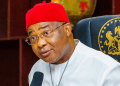







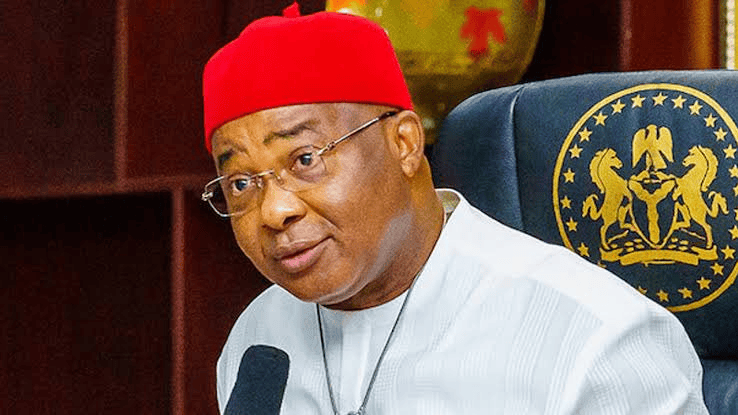
Imo State Governor Hope Uzodinma has questioned the manner in which ethnic representation is handled in Nigeria’s political system, arguing that some minority groups within the broader Igbo population are being presented as representatives of the entire Igbo ethnic group.
Uzodinma made the remarks during an Independence Day banquet, where he reflected on the political representation of Nigeria’s three major ethnic groups—the Hausa, Igbo and Yoruba.
According to the governor, while minority groups exist within each of the three major ethnic blocs, he believes the situation is treated differently when it comes to the Igbo.
“To form Nigeria, there are the Hausa, Igbo and Yoruba. Among the Hausa, we have minorities; among the Igbo, we also have minorities, and likewise among the Yoruba.
“But in the consideration of government today, it is only the Igbos whose minorities are being represented. Why? The Hausa are always represented by a full Hausa, and the Yoruba by a full Yoruba. But in the Igbo case, minorities are claiming to be the majority,” Uzodinma said in a trending video.
Uzodinma did not specify which groups he considers minorities within the Igbo population. He also did not identify particular government officials, appointments or political positions that he believes reflect what he described as an imbalance in representation.
The comments have generated discussion, particularly on social media, with some Nigerians calling on the governor to clarify the groups he was referring to and the basis for his distinction between majority and minority groups within the Igbo population.
Others have interpreted the remarks against the backdrop of longstanding political and identity debates involving the South-East and neighbouring South-South region.
Some social media commentators have also connected Uzodinma’s comments to recent political disagreements involving prominent figures from the two regions.
However, the governor did not mention any individual or specific political dispute in the portion of his speech containing the remarks.
His comments have therefore opened a broader conversation about how ethnic identity, minority status and political representation are defined and applied in Nigeria’s federal system.