






















Thousands of foreign nationals rushed to leave South Africa on Tuesday as the June 30 deadline issued by anti-immigrant groups expired, prompting a massive security deployment across major cities amid fears that xenophobic protests could descend into widespread violence.
Police and other security personnel were deployed across Johannesburg, Durban, Cape Town and other hotspots to prevent attacks, looting and unrest linked to demonstrations organised by anti-immigrant groups. Businesses in several areas remained closed, while normally busy streets wore an unusually deserted look as residents and migrants stayed indoors.
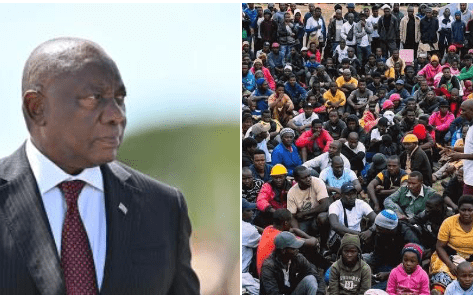
At consulates, temporary shelters and designated assembly points, thousands of foreign nationals queued in hopes of securing transportation out of the country as neighbouring African governments accelerated evacuation efforts for their citizens.
The protests are being driven by a coalition of small political organisations and self-styled vigilante groups demanding the removal of undocumented migrants from South Africa. Analysts say the movement has gained traction through coordinated social media campaigns, fuelled in part by misinformation that has since been debunked.
In Durban, protesters clad in traditional Zulu attire gathered in a public park carrying sticks and shields while chanting “abahambe”—meaning “Let them go”—under the close watch of heavily armed security forces.
One of the demonstrators, 64-year-old pensioner Selwyn Anderson, defended the campaign, arguing that undocumented migrants had taken over many small businesses.
“I travelled a bit in Africa. All these countries are messed up, and South Africa is the America of Africa,” Anderson told AFP.
Despite repeated assurances from protest organisers that the demonstrations would remain peaceful, fears of violence have persisted following recent deadly attacks linked to anti-immigrant sentiment.
At least four foreign nationals—two Mozambicans, one Ethiopian and one Malawian—have reportedly been killed in recent weeks, prompting several African governments to organise emergency evacuations for their citizens.
South Africa, Africa’s most industrialised economy, has long attracted migrant workers from across the continent despite grappling with unemployment above 30 per cent, high crime rates and mounting pressure on public services.
With local government elections scheduled for November, analysts say immigration has increasingly become a political flashpoint.
Labour analyst Dale McKinley argued that the country’s socio-economic challenges, rather than migration, were at the heart of public frustration.
“The xenophobic groups have got it wrong,” McKinley said. “This is a problem of governance, corruption, and mismanagement.”
Nigeria and Ghana have already evacuated 265 and 300 citizens respectively, while the Nigerian government announced that another batch of 271 nationals would be airlifted on Tuesday. Uganda also confirmed plans to begin evacuating nearly 750 citizens in the coming days.
Across Johannesburg and Cape Town, thousands of migrants—many from Malawi and Zimbabwe—continued waiting for buses and flights home. Some said they had lost their jobs or been evicted by landlords fearing possible violence or legal repercussions associated with employing undocumented migrants.
“I decided to go to avoid being attacked,” said 45-year-old Malawian builder Peter Madsoan, who was waiting in Durban for transport home.
“I am a breadwinner back at home in Malawi. It is better for me to go than to die in South Africa,” he added.
Zimbabwean national Evelyn Chinooneka said she and her 10-month-old baby had spent several nights sleeping outside the Zimbabwean consulate in Cape Town while waiting for evacuation.
“It was raining. All the clothes are wet now. We need our buses to come,” she said, explaining that she had worked on a farm near Cape Town for four years before being told to leave.
Meanwhile, Jacinta Ngobese-Zuma, leader of the anti-immigrant March and March movement, insisted the June 30 mobilisation was intended to remain peaceful.
Describing the campaign as “a national march to freedom” and “a rolling mass action,” she said it would continue until undocumented migrants were deported.
“We are not calling for violence. No one will be killed on the 30th of June, and no looting will take place in our name,” she said.
The South African government, however, mounted an extensive security operation amid concerns that the protests could escalate into unrest reminiscent of the July 2021 riots, when about 350 people were killed during widespread looting and violence following the imprisonment of former President Jacob Zuma.
Ahead of the deadline, President Cyril Ramaphosa announced tougher measures to tackle illegal immigration while appealing for calm and urging traditional leaders to help ease tensions.
KwaZulu-Natal Premier Thami Ntuli also warned against any attempts to incite violence.
“Whatever our concerns about undocumented migration, however legitimate the frustrations beneath them, we will not allow this province to be set alight a second time, whether by criminality or by xenophobia,” he said.
South Africa has experienced repeated outbreaks of xenophobic violence, including the deadly 2008 attacks that claimed 62 lives. However, the current crisis marks the first time multiple African governments have simultaneously organised large-scale evacuations of thousands of their citizens over fears of coordinated anti-immigrant violence.