























By Jane Okafor, Abuja
The Senate on Wednesday passed a landmark constitutional amendment bill seeking to establish state police across Nigeria, while outlining a series of safeguards aimed at preventing governors from abusing the proposed security structure.
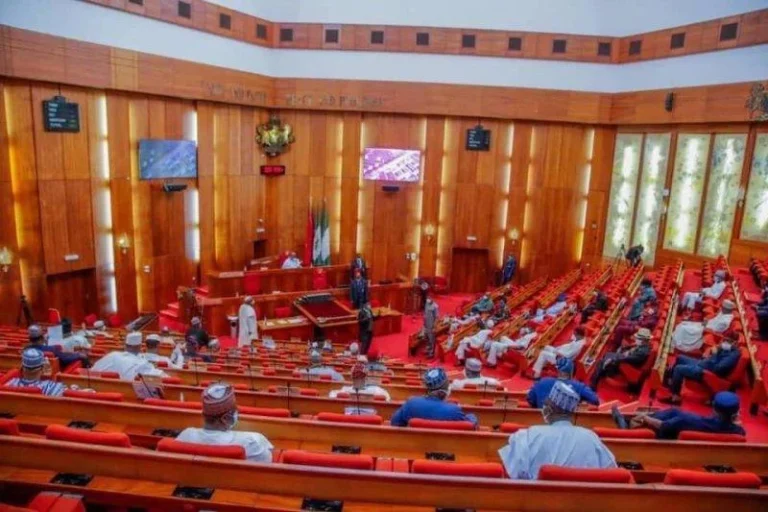
The Constitution of the Federal Republic of Nigeria Alteration (State Police) Bill, 2026, scaled through the Red Chamber after a clause-by-clause consideration and secured the support of more than two-thirds of senators through a manual voting process conducted on the floor of the chamber.
The bill, which seeks to decentralise policing in Nigeria, will now proceed to the House of Representatives for concurrence. It will also require presidential assent and approval by a majority of state Houses of Assembly before it can become law.
Leading debate on the legislation, Senate Leader, Senator Opeyemi Bamidele, said the proposed constitutional amendment was carefully designed to create a decentralised policing framework without allowing state governors to deploy state police for partisan, ethnic, religious, sectional or personal interests.
According to a statement issued by his office, the bill was transmitted to the National Assembly by President Bola Tinubu as part of broader efforts to strengthen internal security while maintaining national cohesion and accountability.
Bamidele explained that the proposal would retain the Nigeria Police Force as the country’s federal policing institution while empowering states that choose to do so to establish their own police services.
Under the proposed arrangement, state police would be responsible for enforcing state laws, maintaining public safety and order, preventing and detecting crimes within their jurisdictions, protecting lives and property, and carrying out other local policing functions.
He noted that the federal police would continue to handle matters of national security, including the protection of federal institutions, counter-terrorism operations, organised crime, cybercrime, border security, arms trafficking and interstate criminal activities.
The Senate Leader also outlined the conditions under which the federal police could intervene in the affairs of a state police service.
According to him, such intervention would only occur in situations involving a complete breakdown of public order, the inability of a state police service to function effectively, serious violations of fundamental rights, established cases of electoral intimidation, or threats to national security.
He stressed that any federal intervention would require written authorisation from the President and Commander-in-Chief of the Armed Forces, be limited in scope and duration, remain subject to Senate oversight, and be open to judicial review.
“The bill generally seeks to balance local policing autonomy with national cohesion, accountability with operational effectiveness, and federal oversight with state responsibility,” Bamidele stated.
He added that the legislation contains “robust safeguards against abuse, preserves federal authority where necessary, protects constitutional rights, and creates a modern policing framework capable of addressing contemporary security challenges.”
The proposal received strong backing from lawmakers across party lines.
Chairman of the Senate Committee on Power, Senator Enyinnaya Abaribe, disclosed that although he had previously opposed the establishment of state police, worsening insecurity across the federation had convinced him of its necessity.
“However, the prevailing security situation across the federation necessitated the establishment of state police in order to tackle security problems,” Abaribe said.
Former Sokoto State Governor and Senator representing Sokoto South, Aminu Tambuwal, also expressed support for the measure, noting that he had consistently advocated the creation of state police.
Similarly, Senate Chief Whip, Senator Tahir Monguno, urged lawmakers to support the constitutional amendment, arguing that decentralised policing would strengthen efforts to combat insecurity at the subnational level.
The passage of the bill marks a significant step in Nigeria’s long-running debate over state policing, a proposal many stakeholders have argued is necessary to address growing security challenges across the country.