























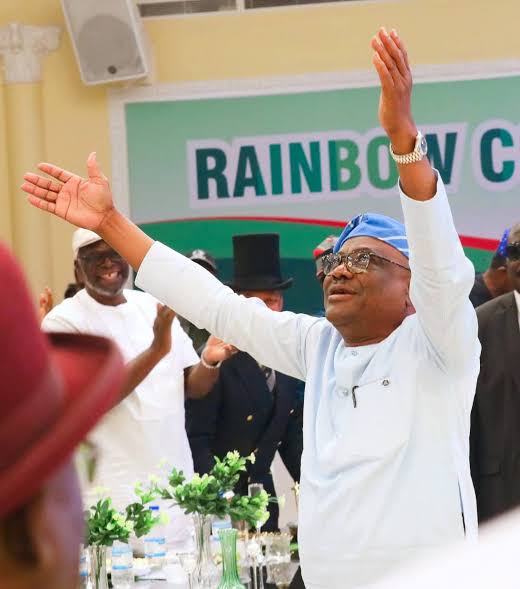
Wike’s Rainbow Coalition offers a valuable lens through which to examine the relationship between political ambition, party organisation, federal power, elite bargaining and democratic accountability in Nigeria
By Adekunle Alaye PhD.
Nigerian Government and Politics is a complex interaction of personalities, political parties, ethnic identities, economic resources and struggles for power. To this large extent, the Rainbow Coalition of Nyesom Wike the Minister of the Federal Capital Territory (FCT) has become a more specific political reference with a dimensional narrative in the contemporary politics of the Nigeria’s fourth republic. Particularly with the build up to the 2027 general elections.
In September 2026, Wike described the Rainbow Coalition as a ‘’cross-party platform for mobilizing support for President Bola Ahmed Tinubu’s re-election, while maintaining that the PDP could continue to field candidates in governorship and legislative elections’’. He however, rejected the characterization of the arrangement as an APC organization.
Be that as it may, this development makes the Rainbow Coalition particularly useful for understanding the difference between party membership, electoral alliances and political loyalty.
In conventional party politics, one might expect politicians who belong to different parties to compete against one another across the entire electoral process. In practice, however, political alliances can be selective. Politicians may support one candidate at the presidential level while competing against that candidate’s party in state or legislative elections.
The Rainbow Coalition, as publicly described by Wike, therefore raises a fundamental question: can politicians belonging to different parties cooperate to elect a president without dissolving their separate party identities?
The answer is yes, in principle. The more difficult question is whether such an arrangement can remain coherent, transparent and politically sustainable.
To understand the contemporary Nigerian politics, it is not enough to study political parties or elections in isolation. One must also examine the informal alliances, negotiations, rivalries and strategic relationships that influence the exercise of political authority.
Rainbow as a Political Metaphor
A rainbow consists of different colours that remain distinguishable while appearing together. So to apply this in a political context, the metaphor suggests unity without complete uniformity.
Political diversity
Politicians from different parties, political tendencies and regional networks may cooperate without abandoning all their existing affiliations.
A shared electoral objective
Different groups may converge around a particular candidate or election, even when their interests diverge on other political questions.
Independent political interests
Participating politicians may retain separate ambitions for governorships, legislative seats, party leadership and future elections.
To a very large extent, the metaphoric assertion is quiet politically attractive because it presents cooperation as compatible with diversity. But the metaphor is not an evidence that all participating groups share a common programme or possess equal influence.
To understand a coalition properly, analysts must ask who belongs to it, what they have agreed to do, how decisions are made, what commitments they have undertaken and who benefits from the arrangement. Within this context, the political activities of Nyesom Wike, provide an important case study.
Wike is widely associated with assertive political leadership, intense party competition, strategic alliances and an approach to politics that frequently crosses conventional party boundaries. The expression ‘’Rainbow Coalition’’, as used here, can be understood as an analytical description of a broad, politically diverse alliance involving actors who may differ in party affiliation, political background, regional interests or ideological orientation but who cooperate around shared strategic objectives.
An important distinction must be established at the outset: the term “Rainbow Coalition” should not automatically be treated as the name of a formally constituted political organization led by Wike. Unless a particular declaration, membership list or organizational structure is identified, it is more academically defensible to use the expression as a framework for analyzing his cross-party political relationships and alliance-building strategies.
The central question of this article is:
What does Wike’s coalition-building approach reveal about the nature of power, political loyalty, party competition, federalism and democratic governance in Nigeria?
The argument advanced here is that Wike’s political relationships offer a useful lens through which to examine the tension between political pragmatism and ideological consistency, personal influence and institutional strength, elite bargaining and popular participation, as well as political stability and democratic accountability.
This is not simply an analysis of one politician. It is an exploration of the wider structures and practices that shape Nigerian government and politics.
A coalition does not automatically replace the parties from which its participants come. Nor does support for a presidential candidate necessarily establish a merger between political parties.
This distinction is especially important in Nigeria, where the competition between the APC and PDP has coexisted with smaller parties, political defections, informal elite negotiations and changing electoral alliances. Research on Nigeria’s Fourth Republic has documented the strength of the two dominant parties and the continuing organizational challenges faced by the wider multiparty system.
One of the most striking dimensions of Wike’s political positioning is the relationship between his PDP affiliation and his declared support for Tinubu, the APC president.
This is not merely a question of personal loyalty. It reveals a broader feature of Nigerian political competition: the interests of a politician, the interests of a political party and the interests of a particular candidate do not always coincide.
Consider three separate levels of political interest.
Individual
The politician’s interest
A political actor may seek influence, access to decision-makers, future electoral opportunities, policy implementation or recognition within the national political system.
Party
The party’s interest
A political party may want to win elections, protect its electoral base, control legislative seats, retain state governments and preserve its organizational identity.
National
The government’s interest
A government may seek national stability, legislative cooperation, policy continuity and a broader political constituency.
These interests can overlap, but they can also conflict.
For example, a PDP politician may believe that supporting Tinubu’s presidential re-election is compatible with helping PDP candidates win governorship or National Assembly elections. From the politician’s perspective, presidential cooperation and local competition are separate strategic decisions.
An APC governor, however, may see the same arrangement as a threat to the ruling party’s organisational unity. If a politician mobilises voters for the APC president while also mobilising against APC candidates in other contests, the governor may question whether that politician is strengthening the party or merely strengthening the president personally.
That tension is central to the Rainbow Coalition debate.
In September 2026, Zamfara State Governor Dauda Lawal publicly argued that Wike should clarify his political allegiance, reflecting concerns expressed by APC governors about a cross-party structure operating alongside the ruling party.
Neither side’s position should be dismissed without examination. Wike’s approach can be interpreted as flexible electoral cooperation; his critics can interpret it as a challenge to party discipline. The key analytical question is whether the arrangement creates legitimate pluralistic cooperation or undermines the ability of parties to maintain coherent programmes and accountability.
A strong political analysis should move beyond describing events. It should use concepts from political science to explain why those events occur, how they operate and what their consequences might be.
The following six perspectives provide a framework for analysing the Rainbow Coalition.
Political pragmatism: Politics as the art of achievable objectives
Political pragmatism refers to an approach that prioritizes practical outcomes over strict adherence to ideological positions.
In a pragmatic framework, politicians evaluate alliances according to their expected benefits, strategic feasibility and political costs.
A politician may support an opponent’s presidential ambition if doing so advances a particular objective, while continuing to oppose that opponent’s party in other contests.
Applied to Wike, pragmatism helps explain how cross-party presidential support could coexist with continued PDP participation in subnational elections.
Potential advantages
It can encourage negotiation between otherwise competing groups.
It may reduce the rigidity of party boundaries.
It can make legislative or intergovernmental cooperation easier.
It may create opportunities for political compromise.
Potential dangers
Political principles may become secondary to personal advantage.
Voters may find it difficult to identify a politician’s consistent programme.
Alliances may change abruptly when political incentives change.
Parties may become vehicles for individual ambition rather than institutions built around public policy.
The central issue is not whether pragmatism is inherently good or bad. It is whether pragmatic behavior produces accountable political cooperation or merely serves the interests of political elites.
Elite theory: Politics and the influence of powerful individuals
Elite theory examines how relatively small groups of influential actors exercise disproportionate influence over political decisions.
In Nigeria, political elites can include governors, former governors, party executives, legislators, ministers, influential financiers and local political organizers.
Such actors may possess resources that ordinary citizens do not: access to party structures, established campaign networks, bargaining power and relationships with decision-makers.
The Rainbow Coalition can therefore be examined as an example of elite coordination across party boundaries.
The relevant questions include:
Who initiates the alliance?
Who determines its priorities?
Which actors negotiate its terms?
Are ordinary party members consulted?
Can citizens influence the alliance’s policy direction?
The existence of elite coordination does not automatically make an alliance undemocratic. Political leadership and negotiation are necessary components of representative government.
The democratic concern arises when political decisions are made without adequate consultation, when public resources are used to advance private interests, or when voters are treated as instruments of elite bargaining rather than independent citizens.
Patron-client politics: The role of networks and political loyalty
Patron-client politics describes relationships in which political support is exchanged for access, protection, resources, appointments or other benefits.
Such relationships can be important in political environments where formal institutions do not fully determine how influence is distributed.
A politician with a strong grassroots network may be able to mobilise supporters, coordinate local political actors or influence the behaviour of party organisations. National leaders may value such networks because they can help build electoral support.
Wike’s long career in Rivers State politics and his national ministerial position make political networks a relevant subject of analysis. His official biography records his service as a local government chairman, chief of staff to a state governor, federal minister and two-term governor before his appointment as FCT minister.
Federal Capital Development Authority
However, it would be inaccurate to assume that every political relationship Wike maintains is a patron-client relationship. That interpretation requires evidence about the actual exchanges, incentives and obligations involved.
The distinction matters because not all political mobilisation is patronage. Citizens may support a politician because of policy preferences, party identity, performance, personal trust or strategic calculations of their own.
Game theory: Political alliances as strategic calculations
Game theory examines situations in which the outcome for one actor depends partly on the choices of other actors.
Consider three hypothetical players:
Wike and the Rainbow Coalition;
The APC’s formal party leadership and governors;
The PDP’s leadership and candidates.
Each actor must decide whether to cooperate, resist, negotiate or pursue an independent strategy.
Wike’s coalition may gain flexibility by supporting Tinubu for president while retaining separate relationships with PDP candidates. APC governors may prefer a unified party structure to avoid competition from parallel mobilization networks. PDP leaders may wish to preserve their party’s independence while preventing the loss of supporters in the presidential contest.
Game theory also shows why trust matters. A coalition is more likely to endure when participants believe that others will honour their commitments. If members suspect that the arrangement is designed to weaken their organizations, they may withdraw, counter-mobilize or demand stronger guarantees.
Institutionalism: Rules, parties and constitutional government
Institutionalism focuses on how formal rules and established organizations shape political behavior.
A politician may have considerable influence, but that influence operates within a system of constitutional powers, electoral laws, party procedures, legislative authority and judicial oversight.
The Rainbow Coalition therefore raises institutional questions beyond personal relationships.
Does the arrangement have transparent procedures? How are political commitments communicated? Does cross-party support comply with applicable electoral law and party rules? Are decisions being made through accountable political organizations or informal networks?
The answers determine whether the coalition strengthens the democratic system or exposes weaknesses within it.
Research on Nigerian federalism has shown that competition between political actors at federal and state levels can create instability even when the same party dominates both levels. Party affiliation alone does not guarantee cooperation between governments or political leaders.
This helps explain why an alliance involving a minister, state governors and politicians from multiple parties may generate both cooperation and conflict.
Rational-choice theory: Why actors choose to cooperate
Rational-choice theory assumes that political actors make choices based on their preferences, available information, perceived constraints and expected consequences.
This does not mean that politicians are always correct or that they act only out of personal greed. It means their behavior can be analyzed as a response to incentives.
Under this perspective, a politician might cooperate with a presidential candidate because the alliance is expected to produce political influence, policy access or a favorable electoral outcome. A party might accept cross-party cooperation if it expects the benefits to outweigh the risks. Another party might reject it if the arrangement threatens its future electoral strength.
The theory directs attention away from slogans and toward incentives.
For example, rather than asking only whether Wike is loyal to the PDP or the APC, a rational-choice analysis asks what each participant gains, what each risks losing, and what alternative strategies are available.
The limitation is that political choices are not determined by material calculations alone. Identity, ideology, moral convictions, public pressure and historical relationships can also influence decisions.
Taken together, these theories reveal that the Rainbow Coalition is not simply a story about an individual politician. It is a case through which to investigate the incentives, institutions and relationships that shape Nigerian political behavior.
The dimensional narratives of Wike’s Rainbow Coalition
The phrase dimensional narratives suggests that a political development can be understood through several interconnected perspectives. One dimension may explain the struggle for power; another may reveal the implications for federalism, party democracy, national unity or public accountability.
Power politics concerns the acquisition, preservation, distribution and exercise of political authority. In contemporary democratic systems, power is not limited to holding an elected office. It also includes the ability to influence candidate selection, shape political negotiations, mobilize supporters, determine policy priorities and affect the decisions of other political actors.
Wike’s political career illustrates the importance of influence beyond a single office. His transition from local government administration to state government leadership, federal ministerial service and the FCT ministry demonstrates how political relationships can operate across different levels of government. The Rainbow Coalition introduces another dimension: the capacity to coordinate political support without necessarily controlling the formal organizations through which all participants operate.
This raises a useful distinction between positional power and relational power.
Positional power derives from a formal office, such as minister, governor or party chairman.
Relational power derives from networks, alliances, personal credibility, organisational connections and the ability to influence others.
The two forms can reinforce each other. A political officeholder may use an established network to increase political influence, while a well-connected politician may use that network to remain relevant after leaving office.
However, relational power is not necessarily permanent. It depends on the willingness of supporters to cooperate, the availability of resources, changing political circumstances and the credibility of the individual at the centre of the network.
Analytical lesson: Wike’s significance should be assessed not only by the offices he has occupied but also by the extent to which his alliances can influence political decisions and produce verifiable electoral or policy outcomes.
Political parties are supposed to perform several essential democratic functions. They aggregate citizens’ interests, develop policy programmes, recruit candidates, organise electoral competition and provide a basis for holding elected officials accountable.
When political alliances cross party boundaries, these functions can become complicated.
The Rainbow Coalition, as Wike has described it, separates presidential support from the choice of candidates in other elections. This suggests a form of selective electoral cooperation rather than complete party merger.
This is not automatically inconsistent with democracy. Voters themselves may support different parties at different levels of government, and politicians may cooperate on particular issues without agreeing on everything.
Nevertheless, the arrangement exposes a structural weakness in Nigerian party politics: political competition may be organized more strongly around personalities and electoral calculations than around clearly differentiated policy programmes.
Wike’s Rainbow Coalition offers a valuable lens through which to examine the relationship between political ambition, party organisation, federal power, elite bargaining and democratic accountability in Nigeria.
Its central significance lies in the possibility of separating support for a presidential candidate from support for that candidate’s political party across every other electoral contest. As Wike has publicly explained the arrangement, support for Tinubu’s re-election is compatible with the continued participation of PDP candidates in governorship and legislative elections.
That position exposes a fundamental tension within Nigerian democracy.
On one side, flexible political alliances can facilitate negotiation, accommodate diverse interests and allow political actors to cooperate without abandoning every existing political commitment. On the other side, alliances built primarily around influential personalities can weaken party coherence, complicate opposition scrutiny and reduce the clarity of electoral accountability.
Neither outcome is inevitable.
The decisive questions concern the coalition’s organisation, its actual commitments, the conduct of its participants and its consequences for democratic institutions.
From the perspective of political pragmatism, the coalition illustrates how political actors pursue achievable objectives across conventional party boundaries. From the perspective of elite theory, it highlights the influence of powerful individuals and their networks. From the perspective of institutionalism, it raises questions about the relationship between informal political arrangements and formal party structures. From the perspective of democratic accountability, it challenges citizens to examine whether political alliances serve public interests or primarily advance elite ambitions.
Ultimately, the Rainbow Coalition should not be judged solely by the prominence of its participants, the strength of their declarations or the number of political endorsements it attracts. Its significance will be determined by its ability to sustain credible cooperation, respect democratic procedures, clarify political responsibility and contribute to governance that serves the public.
The most important lesson is that Nigerian politics cannot be understood through party labels alone. It must also be examined through the networks, incentives, institutions and competing interests that influence political behaviour. Wike’s Rainbow Coalition provides a particularly revealing case study of that broader reality.
•Doctor Adekunle Alaye, is a Senior Research Associate, Doctor of Political Science and Visiting Scholar, Humboldt University, Berlin, Germany.
•Opinions, positions or thoughts expressed here are personal and strictly those of the writer/author and do not represent the views of The Daily Crucible.