

















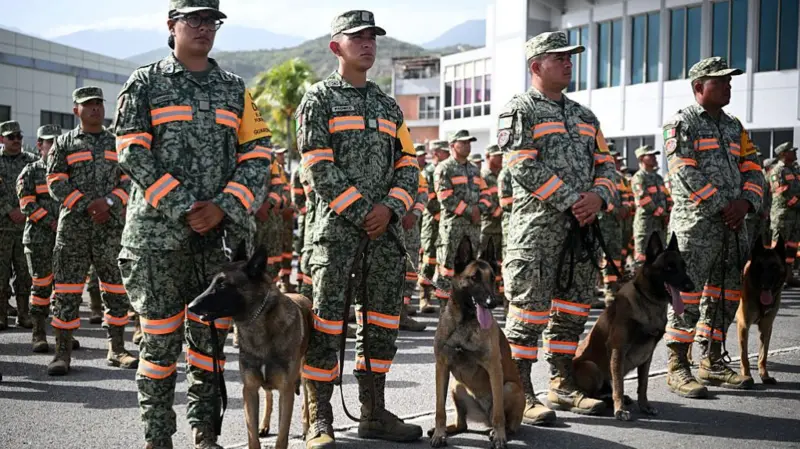
Countries around the world have intensified rescue efforts in Venezuela by deploying specialised search-and-rescue teams accompanied by highly trained sniffer dogs as the death toll from the country’s devastating twin earthquakes climbed to 920.
The Daily Crucible reports that the death toll from the twin earthquakes that devastated Venezuela has risen to at least 920, with more than 3,360 people injured as rescue teams race against time to find survivors trapped beneath collapsed buildings.
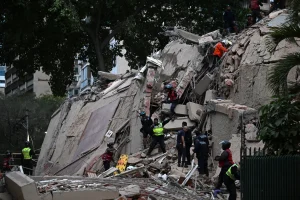 •One of the collapsed buildings.
Authorities said 172 people remain unaccounted for under the rubble after the powerful 7.2 and 7.5 magnitude earthquakes struck barely a minute apart on Wednesday night, making the second tremor the strongest to hit the South American nation since 1900.
Rescue efforts have intensified across the worst-hit areas, particularly in La Guaira State, where more than 240 people have been pulled alive from the debris. However, emergency workers continue to battle damaged infrastructure, communication failures and a shortage of equipment.
In Caracas, student Antoan Marín described the desperate conditions facing rescuers.
“Rescue workers are overwhelmed. They are pulling people out with their bare hands,” he told the BBC.
Heartbreaking scenes have unfolded across the disaster zone as families cling to hope that missing loved ones will be found alive.
Standing beside the ruins of a collapsed shopping centre in La Guaira, Natacha Díaz appealed for help in locating her two daughters, aged 22 and 23, who were at work when the building came down.
“I just want them to be found. I have faith and hope that they are there.
“I just want them back with me. They are all I have, please,” she said.
Another resident, Marianella, told BBC News Mundo that despite the uncertainty, she believes her missing brother is still alive.
“My heart tells me my brother is alive,” she said.
The disaster has triggered a major international humanitarian response, with specialist search-and-rescue teams arriving from several countries, including the United Kingdom, the United States, the Netherlands, Switzerland, Colombia, Mexico, Brazil and El Salvador.
Many of the teams have deployed specially trained sniffer dogs capable of detecting survivors buried beneath concrete and twisted steel, significantly improving search operations in heavily damaged areas.
The UK government confirmed that a military aircraft carrying rescue specialists, drones and search dogs had departed RAF Brize Norton for Venezuela. Prime Minister Keir Starmer also announced £2 million in emergency humanitarian assistance.
“The UK stands in solidarity with all those affected, particularly those who have lost loved ones, homes and livelihoods,” Starmer said.
Humanitarian agencies have warned that the catastrophe could worsen unless additional international assistance arrives quickly.
However, in a joint statement, the Inter-Agency Standing Committee (IASC) urged governments worldwide to increase emergency funding.
“The international community must not allow this emergency to deepen into a larger human tragedy,” the organisation said, noting that the earthquakes struck a country already grappling with food insecurity, fragile healthcare services and widespread humanitarian challenges.
The Norwegian Refugee Council also warned that decades of underinvestment had left Venezuela ill-equipped to cope with a disaster of such magnitude, stressing that large-scale reconstruction would be needed once rescue operations end.
Despite criticism over what some residents described as a slow initial government response, aid supplies have begun reaching devastated communities under military supervision as rescue efforts continue into a third day.
The international response has seen the United States, the United Kingdom, the Netherlands, Switzerland and neighbouring Colombia dispatch emergency personnel equipped with search dogs to assist Venezuelan authorities in locating survivors trapped beneath collapsed buildings.
Rescue operations have continued around the clock across the worst-hit areas, where thousands of homes, public buildings and critical infrastructure were destroyed by the powerful earthquakes.
Emergency officials said the specialised dogs are playing a vital role in the search for survivors. With a sense of smell estimated to be between 10,000 and 100,000 times stronger than that of humans, depending on the breed, the animals can rapidly detect people buried beneath layers of concrete, steel and debris.
The dogs are also capable of navigating unstable rubble and reaching confined spaces that are inaccessible to rescue workers, significantly improving the chances of finding survivors during the critical hours after a disaster.
Authorities warned that the death toll could rise further as rescue teams continue to comb through devastated communities, with hundreds of people still reported missing.
Medical teams have also been deployed to provide emergency treatment for the injured, while humanitarian agencies are distributing food, clean water, temporary shelter and other relief materials to thousands of displaced residents.
Governments participating in the international rescue mission reaffirmed their commitment to supporting Venezuela until search-and-rescue operations are completed and longer-term recovery efforts begin.