
















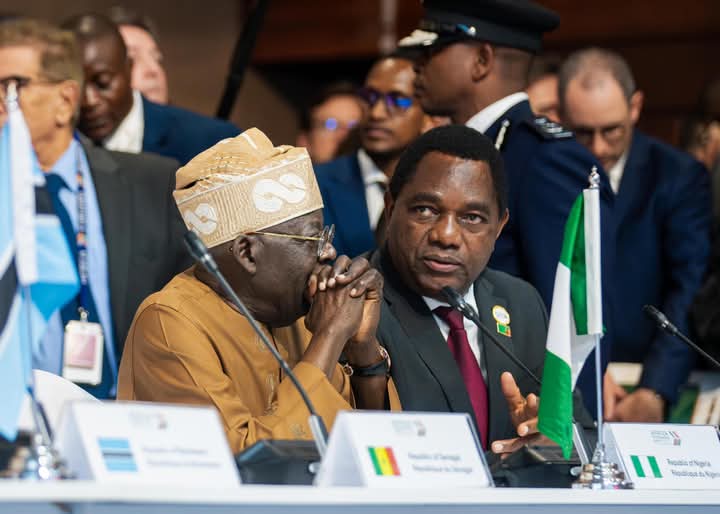
President Bola Ahmed Tinubu on Tuesday called for a sweeping reform of the global financial system, warning that the current international financial architecture is undermining Africa’s industrial growth and economic independence.
Speaking at the Africa Forward Summit held at the Kenyatta International Convention Centre in Nairobi, Kenya, Tinubu said African nations were being forced into economic disadvantage by high borrowing costs, limited access to affordable capital, and unfair global trade structures.
The summit, co-hosted by President Emmanuel Macron of France and President William Ruto of Kenya, drew leaders and senior officials from over 30 African countries, alongside international development partners and business leaders.
In his address, Tinubu said Africa’s share of global manufacturing remained below two per cent because the continent continued to export raw materials while importing finished products at high costs.
According to him, the global financial system has “quietly de-industrialised” African nations through punitive lending conditions and policy restrictions.
“Even a reforming nation like Nigeria is being forced to de-industrialise by a financial system that is stacked against us,” the President said.
Tinubu noted that Nigeria would spend about $11.6 billion on debt servicing in 2026, describing it as a major drain on resources needed for industrial development, infrastructure, and job creation.
“Every single dollar that leaves our treasury to pay punitive interest rates is a dollar that did not go into our steel sector, textile mills, agro-processing plants, or digital industries,” he stated.
The President maintained that Nigeria was not seeking charity but demanding a fair financial system that would support Africa’s industrialisation agenda.
He argued that African countries should be assessed based on their economic fundamentals and industrial potential rather than “outdated stereotypes.”
Tinubu also highlighted Nigeria’s economic reforms, including fuel subsidy removal, exchange rate unification, banking recapitalisation, and Nigeria’s exit from the Financial Action Task Force grey list.
According to him, the reforms have strengthened investor confidence, improved foreign reserves to $45.5 billion, and projected Nigeria’s debt-to-GDP ratio at 32.3 per cent in 2026.
On maritime development, Tinubu pledged that Nigeria would deepen regional collaboration through its Deep Blue Project by offering maritime intelligence infrastructure as a shared data hub for Gulf of Guinea countries willing to participate.
He said secure sea lanes and stronger ocean governance were critical to unlocking investments in Africa’s blue economy.
“Maritime sovereignty does not repel investment — it attracts it,” the President declared.
Tinubu further urged international partners to tackle irregular migration by investing in economic opportunities across Africa, including climate adaptation, agriculture, digital skills, and energy access.
“People who have jobs, security, and hope at home do not typically risk their lives in the back of a smuggler’s truck,” he said.
The President also called for stronger cooperation among African nations to build a more effective global migration governance system.
On the sidelines of the summit, Tinubu held bilateral talks with Madagascar’s President Michael Randrianirina and also met with Confederation of African Football President Dr Patrice Motsepe, where he reiterated Nigeria’s readiness to host the 2026 CAF Awards.
Among those who accompanied the President to the summit were Minister of Foreign Affairs Bianca Odumegwu-Ojukwu, Minister of Marine and Blue Economy Adegboyega Oyetola, Minister of Communications Bosun Tijani, and several top business leaders, including Aliko Dangote, Abdulsamad Rabiu, Tony Elumelu, and Aigboje Aig-Imoukhuede.