






















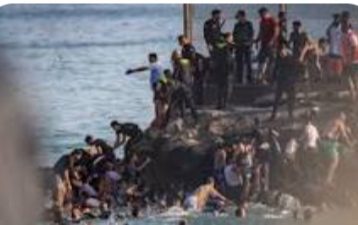
Spain has deployed troops to its North African enclave of Ceuta after tens of thousands of migrants crossed into the territory from Morocco in one of the largest border surges in recent history, prompting the government to describe the situation as an “attack” on its borders.
Ceuta’s regional president, Juan Jesús Vivas, said about 60,000 migrants entered the Spanish enclave within the last 24 hours, while at least 43 people reportedly died during the dangerous journey.
However, Spain’s Interior Ministry gave a slightly lower estimate, saying around 50,000 migrants had arrived since the early hours of Thursday.
The unprecedented influx followed a recent ruling by Spain’s Supreme Court that migrants intercepted at sea while attempting to reach Ceuta or the nearby Spanish enclave of Melilla cannot be summarily returned to Morocco.
Spanish Prime Minister Pedro Sánchez blamed criminal smuggling networks for exploiting the court’s decision and spreading misinformation that encouraged thousands to attempt the crossing.
Speaking during a visit to Ceuta on Friday, Sánchez vowed that all migrants who entered the territory illegally would be returned to Morocco “as soon as possible.”
“We will reinforce the border with Morocco,” the prime minister said, adding that Moroccan authorities were cooperating with Spain’s efforts to repatriate the migrants.
Authorities said more than 25,000 migrants had already voluntarily returned to Morocco by Friday afternoon, with departures reportedly occurring at a rate of about 150 people per minute.
Spain has reinforced security by deploying armed forces to Ceuta and Melilla after reports that between 300 and 400 migrants also crossed into Melilla overnight.
City Overwhelmed
Vivas described the situation as “unsustainable,” noting that the number of arrivals represented roughly 70 per cent of Ceuta’s population of about 83,600 residents.
The Spanish exclave, located on Morocco’s northern coast, has long served as a gateway for migrants seeking entry into Europe. Together with Melilla, it forms the European Union’s only land border with Africa.
Officials estimate that at least 7,000 of the migrants who entered Ceuta over the past day are minors.
Many of those crossing were young men, although women, children and even babies were among the crowds.
Unlike previous migration attempts, many migrants reportedly reached the border fence with little resistance. Some walked along rocky breakwaters before swimming around the barriers into Spanish territory.
The apparent absence of Moroccan border guards during the early stages of the crossings has raised questions, although officials have not explained why the migrants were not stopped.
Deaths and Humanitarian Concerns
The mass crossing has also claimed lives.
At least 43 people were reported dead during the perilous journey across the sea.
One migrant, speaking to Reuters while returning to Morocco, warned others against attempting the dangerous crossing.
“It’s not good at all, and it’s not fun either.”
“I mean, people are dying here. I beg you, please, if you haven’t come yet, don’t come. Don’t do it.”
Residents of Ceuta described scenes of panic as thousands poured into the city.
One resident told Spain’s ABC newspaper that people were afraid to leave their homes.
“Nobody is going out on the street. They’re afraid.”
A hospital security guard added:
“This is stronger and more aggressive than what we’ve experienced before.”
European Leaders React
The crisis has sparked concern across Europe.
European Commission President Ursula von der Leyen described the scenes in Ceuta as “unacceptable” and called for the influx to “stop immediately.”
Italian Prime Minister Giorgia Meloni labelled the images “shocking,” describing the mass arrivals as a security threat to Europe. Italy also suggested it could consider suspending aspects of the Schengen free-movement arrangements with Spain by imposing stricter checks on air travellers.
Finland’s Interior Minister Mari Rantanen supported calls for stronger border controls, while German Chancellor Friedrich Merz urged Morocco to immediately take back migrants who entered Spain illegally.
Spain’s foreign minister criticised Italy’s remarks as “improper,” saying Madrid expected “European solidarity and not partisan demagoguery.” The minister also summoned the Italian ambassador over the comments.
Longstanding Flashpoint
Ceuta and Melilla have belonged to Spain for centuries but are claimed by Morocco, making them recurring sources of diplomatic tension between the two countries.
The last major migration surge occurred in 2021, when around 8,000 migrants crossed into Ceuta during a diplomatic dispute between Madrid and Rabat over Western Sahara.
According to UN migration figures, crossings into Ceuta and Melilla had already risen sharply this year, with 2,826 migrants entering Ceuta and 181 entering Melilla by mid-July—far exceeding the annual totals recorded in recent years.