

























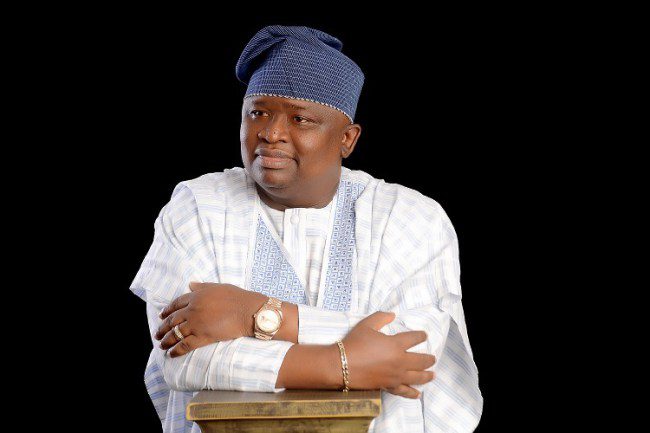
…2027 should be about performance, not just genealogy. If Yayi is unfit to govern Ogun, let his opponents tell Ogun people why. Challenge his record. Challenge his legislative performance. Challenge his competence. Challenge his policy proposals. Challenge his temperament. Challenge his political coalition. Challenge his vision for Ogun
By ‘Dare Odufowokan
There is something rather amusing about the sudden emergence of “emergency historians” whenever Senator Solomon Olamilekan Adeola, popularly known as Yayi, becomes the subject matter, especially from the ranks of those to whom the firebrand Senator is not politically convenient. There has been several attempts. Many of such have disgracefully persisted, even in the face of bountiful evidences, arguments and common senses, to debunk and make mincemeats of the claims therein.
One of such is the unrelenting attempt to blindly interrogate Yayi’s ancestry with mischief as the intention, distinguish between Ishaga-Orile and Ilaro, and then use that distinction to manufacture a political problem around his claim to Ogun West. Unfortunately for the attempt and its promoters, history does not work by political convenience. Neither does indigeneity. And certainly not electoral politics.
The central weakness in this funny historical humpity-dumpity, is the effort to spin that because Yayi’s ancestors originated from Isaga-Orile before migrating to Ago-Isaga/Pahayi in Ilaro, Yayi therefore cannot properly claim Ilaro, Yewa or Ogun West as his place of origin. That proposition is historically simplistic and socially untenable largely because an ancestor’s homeland is not necessarily his descendant’s only homeland. I gladly invite scholarly debates over this time proven position.
Very important to note is the fact that nobody disputes the historical significance of Isaga-Orile in the story of the Isaga people. Indeed, accounts published as far back as a.decade ago quoted prominent Isaga descendants, including Chief Lawrence Osayemi, Balogun of Isaga, explaining that Yayi’s great-grandfather, Olege, migrated from Isaga-Orile to Ago-Isaga/Pahayi in Ilaro following the Dahomey invasion. The same account expressly described Adeola as a bona fide son of Yewa and said the dispersal produced Isaga settlements across Yewa, Abeokuta, Lagos and the Republic of Benin.
We may need to keep educating these sudden storytellers, or are they makeshift storymakers?, that this historical account does not destroy Yayi’s Ilaro identity. It explains it because migration does not cancel settlement.
A family that leaves its ancestral homeland, establishes itself elsewhere, raises successive generations there, builds a family compound there, participates in the community there and becomes recognised by that community does not remain permanently a “stranger” simply because somebody has discovered an older point on the genealogical map.
If that were the rule, a substantial proportion of Nigerians would have to return to the geographical locations from which their great-great-grandparents migrated before they could make any claim to belonging. For example, all Yoruba sons and daughters with traceable roots to Oduduwa and his descendants will have to return to only Ile-Ife in Osun State to stand for elective positions.
…the people of Ogun, not emergency historians, will ultimately determine whether Solomon Olamilekan Adeola is worthy of their mandate in 2027. History should illuminate that decision. It should not be conscripted into a partisan campaign to distort it
The possible scenarios of the implementation of the arguments contained in this unreasonable pursuit would be absurd. The emergency historians have discovered a distinction without a difference. The argument being advanced is essentially this:
“Your ancestors came from Isaga-Orile; therefore Ilaro is merely a refugee settlement and cannot be regarded as your origin.” But what exactly is the meaning of “origin” in this context? There is ancestral origin. There is paternal lineage. There is family settlement. There is place of birth. There is place of upbringing. There is community recognition. And there is political constituency.
These are not interchangeable concepts. A person can simultaneously be Yoruba, Yewa, Isaga, Ilaro, Ogun indigene and Lagos-born without suffering a historical contradiction. Yayi’s publicly documented biography says he was born at Lagos Island Maternity Hospital and raised in Alimosho. His own official profile also identifies his parents and his educational history in Lagos.
Nobody seriously disputes that. But neither does being born in Lagos erase the genealogy of his paternal family. The same logic should apply in reverse. His ancestral connection to Isaga-Orile does not erase the settlement history of his paternal family in Ago-Isaga/Pahayi, Ilaro. If migration invalidates indigeneity, where do we stop?
This is where the argument becomes intellectually dangerous. The history of Yorubaland is a history of migration, wars, dispersal, resettlement, kingdom formation, intermarriage and the establishment of new communities. Ilaro itself is not an archaeological time capsule in which every present resident must demonstrate that his ancestors emerged from the same spot before the nineteenth century.
The same is true of Lagos. The same is true of Abeokuta. The same is true of virtually every major Yoruba settlement. The question is therefore not whether Yayi’s ancestors once lived in Isaga-Orile. The question is whether his paternal family subsequently established a recognised and enduring connection with Ago-Isaga/Pahayi in Ilaro.
On that question, the available historical record is remarkably clear. Contemporary reports from Isaga descendants identified Ago-Isaga/Pahayi in Ilaro as the settlement to which Olege migrated and described Adeola as a bona fide son of Yewa. Another published account states that the family settled first in Ago-Isaga and subsequently in Pahayi, which eventually became integrated with Ilaro as the communities expanded.
That is not a story invented in 2027. It was publicly articulated years before the present governorship contest. The “Lagos Boys” argument is even weaker. There is another curious contradiction in the argument.
Yayi’s critics are happy to emphasise that he was born and politically nurtured in Lagos. Fine. But what exactly does that prove? That he is Lagos-born? Yes. That he built a significant political career in Lagos? Yes. That he represented Alimosho in the House of Representatives and later Lagos West in the Senate? Yes.
But none of those facts proves that his paternal family has no Ogun connection. In fact, his political history demonstrates precisely how Nigerian political identity works. People move. People build careers. People represent constituencies. People return to their ancestral communities. People maintain homes and family relationships in places other than where they were born.
Yayi’s political journey from Lagos to Ogun is therefore not a historical anomaly. It is a very Nigerian story. The real issue is not Isaga-Orile. It is Ogun West. And here the argument should be stripped of unnecessary mythology. The most compelling case for 2027 is not that Yayi must somehow prove that Ilaro was the place where his ancestors first appeared on earth. The compelling political case is that Ogun West has never produced an elected governor since the creation of Ogun State in 1976.
That fact is not Yayi’s invention. It has been repeatedly acknowledged in political discussions about Ogun’s power rotation. Recent reporting also records the position that Ogun East and Ogun Central have produced governors while Ogun West remains without one. That is the real issue. Ogun West is not asking for a governor because Yayi has discovered an obscure genealogical footnote. The zone is demanding political equity because, after five decades of Ogun State, it has never occupied the governorship.
Those who oppose Yayi are free to oppose him. They are free to argue that another Ogun West candidate is better. They are free to campaign against him. They are even free to argue that zoning should not determine the election. But they should not manufacture a historical impossibility where none exists.
And here is the constitutional embarrassment. There is an even bigger problem with the attempt to turn genealogy into a qualification test. The Nigerian Constitution does not say that a governorship candidate must trace his ancestors to the exact geographical location from which his great-grandfather emerged. Section 177 of the 1999 Constitution sets out the qualifications for election as governor: Nigerian citizenship by birth, attainment of the prescribed age, membership and sponsorship by a political party, and the requisite educational qualification. The Supreme Court has expressly restated these requirements.
There is no requirement to pass an “ancestral purity examination.” There is no constitutional provision requiring a candidate to prove that his great-grandfather was born in the same LGA in which he is contesting. And there is certainly no constitutional requirement that a Lagos-born Nigerian whose paternal family settled generations earlier in Ogun must return to a nineteenth-century settlement map before he can seek public office.
Indigeneity can be politically and socially significant in Nigeria. But it should not be confused with the constitutional qualifications for governorship. The Amosun and Obasanjo comparison proves nothing. The comparison with Ibikunle Amosun or Iyabo Obasanjo allegedly having to return to Orile-Owu or Erunmu is rhetorically attractive but historically defective because the relevant question is not simply where someone’s ancestors once lived. The relevant question is the person’s established family and community connection to the political territory in question.
Furthermore, if ancestry alone is to determine political entitlement, then the argument must be applied consistently. If a Lagos-based descendant of an Ogun family cannot claim Ogun because he lives in Lagos, should an Ogun-born person whose ancestors originated elsewhere automatically lose his Ogun identity? If the answer is no, then the argument against Yayi collapses and the clan of sudden storymakers should stop presenting it as though repetition can substitute for evidence. It cannot. Politics should not turn into a courtroom where rumours become exhibits. Truth be told, today in Ogun politics, the real emergency is the emergency historian.
There is a difference between historical scholarship and political archaeology. A historian asks:
What happened?
An emergency historian asks:
What version of what happened can help my political argument today?
That distinction matters.
The historical record available in the public domain does not establish that Yayi suddenly invented an Ilaro connection for the 2027 election. On the contrary, published accounts from Isaga descendants have for years identified his paternal lineage with Olege, Isaga-Orile and the subsequent settlement at Ago-Isaga/Pahayi in Ilaro.
The proper conclusion, therefore, is not that one identity must destroy the other.
It is this: Isaga-Orile may be part of the deeper ancestral history. Ago-Isaga/Pahayi in Ilaro may be the established settlement and paternal family base. Lagos is the place of birth and political upbringing. Ogun West is the current senatorial constituency. Indeed, that is how family histories normally work. There is no contradiction whatsoever.
Moreso, 2027 should be about performance, not just genealogy. If Yayi is unfit to govern Ogun, let his opponents tell Ogun people why. Challenge his record. Challenge his legislative performance. Challenge his competence. Challenge his policy proposals. Challenge his temperament. Challenge his political coalition. Challenge his vision for Ogun.
If another candidate is better, present that candidate and make the argument. But resurrecting nineteenth-century migration patterns and pretending that a settlement becomes permanently illegitimate because its founders migrated there is not a superior argument. It is merely political desperation dressed in historical language. Ogun West deserves to decide who should represent its political interest. Ogun State deserves to decide who should become governor.
And the people of Ogun, not emergency historians, will ultimately determine whether Solomon Olamilekan Adeola is worthy of their mandate in 2027. History should illuminate that decision. It should not be conscripted into a partisan campaign to distort it.
The question in 2027 is therefore not whether Yayi’s ancestors once left Isaga-Orile. They did. The question is whether that migration permanently disqualifies their descendants from belonging to the community where those descendants settled, built families and became recognised. The answer, historically, socially and politically, is a big NO.
•Odufowokan writes from Abeokuta, Ogun State.
•Opinions, positions or thoughts expressed here are personal and strictly of the writer/author and do not represent the views of The Daily Crucible.















Ogun 2027: Yayi, the Moving Geography of Origin and the Questions the “Emergency Historian” Argument Cannot Answer
Dare Odufowokan’s intervention on the controversy surrounding Senator Solomon Olamilekan Adeola’s ancestry is forceful and entertaining, but unfortunately it appears to rebut an argument substantially different from the one actually being made by a critic.
Nobody seriously needs to argue that descendants of nineteenth-century migrants must remain perpetual strangers wherever their ancestors settled. That proposition would be historically absurd. Yorubaland itself was shaped by wars, migrations, dispersals, resettlements, alliances and the establishment of new communities.
A family that settled in Ilaro generations ago can unquestionably develop a genuine Ilaro identity.
But that is not the central question.
The more difficult question is this:
Has Senator Adeola’s account of his paternal origin remained historically consistent, or has the geographical description of that origin evolved alongside his changing political geography—from Lagos politics, through the reported Joga-Orile claim, and eventually to Pahayi/Ilaro in Ogun West?
That is a question of chronology and evidence, not ancestral purity.
Isaga-Orile is no longer seriously in dispute
Ironically, the people Odufowokan describes as “emergency historians” do not have to establish Isaga-Orile as the deeper ancestral origin.
Senator Adeola’s own camp has substantially done that.
Kayode Odunaro has publicly described both himself and Adeola as “originally and historically from Isaga-Orile,” explaining that Isaga families were subsequently dispersed following the Dahomey wars.
Similarly, Chief Lawrence Osayemi, Balogun of Isaga, was reported in 2017 as saying that Adeola’s great-grandfather, Olege, migrated from Isaga-Orile to Ago-Isaga/Pahayi following the Dahomey invasion.
So the basic historical proposition being offered by Adeola’s defenders is:
Isaga-Orile → Dahomey invasion/dispersal → Olege → Ago-Isaga/Pahayi → Ilaro.
Fine.
But once such a precise migration route is advanced as the historical foundation of a modern political identity, it becomes perfectly legitimate to ask for the evidence establishing that particular route.
And this is where the debate becomes considerably more interesting.
What if the Olege migration story itself requires further examination?
There is a tendency in the current argument to treat the proposition that Olege fled specifically from Isaga-Orile to Pahayi/Ilaro as though it were already an independently established nineteenth-century historical fact.
But is it?
That should be demonstrated rather than assumed.
We know from the accounts being advanced by both sides that Isaga people did not disperse exclusively towards Ilaro. The upheavals produced Isaga settlements in several directions, including Lagos and other parts of present-day Ogun State and the Republic of Benin.
Indeed, the wider family narrative attributed to Adeola’s ancestry reportedly acknowledges that sections of the Isaga family network had migrated towards the Lagos area even before the Dahomey destruction of Isaga-Orile.
That introduces an alternative historical possibility which deserves examination.
Could Olege, or the particular branch from which Adeola descended, have belonged to an Isaga family already connected to the Lagos migration before the 1862 invasion?
There is another possibility.
Could Olege have left Isaga-Orile during the Dahomey dispersal but moved towards one of the Isaga settlements associated with Lagos rather than directly to Pahayi/Ilaro?
Neither proposition should presently be asserted as fact.
But neither should the Pahayi proposition be insulated from the same evidentiary scrutiny.
If we are conducting history rather than political advocacy, all plausible migration routes should be tested against records.
And suddenly Adeola’s Lagos history becomes relevant in a different way
Senator Adeola was born in Lagos.
He was raised in Lagos.
His education was substantially in Lagos.
His professional life developed there.
His political career was established there.
He represented Alimosho in the Lagos State House of Assembly.
He subsequently represented Alimosho Federal Constituency in the House of Representatives.
He then represented Lagos West in the Senate.
For roughly two decades of elective politics, therefore, there was apparently no political contradiction between Adeola’s family identity and his being a Lagos politician.
That does not prove that his paternal ancestors originated in Lagos.
But it raises a legitimate historical question that Odufowokan’s rejoinder does not confront:
What exactly was Senator Adeola’s documented state, town and family origin throughout those Lagos political years?
That question becomes especially significant if some branches of the same wider Isaga population had been established in Lagos for generations.
If Olege’s lineage can be independently traced to Pahayi before modern politics, the matter becomes relatively straightforward.
But if that documentation cannot be produced, another possibility deserves investigation: that Adeola’s direct Isaga lineage may have had a much longer Lagos connection than the present Pahayi-centred narrative suggests.
The crucial evidence must therefore predate the political need for Ogun West
This is why contemporary attestations alone cannot finally settle the issue.
What is required are records that predate Adeola’s Ogun political project.
Where was Olege recorded?
Where did his children live?
Where were they buried?
Where was the family compound?
What do nineteenth- and early twentieth-century records say?
What did Adeola himself state on official documents before entering Ogun politics?
What appeared on his 2003 Lagos State House of Assembly records?
What appeared in 2007?
What appeared when he sought the Alimosho House of Representatives seat?
What did his early Lagos AC/ACN biographies identify as his state and town of origin?
What did his employment records at The Guardian say?
And what did his earliest publicly available biographies say before an Ogun governorship became politically relevant?
Those documents would carry considerably greater evidentiary weight than statements generated after the ancestry became politically contested.
Then comes the inconvenient Joga-Orile chapter
This is where the matter becomes particularly uncomfortable for Odufowokan’s thesis.
The allegation that Adeola previously claimed Joga-Orile did not suddenly emerge from opponents preparing for 2027.
Alhaji Raheem Ajayi, popularly known as Baglo, was publicly making the allegation in 2017.
Baglo asked pointedly when Adeola remembered Pahayi, alleging that in 2014 he had claimed Joga-Orile.
In another intervention, he described what he regarded as an evolving sequence of origins: Isaga in Abeokuta North, then Joga-Orile in Yewa North, and subsequently Pahayi in Yewa South.
That allegation is historically important because of the geography involved.
Isaga-Orile is today within Abeokuta North and Ogun Central.
Joga-Orile is in Yewa North and Ogun West.
Pahayi/Ilaro is in Yewa South and Ogun West.
Geography by itself proves no manipulation.
But chronology can.
If documentary records demonstrate that these claims emerged successively as Adeola’s political interests moved from Lagos towards Ogun and specifically Ogun West, then the criticism cannot simply be dismissed as “emergency history.”
It becomes a legitimate question about the evolution of political identity.
Joga-Orile later reappears — but as the grandmother’s origin
Curiously, subsequent family narratives have not entirely discarded Joga-Orile.
Instead, Joga-Orile reportedly reappears much later as the origin of Adeola’s paternal grandmother, Alaba, said to have come from Agbole Alapapo in Joga-Orile and to have given birth to his father, Ayinde Adeola Ogunleye.
That could provide a perfectly innocent explanation.
Perhaps Adeola’s earlier association with Joga-Orile was merely a reference to his, his later explained grandmother’s family, which could be an afterthought and was subsequently misunderstood as his paternal ancestral origin.
If so, contemporaneous documentation should settle it.
But another possibility cannot simply be ruled out without examining the evidence: was Joga-Orile at one stage being explored or presented as the politically relevant Ogun West connection before Pahayi/Ilaro became the definitive paternal-origin narrative?
That is precisely why chronology matters.
From Lagos to Isaga-Orile, Joga-Orile and Pahayi: coincidence or evolving genealogy?
Put the known and alleged stages beside one another:
Lagos — birthplace, upbringing and the platform upon which Adeola constructed almost his entire early political career.
Isaga-Orile — now acknowledged as the deeper ancestral origin of the Isaga lineage.
Joga-Orile — publicly alleged as an earlier Ogun origin claim and, but denied initially and later explained suspiciously as afterthought within the genealogy through the paternal grandmother.
Pahayi/Ilaro — subsequently presented as the destination of Olege and therefore the foundation of Adeola’s Yewa/Ilaro paternal identity.
Each element may ultimately prove historically compatible with the others.
But compatibility must be demonstrated.
It cannot merely be declared.
And there is a legitimate alternative hypothesis that deserves investigation:
Was the direct Olege lineage historically part of the Isaga migration towards Lagos, whether before or following the Dahomey invasion, with the Pahayi connection subsequently elevated—or perhaps reconstructed—as political circumstances made an Ogun West/Yewa ancestral connection increasingly important?
Again, that is a hypothesis, not a conclusion.
But it is no less legitimate a subject for historical investigation than the proposition that Olege fled directly from Isaga-Orile to Pahayi.
The evidence should decide between them.
This is where Baglo becomes particularly interesting
Alhaji Raheem Ajayi’s role in this controversy deserves closer attention precisely because he was challenging Adeola’s ancestry long before the current 2027 contest.
Baglo is associated with the Imasayi area and publicly interrogated the Joga-Orile and Pahayi narratives as far back as 2017.
The Igbogila-Imasayi axis is particularly interesting because the area contains communities whose names preserve an unmistakable Isaga presence, including Isaga Abiodun, Isaga Oke, Isaga Orita and Egba Isaga Orita.
That raises a legitimate historical research question.
Were these settlements among the communities created or enlarged by displaced Isaga people following the Dahomey upheavals?
If so, they could provide valuable evidence about the geographical dispersal of Isaga people into what subsequently became Yewa North.
But here we must distinguish between two very different propositions.
Showing that Isaga people settled in the Igbogila-Imasayi area is one thing.
Showing that Olege, the particular ancestor through whom Senator Adeola claims descent, settled there or passed through there is another.
The first is community history.
The second requires a specific genealogy.
One cannot prove the second merely by establishing the first.
And what exactly was the alleged attempt to court Baglo about?
This is where political insinuation must give way to evidence.
There have been suggestions of subsequent attempts to cultivate or reconcile with Baglo after his earlier criticism.
If such approaches occurred, political reconciliation alone would hardly be remarkable. Politicians routinely reconcile with former opponents.
But because of who Baglo is, what he wrote in 2017 and the historical geography surrounding Imasayi and Igbogila, any documented approach naturally raises additional questions.
Was Baglo being approached simply as an influential political figure?
Was his knowledge of the history of the Isaga settlements around Igbogila-Imasayi being sought?
Was there an attempt to establish whether Olege or related members of Adeola’s claimed family could be connected to those Isaga communities?
Or was there some entirely different purpose?
Until documentary evidence or direct testimony establishes the answer, it would be unfair to convert those questions into accusations.
But it would be equally premature to ridicule the questions merely because they are politically inconvenient.
There is another fundamental problem: Lagos cannot disappear from the genealogy simply because Ogun West became politically important
This is perhaps the part of the story requiring the greatest scrutiny.
If some Isaga families migrated towards Lagos before the Dahomey invasion, while others arrived following the dispersal, then Lagos is not merely where Adeola happened to be born in 1969.
Lagos potentially becomes part of the wider historical geography of the Isaga diaspora itself.
That distinction is enormous.
It means historians should investigate whether Adeola’s Lagos connection was merely accidental — his parents happened to be living there when he was born — or whether his own branch of the family had a deeper generational presence within the Isaga communities of Lagos.
If the latter were established, an obvious question follows:
At what generation did Adeola’s direct paternal family leave Pahayi for Lagos?
If Olege settled at Pahayi after 1862, who moved from Pahayi to Lagos?
When?
Where did that generation settle?
Where were subsequent generations born?
And what independent records establish the chain?
A genealogy cannot simply jump from:
Olege in Pahayi
to
Adeola born in Lagos
without documenting the intervening generations and movements.
That missing middle is potentially more important than all the rhetoric surrounding “emergency historians.”
There is a straightforward way to resolve the controversy
Produce the historical chain.
Not political endorsements.
Not statements made by contemporary supporters.
Not insults.
Not analogies about every Yoruba person returning to Ile-Ife.
The chain.
Olege → his child → grandchild → subsequent generations → Ayinde Adeola Ogunleye → Solomon Olamilekan Adeola.
For each generation:
Where was the person born?
Where did the person live?
Where was the person buried?
What family compound did the person belong to?
When did the family move from Pahayi to Lagos?
What contemporaneous records corroborate the movement?
And most importantly:
Can that genealogy be demonstrated from evidence created before Senator Adeola developed an Ogun political ambition?
If the answer is yes, the Pahayi account becomes considerably stronger.
If the answer is no, then alternative explanations—including a longer-standing Lagos-Isaga lineage—remain legitimate subjects of investigation.
The constitutional argument is a distraction
Odufowokan is correct that the Nigerian Constitution does not require a governorship candidate to demonstrate that his great-grandfather originated within the local government where the candidate claims affinity.
But nobody needs that proposition to investigate this history.
Constitutional eligibility is one question.
Historical accuracy is another.
Political claims to zoning, indigeneity and regional entitlement introduce yet another.
Senator Adeola could be constitutionally entitled to contest for governor while historians and voters continue legitimately asking whether the genealogy advanced in support of his Yewa political identity is historically accurate.
There is no contradiction between those propositions.
The question is therefore not whether migrants can become indigenes
They obviously can.
The real questions are considerably more precise:
Was Olege actually documented as migrating directly from Isaga-Orile to Ago-Isaga/Pahayi following the Dahomey invasion?
Could Olege’s branch instead have been among Isaga families already connected with Lagos before the invasion?
Could his branch have been dispersed towards Lagos during the invasion rather than Ilaro?
When did Adeola’s direct paternal descendants supposedly move from Pahayi to Lagos?
What records establish those generations?
What exactly did Adeola claim as his origin during his long Lagos political career?
Did he claim Joga-Orile around 2014, as Baglo alleged in 2017?
If he did, why?
If he did not, what contemporaneous record disproves the allegation?
Why does Joga-Orile subsequently appear in the genealogy through his paternal grandmother?
And when did Pahayi/Ilaro become the definitive description of his paternal political origin?
Those are historical questions.
They are answerable.
Perhaps the real conundrum is not where Yayi comes from, but when each version of where he comes from emerged
The most revealing investigation may therefore be chronological rather than geographical.
Start before 2003.
Examine Adeola’s records when he was still building his career in Lagos.
Follow them through his Lagos State House of Assembly years.
Then through Alimosho Federal Constituency.
Then Lagos West Senate.
Then his early attempts to enter Ogun politics.
Then the reported Joga-Orile episode.
Then the 2017 controversy.
Then the consolidation of the Olege–Isaga-Orile–Pahayi narrative.
And finally his emergence as Senator representing Ogun West.
Place those records on one timeline.
If the same genealogy appears consistently throughout, the historical record will speak for itself.
But if the asserted geography changes as the political geography changes, that too will speak for itself.
Until such evidence is assembled, nobody should assert that Olege was a Lagos migrant merely because it provides a convenient counter-narrative.
But equally, nobody should demand that the public accept without scrutiny that Olege became a refugee specifically at Pahayi/Ilaro merely because that route conveniently establishes a modern Yewa political identity.
Both propositions require evidence.
That is the point Odufowokan’s “emergency historian” argument fails to answer.
History should neither be weaponised against Senator Adeola nor rewritten for him.
It should simply be followed wherever the evidence leads.