

















Former Head of State, , has disclosed that he advised former President not to contest Nigeria’s 1999 presidential election after his release from prison, insisting that neither he nor his military administration played any role in Obasanjo’s eventual emergence as president.
Abdulsalami made the revelation in his autobiography, Call of Duty, a 264-page memoir unveiled in Abuja during events marking his 84th birthday.
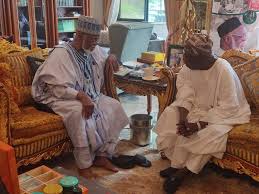
The former military ruler recounted that shortly after regaining his freedom in 1998, Obasanjo visited him with two major concerns: his intention to sue the Federal Government over his imprisonment and an invitation by the Peoples Democratic Party (PDP) to seek the presidency.
According to Abdulsalami, he discouraged Obasanjo from pursuing either course.
“I was forthright with him. One, I advised him that he should not take the government to court because it might not augur well,” he wrote.
“For one, he would not know how long it would take the court to give judgment. I told him that, as a government, we would try to see what could be done about his business in the form of compensation.
“The court process was uncertain, I told him. I tried to dissuade him from pursuing the litigation option, and he agreed with me.”
On Obasanjo’s reported presidential ambition, Abdulsalami said he was even more direct.
“On the invitation by the PDP that he should run in the presidential race, I advised him to return home and thank God that he was still alive after all he had gone through in four years. I told him point-blank that he should forget about contesting to be President,” he wrote.
“He took a deep sigh and said he was going to think about it and revert. He never got back to me. He can confirm this encounter.”
Obasanjo eventually emerged as the PDP candidate and won the 1999 election, becoming Nigeria’s first civilian president after years of military rule. However, Abdulsalami maintained that his government neither endorsed nor sponsored the former military ruler’s candidacy.
“I tell people till today that my administration had nothing to do with the presidential ambition of General Obasanjo,” he stated.
“It may be hard to believe, but we did not endorse him, and we did not work for him. It was a conjecture.”
He explained that Obasanjo’s release and pardon were part of a broader decision to free political detainees and not a special arrangement designed to pave his way to power.
“As a government, we decided to release all political prisoners. We did not pick and choose. We did not single any individual out for favour. General Obasanjo was one of those prisoners who regained freedom,” he said.
Abdulsalami acknowledged widespread reports that some retired military officers quietly mobilised support for Obasanjo’s presidential bid, believing he possessed the national appeal required to stabilise the country following years of political turmoil.
“There were reports that some retired Generals worked behind the scenes to persuade General Obasanjo to run because they believed he was the one who could unite Nigerians at that critical time,” he wrote.
“Those were private initiatives and had nothing to do with our government or me.”
The former Head of State also revealed that his administration deliberately altered electoral guidelines to ensure the registration of the Alliance for Democracy (AD), a party backed by pro-democracy groups in the South-West.
He explained that while the PDP and the All Peoples Party met the established criteria for registration, the AD fell short of the requirements.
“We tinkered with the rules and said any party that came third would be registered. That was how AD scaled through,” he disclosed.
“We did not want to create a system in which the South-West would feel marginalised. Whatever decision we took was for the peace and progress of the country.”
Abdulsalami further shed light on the transition timetable that culminated in the handover of power on May 29, 1999, saying the date was influenced largely by judicial considerations.
“My first suggestion was that we should draw up a six-month transition plan. That would have seen us hand over to a democratically elected President by March 1999,” he said.
According to him, then Chief Justice of Nigeria, , requested at least 60 days after the elections for courts to resolve electoral disputes before inauguration, leading to the adoption of the May 1999 handover date.
The retired general also disclosed that he faced pressure from military colleagues, foreign leaders, members of the international community and even some leaders of the pro-democracy movement to delay the transition.
“Initially, there was intense pressure from some of my colleagues, some Heads of State in the West African sub-region and some in the international community that it was too soon to transition to democracy,” he wrote.
He said some members of the National Democratic Coalition (NADECO) later sought an extension of military rule after realising they were unprepared for the speed of the transition programme.
However, Abdulsalami insisted he was never tempted to remain in office.
“Nigeria was at a breaking point. The military needed to relinquish power,” he wrote.
Reflecting on the eve of the historic handover, Abdulsalami said he had no anxiety about leaving power and slept peacefully, confident that his administration had helped restore stability to the country.
“I was happy that as much as possible, we had brought peace to the country and stabilised the military too,” he stated.
He recalled personally taking Obasanjo on a familiarisation tour of the Presidential Villa on the morning of May 29, 1999, before formally handing over power and returning to his hometown of Minna.
“As we drove through towns and villages, people gathered by the roadside to wave to us. It was quite a sight. I was a very happy man,” he wrote.