





















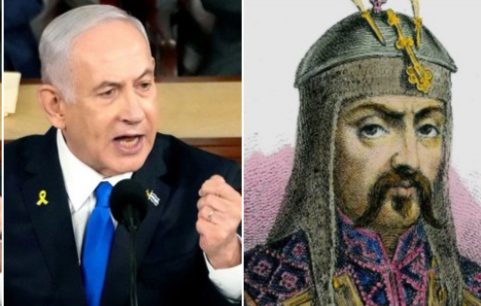
Israeli Prime Minister Benjamin Netanyahu has denied insulting Jesus Christ following widespread outrage over remarks comparing Him to Genghis Khan.
The controversy erupted after Netanyahu said during a televised briefing that “history proves that, unfortunately, Jesus Christ has no advantage over Genghis Khan,” arguing that moral strength alone cannot defeat ruthless power.
“History proves that, unfortunately and unhappily, Jesus Christ has no advantage over Genghis Khan. Because if you are strong enough, ruthless enough, powerful enough, evil will overcome good. Aggression will overcome moderation,” Israel Leader, Netanyahu said, hinting that the Mongolian King who defeated and rule all of Asia and part of Europe from 1206 – 1227 appears to be greater than Jesus going by history of civilization.
The comment triggered backlash, particularly among Christians, who viewed the comparison as offensive and dismissive of Jesus’ teachings.
Responding on Friday via X, Netanyahu dismissed the criticism as “fake news,” insisting he did not denigrate Jesus. He explained that he was quoting renowned historian Will Durant to emphasize that morality without the capacity for self-defence may not ensure survival.
“A morally superior civilisation may still fall to a ruthless enemy if it lacks the power to defend itself. No offence was meant,” he stated.
Netanyahu made the initial remarks while defending the joint Israeli-US strike on Iran, describing it as necessary to counter threats from Iran’s nuclear and missile programmes.
However, critics, including Palestinian pastor Munther Isaac, condemned the statement as deeply offensive, arguing that it misrepresents the message of Jesus and promotes a “might makes right” worldview.
The debate continues to stir reactions online, highlighting tensions between political rhetoric and religious sensitivities.
The Daily Crucible reports that Genghis Khan, born Temüjin around 1162, emerged from the harsh Mongol steppes to become one of history’s most formidable figures. Raised in a fragmented tribal society marked by constant conflict, he rose through a mix of resilience, strategic alliances, and military brilliance to unite the warring nomadic clans under a single authority. His transformation from an outcast to a powerful leader laid the foundation for what would become a vast and enduring empire. 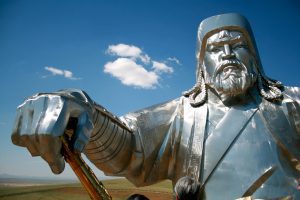 With a highly disciplined army and innovative battlefield tactics, Genghis Khan launched a series of conquests that stretched across Asia and into parts of Europe. His forces were known for their speed, coordination, and adaptability, often overwhelming larger and more established armies. Under his leadership, the Mongol Empire expanded rapidly, creating the largest contiguous land empire in history and opening up trade routes that strengthened connections between the East and the West, particularly along the Silk Road.
Despite his achievements as a unifier and empire builder, Genghis Khan’s legacy remains deeply complex. While he facilitated cultural exchange and economic growth across his territories, his campaigns were also marked by widespread destruction and significant loss of life. To this day, he is remembered both as a visionary military strategist and a ruthless conqueror whose impact on world history continues to be studied and debated.