























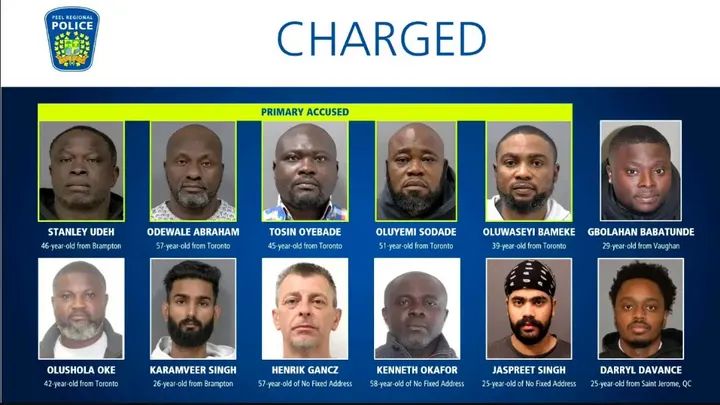
An extensive investigation into transnational auto thefts has led to the arrest of 12 suspects, including eight Nigerians, in Peel Region, Canada.
Peel Regional Police disclosed this in a statement released on Monday, November 16, 2026, saying the operation led to the recovery of 96 stolen vehicles valued at 4.5 million Canadian dollars.
The investigation, known as Project Cadetta, was launched in March 2026 in partnership with Canada Border Services Agency and focused on a Brampton warehouse that police say was used as a primary staging area for stolen vehicles destined for West Africa from Canadian ports.
Investigators allege five suspects were responsible for coordinating the theft, movement and export of stolen vehicles while others allegedly supported the operation.
“This was not an opportunistic crime. It was a coordinated network designed to profit from stolen vehicles taken from our communities and across the GTA,” said Det. Sgt. Ian Harloff.
As a result of the investigation and a series of search warrants, 96 stolen luxury SUVs, pick-up trucks and other high-value vehicles concealed within shipping containers were recovered.
A dozen suspects were arrested and 231 charges were laid against them.
Police say some of the individuals may be referred to the CBSA and face immigration enforcement action.
Two people are also wanted and warrants have been issued for their arrests; a 16-year-old from Hamilton who cannot be identified and Steven Gyamfi, 32, of no fixed address.
“Organized auto theft is not just a property crime; it is a violent, predatory business model that is run by transnational organized crime groups and syndicates that terrorize families in their own driveways and in their homes. They use the funds from those or from that crime to fund a variety of other crimes,” said Peel police Deputy Chief Nick Milinovich.
Milinovich said that usually when a vehicle is stolen in Mississauga or Brampton, it is on a container ship within days, adding that roughly 75 per cent of the stolen vehicles that are intercepted at the Port of Montreal for export out of the country originate from Ontario.