





















For decades, it was dismissed as just a weirdly shaped rock.
Now, researchers in eastern Turkey say they have pulled something out of the ground that could change everything.
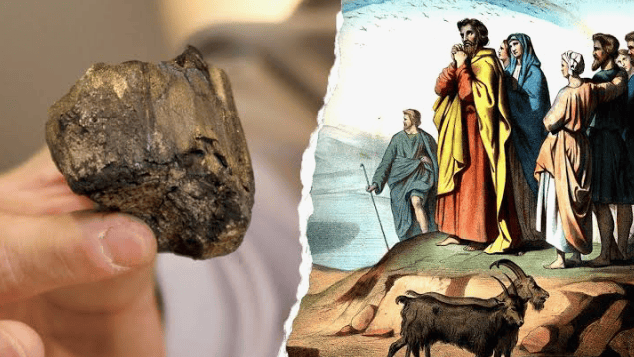
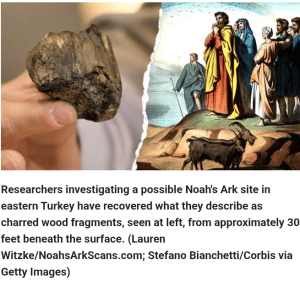
At the Durupinar site near Mount Ararat, a boat-shaped formation first spotted in 1959, a university-backed team has recovered dark, cracked fragments they identify as charred wood. The pieces were found about 30 feet below the surface during deep-core drilling, the first time the site has been drilled that deep.
Exclusive photos show fragments with visible grain and what look like growth rings, according to Fox News Digital.
Lead archaeologist Cenker Atila, from Sivas Cumhuriyet University, says in his professional opinion, the wood is “very ancient.” Lab results are still pending.
The team has sent samples to four labs in four different countries for carbon-14 dating and species identification. More than 300 soil and core samples are also being tested.
Why does this matter? Atila points to a list of coincidences he says are too many to ignore:
– The formation sits in the region described in holy books
– Its length, about 515 feet, lines up with biblical dimensions for the Ark
– Radar scans reportedly show organized patterns, possible chambers and corridors
– The formation appears to have a three-level structure, just like the Ark described in scripture
– Carbon levels inside the formation are higher than outside it
“Are the corridor-like and room-like structures actually parts of a ship? Do the wood fragments really belong to the ship? Will we find any traces of human or animal remains?” Atila asked. “These are all very exciting questions.”
Not everyone is convinced.
Geologists Lorence Gene Collins and David Franklin Fasold argued back in 1996 that Durupinar is a natural rock structure, not a ship. That skepticism still hangs over the project.
The researchers admit the wood has not been independently linked to Noah’s Ark. Age and origin are still unknown.
But Lauren Witzke, director of marketing and fundraising for Noah’s Ark Scans, calls it a potential game changer.
“It is world shaking. It’s a world-shaking discovery,” she said. “We won’t know until we start getting results back from the labs.”
Witzke says this is the first time research at Durupinar has been done with official Turkish oversight, documented chain-of-custody, and independent lab testing. The project is crowdfunded, and results will be published on http://NoahsArkScans.com.
Lead researcher Andrew Jones is urging patience.
“We still have the lab work to do,” he said. “I hope everyone can follow along and see what we find.”
If excavation permits are approved, the team hopes to dig deeper in 2027.
For now, the mystery remains buried. But for believers and skeptics alike, those charred fragments have just made it a lot harder to look away.