























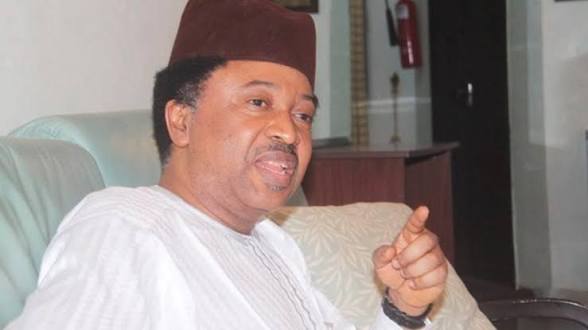
By Hadiza Mohammed, Northern Operation
Former Kaduna Central Senator Shehu Sani has warned that attempts by northern politicians to reclaim the presidency in 2027 could reignite separatist agitations across the South-East, South-West and South-South.
Sani urged northern political leaders to allow President Bola Tinubu to complete his four-year term and seek re-election, arguing that abandoning Nigeria’s informal power-sharing arrangement could undermine national unity and political stability.
The former lawmaker, who is seeking a return to the Senate to represent Kaduna Central, made the remarks during an interview with select journalists in Kaduna on Friday.
He maintained that northern politicians should defer their presidential ambitions until 2031, insisting that the South should be allowed to retain the presidency in line with the principle of rotational power.
According to Sani, disrupting the arrangement could deepen ethnic tensions and weaken the sense of political inclusion that has helped ease separatist sentiments in parts of southern Nigeria.
“The danger of disrupting this rotational idea is the fact that whatever you are doing to Tinubu for ethnic reasons, Tinubu must go,” he said.
Sani argued that the prospect of a southerner contesting for the presidency had contributed to a decline in separatist agitations, particularly in the South-East.
He said the hope of having one of their own participate in the presidential race had reduced support for the agitation for an independent Biafran state.
“Today, if you look at it, the agitation for Biafra has gone to the lowest point because they are hopeful that one of their own is contesting the presidency of this country,” he said.
The former senator also cited agitations for a Yoruba republic and a Niger Delta republic, warning that efforts to alter the existing power-sharing understanding could reverse the trend.
He questioned how any president could govern effectively if significant sections of the country believed they had been denied a fair opportunity to lead.
Sani said the principle of power rotation provided a basis for allowing the South to retain the presidency after former President Muhammadu Buhari, a northerner, completed eight years in office between 2015 and 2023.
“The principle of rotation of power makes it clear that Buhari has been in power for eight years. It is only logical and rational that you have a southerner,” he said.
He also questioned the arguments surrounding former Vice-President Atiku Abubakar’s presidential ambition, referencing Atiku’s previous contests against former Presidents Olusegun Obasanjo, Umaru Musa Yar’Adua, Goodluck Jonathan and Muhammadu Buhari.
Insecurity Should Not Become a Tool for Ethnic Politics — Sani
Turning to the security situation, Sani acknowledged that the Tinubu administration continued to face significant challenges but accused some northern political leaders of applying double standards in their criticism of the government.
He argued that politicians faulting Tinubu over insecurity should also acknowledge the security challenges that persisted under Buhari’s administration.
Sani cited the cases of mass abductions and attacks on schools during Buhari’s tenure, including the kidnappings in Dapchi, Kankara, Jangebe and Yauri, as well as the abduction of students from Greenfield University in Kaduna State.
He maintained that the country could not effectively tackle insecurity if politicians defended members of their own political camp when they were in power but later used similar challenges to score political points against their opponents.
“We cannot address security challenges in the country when we shielded our own who failed to address the problem, and now shift blame and use it for political reasons to achieve certain political ends,” he said.
Sani called for a more consistent and less partisan approach to addressing insecurity, stressing that public safety should not be reduced to ethnic or political calculations.
Former Senator Highlights Healthcare, Education and Poverty.
Beyond the security debate, Sani stressed the importance of effective legislative representation in tackling the North’s persistent challenges, including poverty, inadequate healthcare and limited access to education.
He pointed to his record during his previous tenure, claiming to have facilitated between seven and eight primary healthcare facilities, alongside scholarship opportunities and women’s empowerment programmes.
The former lawmaker argued that representatives should be judged not only by their political positions but also by their contributions to improving the living conditions of their constituents.
Tinubu assumed office on May 29, 2023, succeeding Buhari after the former president completed two terms in office.
Sani’s intervention adds to the debate over Nigeria’s informal power-sharing arrangement and whether the presidency should remain in the South in 2027 or return to the North.