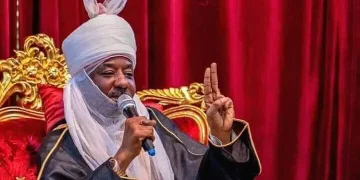



















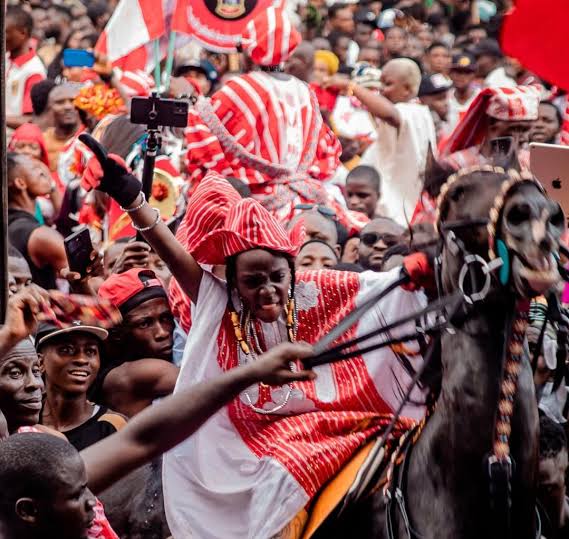
The annual Ojude Oba Festival will go ahead in 2026 despite the absence of a newly installed Awujale of Ijebu land, according to the Baagbimo of Ijebu and Secretary of the Awujale Council of Chiefs, Prof. (Chief) Fassy Yusuf, who insists that the festival is rooted in institution, not personality, and cannot be suspended due to a vacant royal stool.
Speaking on Eagle 102.5 FM’s Frontline, Prof. Yusuf dismissed growing public speculation that the festival may be halted due to the transition period following the passing of Oba Sikiru Adetona, stressing that Ojude Oba remains a permanent cultural heritage of the Ijebu people regardless of monarchical succession.
“Once again, I confirm to you, and I confirm to you all, I confirm to the whole world that the Ojude Oba festival is holding in May,” he said. “That’s on May 28th or 29th, depending on the signals. We are talking about institutions now, not about individuals. We are talking about institutions not individuals.”
He argued that historical precedent already establishes that the festival is not dependent on the physical presence of a reigning monarch, insisting that attempts to link its continuity strictly to the throne misunderstand its cultural foundation.
“There were times in the past that a late monarch or a revered monarch was not available due to one reason or the other, and yet the festival took place,” he said.
Prof. Yusuf warned against what he described as unnecessary agitation around the issue, adding that those calling for suspension of the festival were misreading both tradition and history.
“It is inconceivable that anybody will be thinking or will be clamouring for the cancellation of Ojude Oba festival until a new Awujale is installed,” he said.
He added a more forceful rebuke of such arguments, describing them as uninformed and destabilising to cultural continuity.
“All those people talking about cancellation, or the like are people that lack self-identity,” he said. “They are people, we call them rabble-rousers, they are people fishing in troubled waters.”
According to him, the festival transcends individual reigns and even moments of interregnum, insisting that Ijebu cultural identity is not suspended by royal transition.
“We, the founder, the creator, should we now sit at akimbo, and let the shine be taken off us,” he said, warning against undermining the cultural authority of Ojude Oba itself.
He further stressed that the festival has always survived periods of uncertainty in leadership, pointing to past historical occurrences where Ojude Oba held despite royal absence or illness.
“In 1959 Ojude Oba was held after the demise of Oba Robertson Adesanya Gbelegbuwa,” he said.
Prof. Yusuf explained that the transition period following Oba Adetona’s emergence also witnessed similar continuity.
“So, his appointment was approved second January 1960, and he was crowned April 2nd, 1960,” he said. “That was about one year the week that Ojude Oba was held without any king on the throne.”
He further referenced another instance during a period of royal illness, insisting that the festival still proceeded with alternative leadership arrangements.
“In 1995, Ojude Oba festival held,” he said. “Oba Adetona was critically ill, he was flown abroad. The Ojude Oba festival held.”
According to him, cultural stakeholders ensured continuity even during leadership incapacitation, reinforcing his argument that the festival is institutionally anchored.
“It was the late Ogbeni-Oja Bayo Okuku that stood in for him, supported by eminent sons and daughters like Otunba Subomi Balogun and Papa Chris Okunbadejo,” he said.
Prof. Yusuf dismissed suggestions that current circumstances are unprecedented, insisting that Ijebu history provides sufficient examples of continuity under transitional leadership.
He immediately rejected such reasoning, describing it as fundamentally flawed and inconsistent with historical logic.
“That is an illogical argument. It is an argument that cannot withstand the test of logic. It is nonsensical,” he said.
He further argued that governance and cultural expression cannot be frozen due to leadership transitions, stressing that societies naturally adapt to institutional gaps.
“Nature abhors a lacuna. Nature abhors a vacuum,” he said. “So, somebody has to stand in.”
According to him, institutional continuity has already been structured through interim arrangements to ensure cultural governance remains functional.
“We have in place Awujale Interregnum Administrative Council,” he said. “The chairman may not be occupying the seat of Awujale, but he is standing in as acting Awujale.”
He urged critics to avoid over-dramatizing the situation, insisting that administrative mechanisms are already in place to manage responsibilities.
“Don’t make a mountain out of a molehill,” he said.
When pressed further on whether the absence of a monarch undermines the essence of the festival, he maintained that the symbolic function of the Awujale does not cancel cultural expression.
He explained that the interregnum structure temporarily fills that symbolic gap, ensuring continuity of tradition.
“We have Awujale Interregnum Administrative Council,” he reiterated. “The chairman is standing in.”
Prof. Yusuf also addressed concerns around historical documentation, admitting that his direct recollection of older events is limited by age but insisting that institutional memory remains intact.
“I was a young boy then, I would not know what happened in 1930, 1920,” he said. “But I’ve not come across such a situation again.”
He argued that the absence of modern precedent does not invalidate the current arrangement, but instead highlights its rarity and sensitivity.
“What we are having now is a lacuna, a vacuum,” he said. “And therefore, we cannot afford a situation where we deny ourselves the opportunity of hosting Ojude Oba.”
He warned that allowing the festival to collapse due to leadership transition would have long-term consequences for cultural identity.
“That would mark the extinction of Ojude Oba,” he said. “By the time we want to come back, we would not even be able to start from scratch.”
Prof. Yusuf also addressed questions surrounding succession processes, confirming that traditional institutions are already engaging with government-approved mechanisms.
“We have complied with the Oba and Chiefs Law,” he said. “We have forwarded the list to the kingmakers. The kingmakers have started working.”
He explained that the process is currently suspended due to government directive, not institutional failure.
“There was an instruction from the government to suspend action,” he said. “And in obeisance, action has been stopped.”
However, he confirmed ongoing appeals for resumption of the process.
“We, the family, have appealed to the government to allow the process to continue,” he said.
On allegations surrounding the selection process, including claims of coercion and corruption, Prof. Yusuf maintained that nothing has been substantiated.
“These are allegations, and they remain in the realm of speculations and accusations,” he said. “The law says he who alleges must prove.”
He further noted that no official indictments have been made public, reinforcing his position that claims remain unverified.
“So far, nothing has been made public. Nobody has been indicted,” he said.
When asked about his interaction with security agencies, he confirmed that he had been invited for clarification but insisted there was no formal accusation.
“The DSS invited me as vice chairman of the ruling house,” he said. “They just wanted me to clarify what I saw or did not see.”
He said he responded as a citizen, not as an investigator, maintaining that intelligence gathering is not his professional responsibility.
“I told them I am not an intelligence officer,” he said. “You are the ones to investigate, not me.”
Turning to festival logistics, Prof. Yusuf detailed preparations already underway for the 2026 edition, noting that structural reforms have been introduced to avoid previous challenges.
“In the last two or three editions, we had challenges due to timing and logistics,” he said. “So, we set up sub-committees to handle security, communication, traffic, and safety.”
He explained that improved planning is aimed at ensuring a more orderly and efficient festival experience.
“We have no excuse this time around,” he said. “When we say we are starting at 8:30, we will start.”
He added that financial management of the festival remains strictly institutional and transparent.
“No cash is paid to anybody,” he said. “Everything goes through the palace account under the interregnum administrative council.”
Prof. Yusuf concluded by reaffirming that Ojude Oba remains a cultural constant that cannot be suspended due to royal transition.
“Even without an installed Awujale, Ojude Oba will hold,” he said. “It is not about individuals. It is about continuity, identity, and institution.”