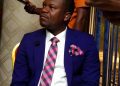


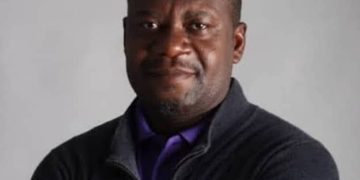














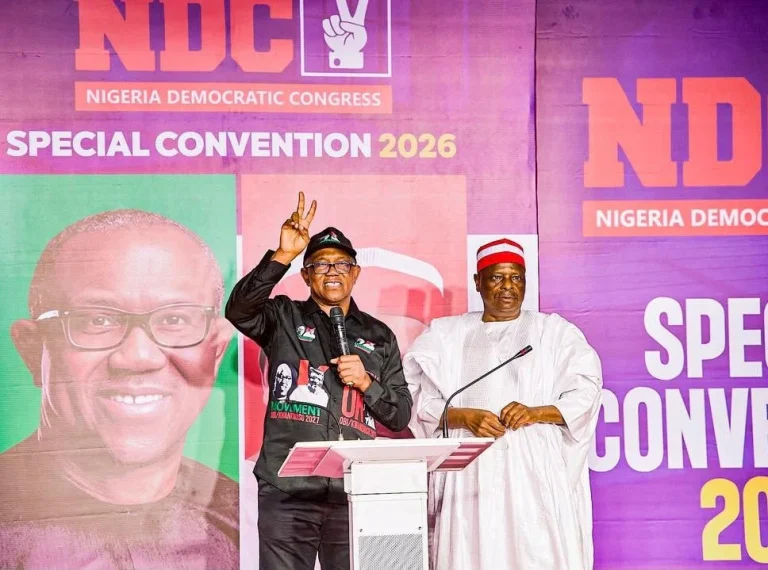
The presidential candidate of the Nigerian Democratic Congress (NDC), Peter Obi, has pledged that Senator Rabiu Kwankwaso will serve as his vice president “as a partner, not a spare tyre” if they win the 2027 presidential election.
Obi made the declaration in his acceptance speech after emerging as the NDC’s presidential candidate, according to a statement shared on his X account on Sunday.
The former Anambra State governor had formally announced Kwankwaso as his running mate on Saturday.
Obi and Kwankwaso both contested the 2023 presidential election, finishing third and fourth respectively behind former Vice President Atiku Abubakar and President Bola Tinubu, who won the poll.
Kwankwaso, a former governor of Kano State, contested under the New Nigeria Peoples Party (NNPP) and secured victory only in Kano State, where he maintains considerable political influence.
In his speech, Obi described his nomination as a call to national service and reaffirmed his commitment to building a “New Nigeria” founded on unity, security, economic transformation, and accountable governance.
He thanked party leaders, including National Chairman Seriake Dickson, the National Secretary, members of the National Working Committee (NWC), and supporters across the country for their confidence in his leadership.
Obi said Nigeria was currently facing significant challenges, citing insecurity, economic hardship, and declining public trust in government institutions.
Addressing national unity, he cautioned against ethnic, religious, and regional divisions, stressing that the country’s diversity should be harnessed as a source of strength rather than conflict.
On security, Obi expressed concern over the country’s worsening situation.
“In terms of security, the situation in Nigeria has considerably worsened. The global terrorism impact assessments ranked Nigeria as the 8th most affected nation in 2022, 6th in 2024, and 4th in 2026.
“Yet, for many years, Nigeria garnered global recognition as a reliable contributor to peacekeeping, regional stabilisation, and conflict resolution. Our troops have not only displayed bravery but have also shown professionalism, discipline, resilience, and empathy in the most challenging operational contexts.
“Our officers and personnel have successfully commanded multiple international forces, safeguarded vulnerable civilian populations, monitored ceasefires, reinstated constitutional order, and contributed to rebuilding efforts.
“Nigeria became one of the leading contributors of troops from Africa to UN peacekeeping missions and earned widespread admiration for operational effectiveness and leadership in various countries, including Rwanda, Sudan, Liberia, Sierra Leone, Mali, Western Sahara, Congo, Lebanon, Cambodia, Haiti, and Kuwait. At one point, Lt. General Isaac Obiakor (retd.) even led global peacekeeping initiatives.
“We must address insecurity with resolve and urgency, for no nation can thrive while its citizens live in trepidation. The primary responsibility of the government is to ensure the safeguarding of lives and property.”
On healthcare, Obi said Nigeria’s health sector remained underperforming, noting that only 10 to 20 per cent of the country’s estimated 30,000 primary healthcare centres were operational, while health insurance coverage remained around 10 per cent.
He pledged to increase health insurance coverage to more than 20 per cent within four years and raise healthcare spending to at least 10 per cent of GDP. He also promised to rehabilitate primary healthcare centres across Nigeria’s 8,809 wards and improve staffing and training for healthcare workers.
Speaking on education, Obi said investment in human capital development would be a major priority of his administration. He promised greater support for schools, teachers, and vocational training programmes to enhance productivity and innovation.
On agriculture and food security, the NDC candidate expressed concern about Nigeria’s position in global hunger rankings, citing projections by the World Food Programme that more than 35 million Nigerians could face acute food insecurity this year.
He said transforming agriculture through targeted investment would be critical, describing Nigeria’s vast uncultivated land as a strategic national asset.
Obi also highlighted the country’s power deficit, noting that Nigeria currently generates about 4,000 megawatts of electricity for a population exceeding 200 million people. He pledged to increase electricity generation by at least 10,000 megawatts within four years.
Addressing unemployment, Obi argued that official figures do not fully reflect the scale of the challenge, maintaining that actual unemployment and underemployment rates exceed 30 per cent, while youth unemployment is above 40 per cent.
He promised support for micro, small and medium-sized enterprises through tax incentives, improved access to funding, and targeted interventions across key sectors of the economy.
The former governor also vowed to reduce corruption, cut the cost of governance, strengthen the rule of law, and deepen democratic institutions.
Announcing his running mate, Obi said: “Following this, I will make democracy work and the Vice President will be a partner, not a spare tyre. I hereby accept my affirmation and nominate Senator Rabiu Kwankwaso @KwankwasoRM as my Vice President.”