
























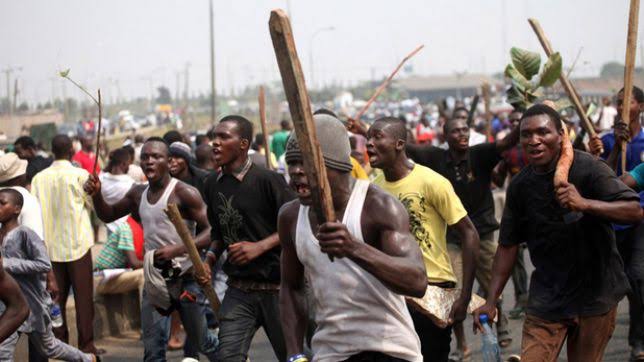
The central question confronting Nigeria is no longer whether political violence exists, but who organises it, who finances it, who benefits from it and why those responsible are rarely brought to justice
By Adekunle Alaye, PhD.
Nigeria’s democratic journey continues to face a recurring challenge: the use of violence, intimidation, political thuggery and other forms of electoral hostility as instruments of political competition.
As the country moves towards the 2027 general elections, concerns about pre-election violence raise fundamental questions about the commitment of political actors to democratic values, the rule of law and peaceful political participation.
What makes the situation particularly troubling is not merely the reported incidents of political violence, but the politics of denial that often follows them. Whenever violence occurs, the immediate response from political parties is frequently one of distancing, accusation and counter-accusation.
The ruling All Progressives Congress (APC), the African Democratic Congress (ADC) and the Nigeria Democratic Congress (NDC), among other political interests, have reason to be concerned about the implications of electoral violence.
Yet, when responsibility becomes a subject of public debate, political actors may present themselves as victims rather than perpetrators.
If every major political party claims to be a victim of pre-election violence, who, then, is responsible for perpetrating it?
The question deserves more than political rhetoric. It demands an objective investigation, institutional accountability and a willingness to confront the culture of impunity that has historically weakened Nigeria’s electoral democracy.
The APC has reportedly accused opposition parties, particularly the ADC and NDC, of sponsoring violence and employing misinformation to undermine its political activities. On the other hand, opposition parties have raised concerns about intimidation, attacks on their supporters, disruption of political gatherings and restrictions on their political activities.
These competing narratives have made it increasingly difficult for ordinary Nigerians to distinguish between genuine political victimisation and politically motivated allegations.
This is where the politics of denial becomes a serious democratic concern. Political parties cannot continually demand justice when their opponents are attacked while refusing to support the same principles of accountability when allegations involve their own members.
Democracy cannot survive on selective condemnation. A political party that condemns violence against its supporters must equally condemn violence committed by its supporters against political opponents.
The principle should be universal, irrespective of whether the victim belongs to the ruling party or the opposition.
The responsibility of political leadership is not simply to issue statements of condemnation after violence has occurred. It is also to prevent the recruitment, mobilisation and protection of individuals who use intimidation as a political instrument.
The central question confronting Nigeria is no longer whether political violence exists, but who organises it, who finances it, who benefits from it and why those responsible are rarely brought to justice.
A report published by The PUNCH on November 26, 2026, citing the Kimpact Development Initiative, documented 124 incidents of political violence resulting in 22 deaths across 35 states and the Federal Capital Territory between July 1 and November 23, 2026. These incidents reportedly included physical assaults, destruction of property, shootings, intimidation and harassment.
Similarly, the National Peace Committee recorded 109 breaches of the National Peace Accord across 26 states and the FCT between August 19 and October 27, 2026. Political violence and thuggery accounted for 33 incidents, while misinformation and disinformation accounted for another 29 as reported by the same paper.
These figures suggest that the problem extends beyond isolated confrontations between rival supporters. They point to a wider challenge involving political intolerance, weak enforcement, misinformation and the possible use of organised groups to disrupt democratic participation.
However, it would be intellectually dishonest to assign collective responsibility to any political party without credible evidence identifying the perpetrators and establishing the circumstances of each incident.
The APC, ADC and NDC should therefore be subjected to the same standards of investigation. Where members or supporters are implicated, the relevant individuals should face the law. Where political sponsors are identified through credible evidence, they should equally be held accountable. The real test of Nigeria’s democracy is whether the identity, influence or political affiliation of an alleged perpetrator can prevent the administration of justice.
A major factor sustaining electoral violence in Nigeria is the dangerous relationship between political patronage and the recruitment of vulnerable young people as political foot soldiers.
For many years, political competition in parts of Nigeria has created opportunities for the emergence of groups whose loyalty is built around financial incentives, promises of political protection and expectations of future rewards.
These young people are sometimes mobilised to disrupt opposition meetings, intimidate political opponents, destroy campaign materials and create an atmosphere of insecurity around rival political activities.
The tragedy is that those who recruit and finance such groups are rarely the ones who suffer the immediate consequences of violence. It is the ordinary young Nigerian who risks imprisonment, injury or death, while political sponsors may remain distant from the scene.
This raises an important question about political morality: why should the future of Nigerian youths be sacrificed on the altar of political ambitions?
Political parties must understand that the use of violence to secure political advantage undermines the very democratic institutions through which they seek political power.
The APC, ADC, NDC and other political parties must understand that no political ambition is worth the life of a Nigerian citizen. Equally, no party should be presumed guilty merely because its opponents make allegations against it. Responsibility must be established through credible evidence and impartial investigation
Another disturbing development is the tendency to convert incidents of political violence into opportunities for partisan propaganda. Rather than prioritising independent investigations, political actors frequently rush to establish narratives that favour their political interests.
An attack becomes evidence of an opposition conspiracy when the ruling party is implicated, but a demonstration of political oppression when opposition supporters are victims. It creates an environment in which facts become secondary to political convenience, while the suffering of victims becomes material for partisan arguments.
The recent violence surrounding political gatherings and campaign activities, including the reported November 12 attack on an NDC town hall meeting in Oregun, Lagos, illustrates the seriousness of the situation. A democratic society must reject the tendency to determine the credibility of a victim’s complaint according to political affiliation.
An injured APC supporter deserves justice. An attacked ADC member deserves justice. An intimidated NDC supporter deserves justice. Equally, anyone accused of committing violence deserves a fair investigation and due process.
The growing tension ahead of the 2027 elections places an enormous responsibility on political party leadership. The APC, ADC, NDC, PDP and other political organisations must demonstrate that their commitment to democracy extends beyond winning elections.
Political leadership should not be measured exclusively by the ability to mobilise supporters, organise rallies or attract political followers. It must also be measured by the ability to maintain discipline, discourage political intolerance and prevent supporters from engaging in unlawful activities.
It is unacceptable for party leaders to enjoy the political benefits of aggressive mobilisation while distancing themselves from the consequences when such mobilisation degenerates into violence. Presidential candidates, governors, party chairmen and other influential political figures must publicly discourage political thuggery and cooperate with investigations into incidents involving their supporters.
The National Peace Committee has already called for political parties to condemn violence, disown armed groups and discipline erring members. This is an important reminder that peaceful elections require more than the signing of political agreements; they require demonstrable compliance.
While political parties have a responsibility to maintain peaceful political activities, the Independent National Electoral Commission (INEC) and security agencies must demonstrate the institutional capacity to protect Nigeria’s democratic process.
The police must investigate reported attacks impartially, identify perpetrators and establish whether there are political sponsors behind organised violence. Arrests should not become instruments of political intimidation, nor should politically influential suspects receive preferential treatment.
INEC must also demonstrate its willingness to enforce the relevant provisions of the Electoral Act 2026 against individuals and political parties found culpable.
Indeed, the Socio-Economic Rights and Accountability Project (SERAP) recently urged INEC to obtain police investigation files concerning reported electoral violence and prosecute suspects where sufficient evidence exists. The effectiveness of Nigeria’s electoral institutions will ultimately depend on their willingness to enforce the law without fear or favour.
There must also be transparency in investigations. Nigerians deserve to know who was arrested, what allegations were established, whether charges were filed and what the courts eventually decided. Without visible accountability, political violence may continue to flourish under the protection of political influence and institutional weakness.
The implications of pre-election violence extend far beyond the immediate injuries, destruction of property and loss of lives.
First, violence threatens citizens’ constitutional freedom to participate in political activities and support candidates of their choice.
Second, it discourages voter participation. Citizens who fear attacks at political gatherings or polling locations may withdraw from democratic engagement altogether.
Third, violence undermines the credibility of elections. An election conducted in an atmosphere of intimidation cannot fully guarantee that citizens have exercised their political choices freely.
Fourth, it damages Nigeria’s international democratic reputation. A country aspiring to strengthen its democratic institutions cannot afford to normalise political violence as an ordinary feature of electoral competition.
Perhaps most importantly, the politics of denial threatens to destroy public confidence in the political class itself. When citizens begin to believe that political parties are more interested in protecting their reputations than protecting human lives, democratic legitimacy suffers.
Nigeria must not allow the 2027 elections to become another opportunity for political actors to test the limits of citizens’ tolerance for violence.
The solution to Nigeria’s pre-election violence cannot be found in endless press statements, accusations and counter-accusations.
There must be a fundamental shift from political denial to political accountability.
Every political party should establish internal disciplinary mechanisms to address violence involving its members. Security agencies should investigate incidents independently, while INEC should ensure that credible evidence of electoral offences results in appropriate legal action.
Civil society organisations, religious leaders, traditional rulers, journalists and community stakeholders also have important responsibilities. They must resist the temptation to defend political violence simply because the alleged perpetrators belong to their preferred political parties.
Nigerian youths, in particular, must recognise that their future is considerably more important than the temporary political interests of individuals seeking elective offices.
The 2027 elections should be an opportunity to demonstrate the maturity of Nigeria’s democratic institutions, not a platform for the commercialisation of violence and political intimidation.
The Mask Must Come Off
The politics of denial surrounding Nigeria’s pre-election violence presents a fundamental challenge to the country’s democratic future. When political parties repeatedly claim innocence, accuse their opponents and portray themselves exclusively as victims, the real perpetrators risk disappearing behind the fog of partisan controversy.
But democracy cannot be sustained by political innocence declared through press conferences. It must be sustained through responsible leadership, respect for the rule of law and accountability for wrongdoing.
The APC, ADC, NDC and other political parties must understand that no political ambition is worth the life of a Nigerian citizen. Equally, no party should be presumed guilty merely because its opponents make allegations against it. Responsibility must be established through credible evidence and impartial investigation.
The fundamental question, therefore, is not which political party can win the argument over who is responsible for the violence. It is whether Nigeria’s political institutions possess the courage and independence to identify those responsible and bring them to justice.
The greatest danger to Nigeria’s democracy is not simply the violence that takes place before elections; it is the political culture that allows violence to happen, encourages its denial and makes accountability difficult to achieve.
Until political parties begin to accept responsibility for the conduct of their members, and security institutions demonstrate that nobody is above the law, Nigeria will remain vulnerable to the dangerous politics of electoral intimidation.
The time has come to unmask the perpetrators, expose the sponsors and end the culture of political impunity. Democracy must not become a casualty of the ambitions of those who seek to govern it.
Adekunle Alaye, PhD,
Senior Research Associate of Political Science and Visiting Scholar,
Humboldt University Berlin, Germany.
Telephone: +4915201847389.
Email: skalaye2005@yahoo.com
•Opinions, positions or thoughts expressed here are personal and strictly those of the writer/author and do not represent the views of The Daily Crucible.