
















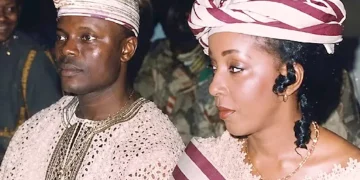








Oyo State Governor, Seyi Makinde, has revealed how he and his wife, Tamunominini, got a male child after having two daughters — by buying a book on how to conceive a boy, studying the Shettles theory, and using conception kits.
Makinde disclosed this in an interview with media personality, Chude Jideonwo, on Wednesday, explaining that the decision to try for a son came after his wife expressed a desire for a male child.
He said he initially wanted only one child, but reluctantly agreed to have two after his wife questioned why they should have just one.
He said he was contented after their second child was also a girl and did not consider the children’s gender important.
“Gender doesn’t mean anything to me, really, because I felt whether it’s a girl or a boy, it’s all linked to how you’re going to bring them up and how you set them up to impact their environment. You know, and you can do it with either,” he said.
The governor, however, said cultural expectations and pressure from his wife’s mother contributed to the couple’s subsequent discussions about having a male child.
According to him, his mother-in-law repeatedly told his wife that Yoruba men might seek to have sons elsewhere if their wives did not give birth to boys.
Makinde said he initially dismissed the suggestion, insisting that he was satisfied with the two daughters they had.
“I’m a Yoruba man, but I think I’m okay with the two girls that God has blessed us with,” he recalled telling his wife.
He said the issue persisted for more than five years before he eventually understood why his wife wanted another child.
Makinde said they then agreed to explore ways of having a boy, prompting him to buy a book on methods of conceiving a male child.
“So, I said, ‘Okay, well, that’s fine. We have to go buy a book on how to have a boy, and then we’ll read it and apply it strictly.’ Shettles’ theory, all of that,” he said.
The Shettles theory is a method of attempting to influence a baby’s sex by timing sexual intercourse in relation to ovulation. It is based on the unproven assumption that sperm carrying male chromosomes swim faster but have shorter lifespans than those carrying female chromosomes.
The method recommends intercourse closer to ovulation to increase the chances of conceiving a boy. However, its effectiveness has not been scientifically established.
Makinde said he bought the book and they read it together, adding that they also purchased conception kits as part of their efforts.
According to him, studying the book made them realise that they would probably continue having girls unless they changed certain things.
“And we bought all the kits as well, you know, the ovulation kits, blah, blah, blah,” he said.
Makinde said their efforts eventually resulted in the birth of their son, adding that he felt relieved after the arrival of the boy.
“That was it. That was what produced the boy. And then I finally got off the hook,” he said.
Makinde, who was born on December 25, 1967, in Ibadan, Oyo State, is married to Tamunominini Makinde.

The couple got married in 1997 and have three biological children: two daughters and a son.
The governor, a trained engineer and businessman, became Oyo State governor in 2019 and was re-elected in 2023.
Before his election, he contested the governorship election in 2007, 2011 and 2015. He was elected on the platform of the Peoples Democratic Party in 2019 and secured a second term in 2023.
Makinde has also spoken publicly about his experience as a father.
About a decade earlier, he told a national daily that witnessing his wife’s childbirth brought him closer to God, describing the experience as one that deepened his appreciation of childbirth and life.