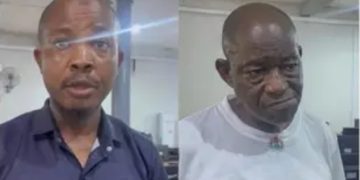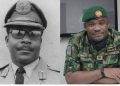



















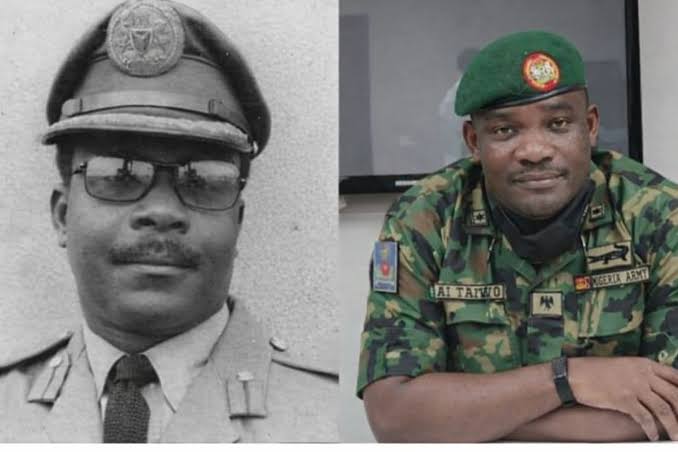
•Late Col. Ibrahim Taiwo & retired Maj.-Gen. Ahmed Taiwo (son)
By Mick Oseji, Asaba
The Asagba of Asaba, Prof. Epiphany Azinge, has publicly declared that the Asaba community has forgiven the family of the late Col. Ibrahim Taiwo over the events surrounding the 1967 Asaba Massacre.
Azinge made the declaration on Wednesday at the 59th anniversary commemoration of the massacre, shortly after former President Olusegun Obasanjo called on survivors and families of victims to embrace forgiveness and reconciliation.
The Daily Crucible reports that the horrifying killings occurred on October 7, 1967. Troops of the Nigerian Army’s 2nd Infantry Division had on that day carried out a deadly operation in Asaba, in the country’s then Mid-Western Region, in which an estimated 500 to 800 unarmed Asaba men and boys were killed. The victims had assembled peacefully in white ceremonial attire as a demonstration of their support for the Federal Government during the Nigerian Civil War but the soldiers savagely turned the guns on them, cutting the defenceless people down in gales of bullets. Late Col. Ibrahim Taiwo from Ilorin in Kwara State was said to have played a role in the gruesome act.
Speaking, however, at the anniversary of the massacre, the Asagba said the community had accepted an apology offered by retired Maj.-Gen. Ahmed Taiwo, son of Col. Taiwo, who expressed regret on behalf of his father and family over any act, omission or commission that contributed to the tragedy.
“On behalf of the Asaba community, and as the prescribed authority, the Asagba of Asaba, I hereby publicly proclaim that we have forgiven the Taiwo family,” Azinge said.
His declaration marked a significant reconciliation gesture at an event that has continued to keep alive the memory of one of the darkest episodes of the Nigerian Civil War.
Obasanjo, who participated virtually as chairman of the occasion, had earlier urged survivors and families of those killed during the massacre to forgive and work towards reconciliation.
Describing the civil war as an unfortunate event that should never have occurred, the former president said the Asaba killings remained one of its most painful and terrible chapters.
He said he was moved to tears after receiving documents on the massacre from Chief Chuck Nduka-Eze.
“To all of you assembled: let us keep one thing in mind, forgiveness, forgiveness, and forgiveness again,” Obasanjo said.
He urged the people of Asaba to forgive while ensuring that the tragedy was remembered and that measures were taken to prevent a recurrence of such events.
Responding to the former president’s appeal, Azinge said the people of Asaba were prepared to forgive, but would not forget the tragedy.
He, however, maintained that forgiveness should not erase the community’s demand for acknowledgement and closure.
According to him, a public apology from a sitting President would be necessary to bring closure and promote healing among the people.
“We may not forget, but certainly, we have to forgive,” the traditional ruler said.
Azinge noted that former military Head of State, retired Gen. Yakubu Gowon, had apologised while out of office, but said the community wanted a sitting President to formally apologise to the people of Asaba.
“We need a sitting president to apologise to the people of Asaba; that will bring closure,” he said.
The monarch also questioned the call for a “never again” approach to such tragedies, recalling the killings in Odi during Obasanjo’s administration as President.
“Coming from him, I was a bit taken aback. How long do we say ‘never again’? But it happened at Odi,” he said.
Despite the unresolved demand for a presidential apology, Azinge stressed that the community had chosen the path of forgiveness, particularly in accepting the apology from the Taiwo family.
He said remembrance remained important as Asaba prepares to mark the 60th anniversary of the massacre.
The Asagba said the community had moved forward but would continue to remember those who lost their lives.
“From the going down of the sun till the morning, we will always remember them,” he said.
The 1967 Asaba Massacre occurred during the Nigerian Civil War, and the memory of the killings has remained a significant part of the community’s history and calls for justice, remembrance and reconciliation.
As the 60th anniversary approaches, the latest gesture by the Asaba traditional institution signals a willingness to pursue reconciliation with the Taiwo family while maintaining the community’s broader demand for acknowledgement, remembrance and closure.