



















By Our Reporter
In the evolving political theatre of Delta State, the contest for the Delta North Senatorial ticket under the All Progressives Congress (APC) is shaping up to be more than a routine primary—it is becoming a defining clash between legacy and disruption, experience and insurgency, past dominance and present momentum.
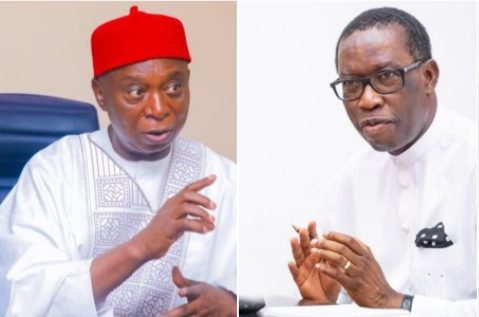
At the heart of this unfolding drama are two formidable figures: Ifeanyi Okowa, a physician from Owa Oyibu in Ika North East Local Government Area of the state and Senator Ned Nwoko, the Idumuje – Ugboko – born Prince and lawyer.
To grasp the magnitude of the unfolding contest, it is worth revisiting the political trajectory of Delta North since Nigeria’s return to democracy in 1999. For over two decades, the district—comprising Aniocha, Ika, Oshimili, and Ndokwa areas—was largely under the grip of the People’s Democratic Party (PDP).
The long reign of Patrick Osakwe (1999–2011) entrenched stability and grassroots politics. Okowa’s own brief but strategic stint in the Senate (2011–2015) elevated the district’s national relevance before he transitioned to become governor from 2015 to 2023.
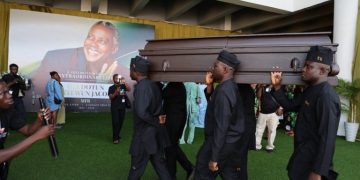
This was followed by the era of Peter Nwaoboshi, whose tenure reinforced party machinery dominance. Senator Peter Nwaoboshi died recently and was laid to rest in February at his country home, Ibusa, Oshimili North Local Government Area, Delta State. He was remembered as a bridge-builder and patriot, whose contributions transcended political affiliations and strengthened democratic governance in Nigeria.
However, 2023 came with a political disruption and rupture as it threw up Ned Nwoko. His victory broke the PDP’s longstanding grip on the district, handing the APC a historic foothold in Delta North and reshaping its political calculus today.
Okowa symbolizes the return of the strategist just as his entry into the APC contest represents a calculated comeback. Armed with deep institutional knowledge, a vast grassroots network, and years of governance experience, Okowa who was the running mate Alhaji Atiku Abubakar in the 2023 presidential election, embodies structure and continuity.
To his supporters, Okowa is the architect of modern Delta politics—a man who understands not just elections, but the intricate web of alliances that sustain power. His appeal cuts across traditional PDP loyalists, many of whom could follow him into a new political alignment.
Yet, his candidacy is not without complications. Critics question the optics of a long-standing PDP leader seeking relevance under the APC banner.
For them, Okowa represents the old guard—seasoned, yes, but perhaps out of sync with a shifting political mood.
Nwoko: The Incumbent Disruptor
In contrast, Nwoko stands as a symbol of political disruption. His emergence in 2023 was not merely an electoral victory—it was a statement that Delta North could break from entrenched patterns.
As the sitting senator, he enjoys the advantages of incumbency, bolstered by visibility and a distinct personal brand. His advocacy, including the push for Anioma State creation and campaigns like malaria eradication, has amplified his presence beyond the district.
Nwoko’s strength lies in his independence—financial, political, and ideological. But that same independence fuels criticism that his style leans more toward personal influence than institutional cohesion.
The real battlefield is the party primaries.
While the general election looms in 2027, the true contest may unfold long before then—within the APC itself.
This is where loyalties will be tested, alliances redrawn, and the party’s strategic direction decided. Choosing Okowa would signal a pivot toward experience and elite recalibration.
Retaining Nwoko would affirm continuity and reward the man who delivered the district to the APC.
But beyond the party primaries, who is going to be the likely choice of the Delta North on election day if the two titans from the same political platform – APC, were the only senatorial candidates?
Okowa represents memories of developments. Despite criticisms, many people are quick to recall his many developmental strides as a Governor, especially his roads rehabilitation and reconstruction projects, and the democratization of tertiary education in the state – making university education accessible and relatively affordable at close range to the Delta indigenes and residents.
The expectations are high that given a fresh opportunity to return to the Senate the second time, Okowa may perform wonder for the Delta North through effective representation and quality legislation.
For Ned Nwoko, he is not a pushover. The incumbent Senator is seen as a revolutionary and disruptive innovator. Since becoming Senator in 2023, he is believed to have facilitated over 113 projects valued at over ₦30 billion, targeting infrastructure, health, agriculture, education, and empowerment.
Ned Nwoko’s visible initiatives include the proposed Federal University of Medical and Health Sciences, solar streetlights, road rehabilitation, ICT hubs, and water boreholes in some places within the senatorial district.
However, his push for the creation of Anioma State is a significant milestone and fits into the long yearnings of the good people Aniomaland but the proposal that the new State if created should be assigned to the Southeast geopolitical zone is unsettling and has polarized the people.
What ought to be a unifying force has regrettably morphed into a subject that elicits discord and division among Anioma people each time the topic is mentioned.
Those opposed to Ned Nwoko’s move to herd the Delta North to the Southeast geopolitical zone are now silently waiting for him. A good number of the people feel disappointed and worried that Ned Nwoko is knowingly or inadvertently pursuing ‘Anioma for Southeast’ agenda, which they feared, has potentials to expose them to the grave risk of seamy side of the Southeast geopolitical zone.
Such opponents often warned that taking Anioma to the Southeast could hand the Biafra agitators, IPOB, ESN, UGM, Sit – at – Home enforcers among other non – State actors the legitimacy and oxygen they need to expand their scope of terror to a peaceful Aniomaland. And they don’t want such in Anioma.
According to them, it could proof in the end to be a clear case of attempting bringing home, ants infested firewood by oneself and importation of despicable practices such as Oke – Ite, the dire fate of Lilu, Orsu, Okigwe communities among others to Anioma.
So, the stakes are profound and the choice defining. For the APC, it is a decision between consolidating recent gains being in power in Delta North or leveraging established political machinery for broader expansion.
For the senatorial district, it is a referendum on identity—whether to embrace a new political order or return to a familiar one.
On paper, Okowa leads in experience and structural depth. Nwoko, however, holds the edge in current relevance, incumbency, and alignment with the APC’s recent breakthrough in the district.
Beyond Politics.
Ultimately, this contest transcends personalities. It is about the evolution of power in Delta North—how it is built, sustained, and transferred.
As 2027 approaches, one thing is clear: Delta North is no longer a predictable stronghold. It has become a battleground where the past confronts the future, and where the outcome will resonate far beyond a single senatorial seat.
In this high-stakes duel, the APC is not just choosing a candidate—it is choosing a direction. Who wins the ticket? The answer is tied to events that may unfold in the coming days and weeks.