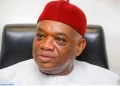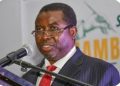












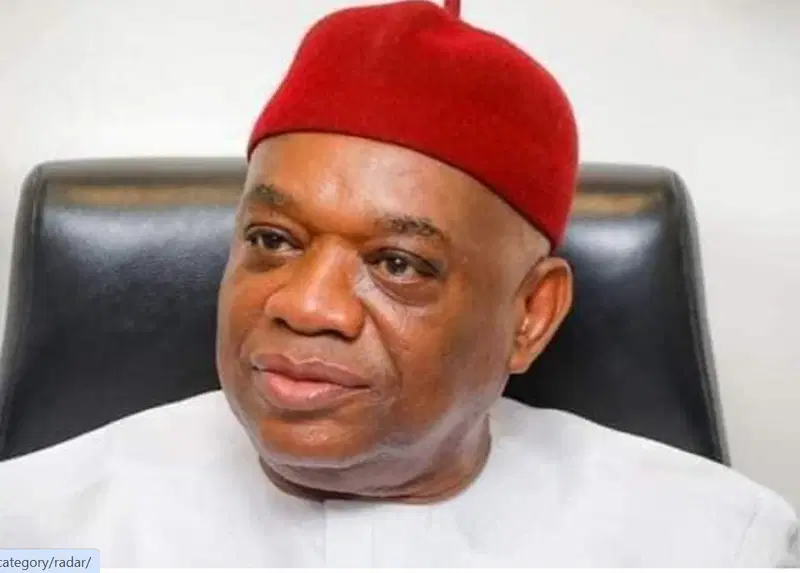
The Senator representing Abia North, Orji Uzor Kalu, has declared his unflinching support for President Bola Tinubu and the All Progressives Congress (APC), insisting that party loyalty should take precedence over ethnic considerations in politics.
Kalu said he would not abandon his political party to support candidates from other parties simply because they are of Igbo extraction.
The former Abia State governor stated this on Monday during an appearance on Arise Television’s Prime Time programme, where he addressed questions about his political allegiance and expectations that he should support Igbo candidates ahead of the 2027 general elections.
Speaking on the issue, Kalu said his responsibility was to support his party rather than allow ethnic considerations to determine his political decisions.
“Party loyalty is number one. I am not ethnically loyal; I am a Nigerian, and we must behave like Nigerians. My business is to support my party,” he said.
He also dismissed calls for him to support Igbo politicians contesting on other political platforms, insisting that he had no reason to campaign for candidates outside the APC.
According to him, his membership of the ruling party makes it unreasonable to expect him to support candidates of other political parties.
“I am not in the political party where they are contesting. Why should they call my name? I mean, they shouldn’t,” he said.
Kalu further recalled his political journey through the Peoples Democratic Party, PDP, the Progressive Peoples Alliance, PPA, and his eventual membership of the APC.
He maintained that having chosen to remain in the APC, he would not support candidates contesting against the party.
The senator also argued that the APC remained the appropriate political platform through which the interests of the South-East could be pursued.
He said Nigerians who preferred to pursue their political interests outside the APC were free to do so, adding that their decisions would not change his commitment to the ruling party.
His comments come amid political realignments and growing discussions over the 2027 presidential election, particularly concerning the possibility of an Igbo presidential candidate and support from political leaders in the South-East.
Kalu has consistently defended his support for Tinubu, arguing that political loyalty should be determined by party affiliation rather than ethnic identity.
He was also recently reported to have predicted victory for Tinubu in the 2027 presidential election.
Chairman, Senate Committee on South East Development Commission (SEDC), Senator Orji Uzor Kalu, revealed how former President Olusegun Obasanjo betrayed his agreement to serve one term and to subsequently hand over to the North.
Kalu revealed an account of an alleged political understanding involving Obasanjo and former military president Ibrahim Babangida ahead of the 2003 presidential election.
The former Abia State governor, who spoke on why his once cordial relationship with Obasanjo eventually collapsed, disclosed that their disagreement was rooted partly in what he described as an agreement that Obasanjo would serve only one four-year term before power returned to the North.
According to him, the understanding was reached during a meeting involving himself, Obasanjo and Babangida at Obasanjo’s residence in Ota, Ogun State, stressing that the arrangement was intended to accommodate the political circumstances surrounding the emergence of Obasanjo in 1999, following the annulment of the June 12, 1993, presidential election.
Kalu maintained that the agreement was for Obasanjo to complete one term and hand over to another political leader from the North, allowing the country’s power rotation arrangement to continue.
When asked specifically to speak about reports that Babangida was expected to succeed Obasanjo in 2003, with Kalu potentially becoming his running mate, the senator said he could not confirm the vice-presidential arrangement but stood by the agreement concerning Obasanjo’s tenure.
“Well, I cannot be certain about the vice presidency, but I can tell you, yes, this was our discussion in Ota. That he would leave, he would leave for four years and give back to the North,” he disclosed.
Providing further details, Kalu identified an individual he described as Obasanjo’s aide from Benue State, named Adobeye in the interview, as being present during the discussion.
“What we discussed and agreed there were people there, there were people there, like His Boy, Obasanjo’s Boy, Adobeye from Benue State; he was sitting down there where we sat, me, Ibrahim Babangida and President Obasanjo. Where we agreed, we agreed.”
Kalu said the disagreement over the alleged arrangement was among the issues that eventually damaged his relationship with the former president, just as he accused Obasanjo of using state institutions, particularly the Economic and Financial Crimes Commission (EFCC), to pursue political opponents and remove elected governors through what he considered unconstitutional means.
The senator maintained that his opposition to Obasanjo was not driven by personal ambition but by his disagreement with what he considered a departure from their political understanding and constitutional principles.
Kalu, who also provided an account of his financial contributions to the formation of the PDP during the transition from military to civilian rule, dismissed suggestions that he was the only wealthy individual involved in the party’s formation, acknowledging the contributions of prominent figures, including former Vice-President Atiku Abubakar, Yomi Edu and General Theophilus Danjuma.
The former Abia State governor, who maintained that he played a significant role in financing the early meetings and logistical arrangements that facilitated the formation of the party, said:
“I was the one funding the meetings, aircraft, paying honourariums to people that came for cooking food and all the rest of them. That is the truth.”
He explained that his motivation was to ensure the emergence of a formidable political platform capable of ending military rule.
“So for me, it was just a joyful thing to make sure that we had a strong party to drive away the military,” he added.
Kalu, however, expressed disappointment with how some of the party’s members treated him after he had invested considerable resources in its formation.
“I became a fool before the PDP because after bringing all the money, they turned against me,” he said.
He further claimed that he had supported Obasanjo financially after the former president’s release from prison, including funding his movements and providing aircraft for his political engagements.
The Senator representing Abia North disclosed that he previously engaged in the international trade of heavy weapons, selling arms to buyers in different countries before quitting the business at the insistence of his parents.
Asked whether he was an arms dealer, the former Abia State governor answered in the affirmative, saying he stopped after his parents intervened.
“Yes, so I stopped because my parents, my mother, my father came and said I must stop, and I stopped,” he said.
Asked whether he sold weapons to people who intended to use them to kill others, Kalu dismissed the suggestion, saying his motivation was to make money.
“No, no, no, no, no, no. I was selling guns to make money, whether they blow up it’s not my business,” he said.
The interviewer subsequently asked whether he supplied weapons to the African National Congress (ANC) during its struggle against apartheid in South Africa.
Kalu said he did not restrict his business to the ANC, explaining that he sold weapons to any buyer who could afford them.
“No, I was selling to anybody who wants to buy. If you have the money, you want to buy in D.R.C, I sell to you, you want to buy in Namibia, you want to buy…” he said.
Asked about the source of the weapons, the senator declined to provide details, saying, “It’s only my business.”
The interviewer also questioned how his former arms trade related to Nigeria’s current security challenges and the proliferation of small arms.
In response, Kalu clarified that the weapons he traded were not small arms but heavy weapons sold between countries.
“No, these are heavy arms that were sold country to country,” he said.
Asked specifically whether he sold weapons to Libya under its late leader, Muammar Gaddafi, Kalu said he sold to anyone with the financial capacity to purchase them.
“To anybody that had money to buy,” he responded.
When the interviewer suggested that his answer meant he had supplied weapons to Gaddafi, Kalu replied, “May his soul rest in peace. He was a good man. If you have money to buy, when I was selling, I would sell to you.”
The Abia North Senator also discussed his longstanding relationships with influential political figures within and outside Nigeria, attributing much of his approach to relationship-building to lessons from three individuals.
He identified former military President Ibrahim Babangida, the late Professor Jibril Aminu and businessman Gilbert Chagoury as the people who taught him the importance of maintaining relationships across different social and political backgrounds.
“Three men taught me how to cultivate this. One, still alive, is his present, Ibrahim Babangida. Two, was Professor Jubril Aminu. And the third one was Mr Gilbert Chagoury,” he said.
According to Kalu, their advice was that maintaining relationships required humility, accessibility and the willingness to interact with people regardless of their social standing.
“They told me that it’s always good to keep people and eat with people. And I maintained that, and this is what I maintained in my life,” he said.
He explained that he deliberately maintains relationships with people from different social classes and makes efforts to return missed calls and respond to messages.
“I welcome people of no status. I welcome people with status. I welcome people of the same below and above. I keep relationships,” he stated.
Kalu also acknowledged that his relationship with Babangida opened doors for him to meet influential international figures, which he subsequently leveraged to expand his business and diplomatic networks.
He recalled his friendship with the late South African President Nelson Mandela, who, according to him, introduced him to other influential South African leaders, including Thabo Mbeki and Jacob Zuma.
He said Mandela introduced him to several South African leaders, including former President Thabo Mbeki and incumbent President Cyril Ramaphosa.
According to Kalu, Mandela once told him that Mbeki’s father had contributed more to the anti-apartheid struggle than Ramaphosa’s father.
He said the consideration influenced the ANC’s decision to select Mbeki ahead of Ramaphosa as Mandela’s running mate.
Kalu added that Mbeki later introduced him to former President Jacob Zuma, maintaining that his relationships with South African leaders had continued across successive administrations.
He also confirmed that he had maintained relationships with influential individuals in the United States, including people associated with the Democratic Party, while clarifying that his relationships with international intelligence officials did not make him an agent of any foreign government.
Asked about allegations linking him to the CIA and Israel’s Mossad intelligence agency, Kalu categorically denied working for either organisation.
“I’m not an agent,” he said.
Kalu also addressed his previous recognition by Forbes magazine as one of Africa’s wealthiest individuals, explaining why he had not featured prominently in more recent wealth rankings.
He attributed the difference to his current involvement in politics, arguing that his business profile would become more prominent if he returned fully to the private sector.
“Any day I drop out of politics, I’m sure Forbes, if I have anything to rank, they’ll rank me,” he said.
He further made a notable claim about his previous recognition by the international financial publication.
“Because in the history of Forbes, I’m the only person active in politics ever they have ranked,” he declared.
Recounting his transition from business into politics, Kalu revealed that some of his closest associates initially considered his decision to contest the governorship of Abia State an unwise move.
Kalu, who specifically recalled the reaction of Africa’s foremost industrialist, Aliko Dangote, when he informed him of his intention to enter politics, said the conversation took place at his residence in the presence of other associates, including Chat Sahi and the late Mohammed Wazgiri.
He said Dangote was surprised by his decision, considering the business empire he had built and the risks associated with entering Nigerian politics.
“The day I told him I was going to run for governor, he felt I was a fool,” Kalu recalled.
Recounting Dangote’s reaction, he said:
“He said you must be very strong to think about that. He said, ‘You will not do that.’”
Kalu explained that his decision was influenced partly by the encouragement of politicians who approached him to participate in the formation of a political movement capable of ending military rule.
He recalled that he became actively involved in financing meetings, providing aircraft and supporting the logistics required to establish the PDP ahead of the return to democratic governance in 1999.