























By Our Reporter
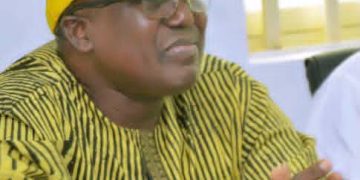
A retired Assistant Director of the Department of State Services (DSS), Dennis Amachree, has offered a fresh account of the final moments of Nigeria’s former military Head of State, Gen. Sani Abacha, claiming the late ruler died during an intimate encounter at the Presidential Villa in Abuja.
Amachree made the revelation in his newly released 348-page memoir, DSS @40: My Journey Behind the Shield, where he said his account was based on the confession of a young pharmacist whom he personally interrogated shortly after Abacha’s death on June 8, 1998.
According to the former intelligence officer, Abacha suffered what appeared to be a coitus-induced cardiac arrest at about 4:05 a.m. while alone with the pharmacist, who had accompanied her elder sister to the Aso Rock Guest House.
He wrote that the woman later told him during interrogation in Lagos: “I did not kill him, he died on top of me.”
Amachree said the pharmacist immediately returned to her hotel before boarding an early morning flight to Lagos, prompting the DSS to launch a search that eventually led to her arrest in Ogudu, Lagos.
The retired DSS officer said he was directed by the agency’s headquarters to interrogate the woman, after which she was flown back to Abuja.
He maintained that the account provided by the pharmacist represents the true circumstances surrounding Abacha’s death and dismisses the numerous conspiracy theories that have circulated for nearly three decades.
“The lady pharmacist’s account… remains the true position and puts an end to the conspiracy theories and half-truths that have gone viral,” Amachree wrote, insisting that any contrary narrative amounts to “an act of deceit and a disservice to our countrymen and women.”
In the book, he rejected several widely circulated explanations of Abacha’s death, including claims that the late military ruler was poisoned through a handshake, a poisoned apple, or a plot allegedly orchestrated by foreign intelligence agencies.
He also faulted previous accounts by Abacha’s former Chief Security Officer, Major Hamza Al-Mustapha; former military officer Gen. Jeremiah Useni; former US National Security Adviser Susan Rice; former Aviation Minister Femi Fani-Kayode; medical officer Brig.-Gen. Oviemo Ovadje; and journalist David Orr, describing them as either inconsistent or unsupported by verifiable evidence.
Amachree argued that the conflicting versions of events have distorted Nigeria’s historical record and said he decided to document his own experience because he was directly involved in the investigation.
Reflecting on Abacha’s legacy, the retired DSS officer described his five-year military administration as a period marked by authoritarian rule, widespread human rights abuses, arbitrary arrests, torture and extrajudicial killings.
He added that the circumstances surrounding Abacha’s death illustrate the fleeting nature of power.
“No amount of security can shield a leader from their ultimate fate,” he wrote.
Before his death in June 1998, Abacha was reportedly positioning himself to transform from military ruler to civilian president by backing five political parties, all of which adopted him as their sole presidential candidate in what critics described as a tightly controlled transition programme.
The late elder statesman and former Oyo State governor, Chief Bola Ige, famously likened the five parties to “the five fingers of a leprous hand.”
Abacha died at the age of 54, ending a regime that remains one of the most controversial chapters in Nigeria’s political history.