























...No definitive DNA evidence yet confirms a specific ethnic lineage as the biological inheritors of the Nok population. What the archaeological, linguistic, and material culture evidence allows is a probability ranking of descendant claims…
By Alex Sewo
Long before the Oyo Empire raised cavalry across the savannah, before the Benin Kingdom cast its bronzes, before Ile-Ife became the sacred city of the Yoruba world, before any of the civilisational networks this series has documented had crystallised into the forms that history now recognises, there was Nok. Flourishing across 78,000 square kilometres of central Nigeria from approximately 1500 BCE to 200 CE, the Nok people built the earliest known complex civilisation in West Africa, produced the oldest life-sized terracotta sculpture in sub-Saharan Africa, smelted iron centuries before any other known society in the region, operated a judicial system of documented complexity, organised agricultural production at scale, and left in the red laterite soil of the Jos Plateau a material archive so technically accomplished that a British archaeologist who first formally documented it in 1943 described it as the product of a mature tradition with the probability of a long antecedent history. A civilisation that had already reached maturity by 500 BCE is a civilisation whose unrecorded history stretches backward into antiquity that no current excavation has reached.
DISCOVERY, DATING, AND THE ARCHAEOLOGY OF AN ACCIDENTAL REVELATION
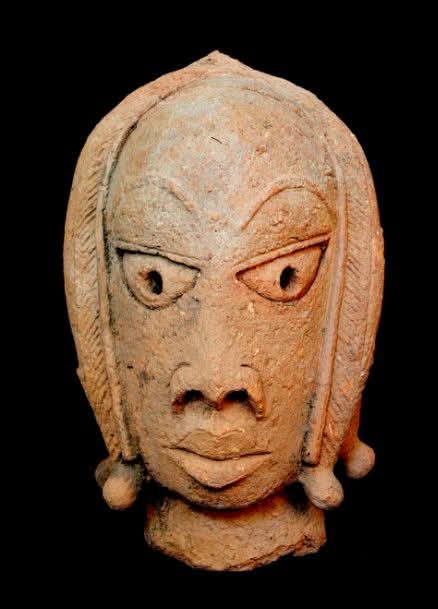
The Nok civilisation entered the academic record through an act of routine industrial extraction rather than deliberate archaeological investigation. In 1928, Colonel Dent Young, co-owner of an alluvial tin mine near the village of Nok in present-day Kaduna State, unearthed terracotta figurines from a mining level 24 feet below the surface. He presented the sculptures to the Museum of the Department of Mines in Jos, where they sat largely unexplained until 1943, when a mine clerk near the same village found a terracotta head and took it home for use as a scarecrow. The clerk mentioned it to archaeologist Bernard Fagg, who recognised the object as the Jemaa Head, now one of the most iconic artefacts from ancient Africa, and thermoluminescence dating subsequently placed it at approximately 500 BCE.
Fagg’s subsequent excavations at Taruga, near present-day Abuja, produced the finding that changed the entire interpretation of West African prehistory. He found 13 iron smelting furnaces, with terracotta figurines in such close association, inside the furnaces and around them, that he concluded the figurines were objects of worship integrated into the metallurgical process itself. Carbon dating of charcoal inside the furnaces produced dates as far back as 280 BCE, establishing for the first time that sub-Saharan Africa had iron smelting technology during the early Iron Age, contemporary with or preceding iron technology in Europe, the Middle East, and East Asia rather than derived from those regions as colonial historiography had assumed.
Peter Breunig of Goethe University Frankfurt, whose team has conducted the most systematic modern excavation of Nok sites since Fagg’s era, extended the cultural dating to approximately 1500 BCE for earliest emergence, with iron smelting confirmed from at least 900 BCE and the terracotta tradition reaching its artistic peak between 500 BCE and 200 CE. Breunig’s excavations added critical contextual evidence beyond the figurines: ceramics, stone beaded necklaces, and burial pit evidence confirming a complex funerary culture in which the terracotta sculptures served ritual functions integrated with ancestor veneration and metallurgical worship simultaneously.
The clay evidence is the most consequential single finding for understanding Nok political organisation. Compositional analysis of the clay used across all Nok terracotta sites confirmed that sculptures found across the full 78,000 square kilometre distribution area were made from clay sourced at a single central location. A centralised clay supply serving sculptors across an area the size of Ireland requires either a political authority capable of organising and enforcing that supply network, or a trade system sophisticated enough to move raw clay across hundreds of kilometres to production centres. Either interpretation confirms what the distribution itself suggests: the Nok were not a dispersed collection of independent villages practicing similar artistic traditions. They were a unified civilisation with institutional coherence over an enormous territory.
WHY THE NOK WERE SO STRONG: FIVE STRUCTURAL ADVANTAGES**
The strength of the Nok civilisation rested on five structural advantages that no contemporary West African society possessed simultaneously, and the combination of which produced a political and cultural dominance that lasted fifteen centuries.
The first was iron metallurgy at a time when no other known West African society had it. Iron changes the equations of agriculture, warfare, and construction simultaneously. An iron-tipped spear penetrates where a stone-tipped one deflects. An iron hoe cultivates land that a wooden implement cannot. An iron axe clears forest that resists every other tool. The Nok who had iron existed in a different technological order of magnitude from every neighbour who did not, and their 13 documented smelting furnaces at Taruga alone suggest a production capacity organised for society-scale output rather than individual artisan use. The association of terracotta figurines with the furnaces suggests that metallurgy was simultaneously economic production and sacred ritual, that the knowledge of iron was understood as divinely given power that required ongoing spiritual acknowledgement to maintain.
…The National Commission for Museums and Monuments may immediately establish a dedicated Nok Heritage Protection Zone covering the full extent of documented Nok archaeological sites across Kaduna, Kogi, Niger, Nassarawa, and Plateau States, with legally enforced penalties for unauthorised excavation comparable to those protecting World Heritage Sites
The second was the terracotta tradition as a centralised knowledge institution. The single-source clay supply is not merely logistical evidence. It is governance evidence. The entity controlling the clay supply controlled the production of the objects that documented Nok cultural identity, commemorated Nok ancestors, and probably legitimised Nok political authority. In a pre-literate society, control of the representational medium is control of the historical record. The Nok who controlled the clay controlled what the civilisation remembered about itself.
The third was agricultural organisation in a climatically favourable zone. The Nok cultivated pearl millet, a Sahel-adapted grain whose native zone matches the Niger-Kaduna river basin where Nok artefacts are most densely concentrated. Pearl millet produces reliable yields in the Guinea savannah transition zone with minimal irrigation, supporting population densities that the forest zone’s more labour-intensive agriculture cannot sustain. A dense settled agricultural population produces the surplus that funds specialist artisans, warriors, administrators, and religious practitioners, which is the economic foundation of every complex society from Mesopotamia to the Niger confluence.
The fourth was a judicial system that Ancient Origins describes as one of the most complex of their time globally. The specific evidence for this complexity comes from burial site analysis and the social differentiation visible in the terracotta figurines themselves: individuals depicted with elaborate hairstyles, beaded necklaces, and specific seated postures that archaeologists interpret as markers of social rank. A society that encodes social hierarchy in its representational art is a society that has institutionalised the hierarchy itself, which requires legal and administrative frameworks to maintain. The Nok judicial system is not a peripheral detail of their civilisation. It is the mechanism that sustained the clay supply network, the iron production system, the agricultural surplus distribution, and the territorial coherence across 78,000 square kilometres for fifteen hundred years.
The fifth was geographic positioning at what this series has repeatedly identified as the most strategically significant location in West African civilisational history: the Niger-Benue confluence zone. The Nok occupied the territory immediately west, north, and east of the point where the Niger and Benue Rivers meet, the same confluence that this series documented as the cradle of the Bantu migration, the ancestral territory of the Ijaw ORU, the manufacturing base of the Igbo-Ukwu bronze culture, and the trade corridor connecting the Sahel to the forest and the coast. A civilisation sitting astride this confluence for fifteen centuries is a civilisation sitting at the intersection of every major trade route in West African history for fifteen centuries.
WHO ARE THE DIRECT DESCENDANTS OF NOK
The question of Nok descendants is the most scientifically unresolved and most historically significant question in West African archaeology, and the honest answer is that no definitive DNA evidence yet confirms a specific ethnic lineage as the biological inheritors of the Nok population. What the archaeological, linguistic, and material culture evidence allows is a probability ranking of descendant claims, and that ranking produces a result consistent with everything this series has documented.
The strongest material culture evidence connects the Nok to the Yoruba through the terracotta and bronze casting chain. The lost-wax casting technique that produced the Nok terracottas appears identically in the Ife bronzes of the 12th to 14th centuries CE and in the Benin bronzes of the 15th century onward. The triangular eye form, tubular nostril treatment, and elaborate hairstyle iconography of Nok terracottas appear as stylistic precursors in the naturalistic Ife bronze portraiture tradition. Multiple academic sources including World History Edu, Historic Mysteries, and the OER Project all state directly that the Nok are believed to be the ancestors of the modern Yoruba culture in Nigeria. The Taruga Nok furnaces, located 60 kilometres from Abuja and approximately 300 kilometres north of Ile-Ife, represent the material technology transmission chain: Nok iron and terracotta knowledge moving southward through the Guinea savannah as the Nok population dispersed, arriving in modified form at the proto-Yoruba settlements of the Ile-Ife corridor.
The Igbo-Ukwu bronze culture, documented in the Igbo civilisation article in this series as predating the Ife bronzes by several centuries with its 9th century CE dating, represents a parallel inheritance of the same Nok metalworking tradition moving southeastward rather than southwestward. The Nsukka iron smelting sites at Lejja dated to 2000 BCE and Opi dated to 750 BCE, discussed in the Igbo article, overlap temporally and geographically with the Nok cultural zone’s northeastern boundary, suggesting that the Igbo-Ukwu metallurgical tradition inherited Nok iron knowledge through the Nsukka-Igboland corridor.
The Middle Belt peoples of present-day Nigeria, specifically the Jukun who led the Kwararafa Confederacy, the Birom of the Jos Plateau, the Gwari of Niger State, the Kaje, Kadara, and Atakar of Kaduna State, are the most geographically direct living inheritors of the Nok territorial legacy. The Kwararafa Confederacy mentioned in the Middle Belt article in this series as a multi-ethnic alliance that humiliated the Kano Emirate in open battle occupied precisely the Nok civilisational zone. The Jukun’s political and military sophistication, which made them capable of defeating the most powerful Islamic emirate in West Africa for centuries, is most coherently explained as an inheritance of the governance and metallurgical traditions of the Nok civilisation whose territory they occupied.
The Bantu migration connection is the most geographically expansive descendant claim and the one with the most extraordinary implications. The proto-Bantu speakers who began the migration documented in the first article of this series, originating from the Cameroon-Cross River corridor adjacent to the Nok cultural zone’s eastern boundary, share the Benue-Congo language branch with the Nok territory’s inhabitants. The Niger-Congo linguistic family’s Benue-Congo branch, from which all Bantu languages descended, originated in the same geographic corridor as the Nok civilisation’s eastern extent. If future ancient DNA analysis confirms genetic continuity between the Nok population and the proto-Bantu speakers, the Nok would be identified as the civilisational grandparents not only of the Yoruba and the Igbo but of the entire Bantu-speaking world from Nigeria to South Africa, including the Zulu whose linguistic connection to the Tiv opened this series. That confirmation, when it comes, will be one of the most significant findings in African genetic history.
THE DISAPPEARANCE: WHAT THE EVIDENCE ACTUALLY SUGGESTS
The rapid decline of Nok material culture after approximately 200 CE has generated multiple explanations ranging from climate change to epidemic to conquest to resource exhaustion. The evidence most consistent with the 13 Taruga furnaces’ charcoal requirement is the resource exhaustion hypothesis. Iron smelting in the ancient world was an enormous consumer of wood, requiring charcoal production at industrial scale to sustain even modest iron output. A single iron smelting campaign sufficient to produce tools for a community requires the destruction of several hectares of forest. Thirteen furnaces operating over centuries across a 78,000 square kilometre territory could have produced the kind of systematic deforestation that degrades agricultural productivity, disrupts rainfall patterns through loss of tree cover, and eventually collapses the food surplus on which the entire civilisational superstructure rests.
The disappearance of the terracotta production tradition does not require the Nok people themselves to have disappeared. It requires only the collapse of the centralised authority that controlled the clay supply and organised the production system. When that authority dissolved, the people dispersed, the clay routes closed, and the distinctive terracotta tradition ended while the populations carrying the Nok’s agricultural knowledge, iron technology, and artistic capability continued southward, eastward, and westward, eventually emerging in the archaeological record as the Ife terracottas, the Igbo-Ukwu bronzes, and the iron traditions of the Middle Belt peoples.
The Nok did not vanish. They became everyone.
IT THEREFORE BECOMES NECESSARY TO CONSIDER THE FOLLOWING POLII SUGGESTIONS
First, the National Commission for Museums and Monuments may immediately establish a dedicated Nok Heritage Protection Zone covering the full extent of documented Nok archaeological sites across Kaduna, Kogi, Niger, Nassarawa, and Plateau States, with legally enforced penalties for unauthorised excavation comparable to those protecting World Heritage Sites, since the ongoing looting of Nok terracottas for the international antiquities market, documented by UNESCO as a persistent problem since the 1990s, is destroying irreplaceable stratigraphic context that can never be recovered once lost. A terracotta sold in a Paris auction house has been permanently removed from the archaeological record that could have answered the descendant question.
Second, the Federal Government of Nigeria must fund a dedicated ancient DNA research programme specifically targeting Nok period skeletal remains, engaging the same paleogenomics methodology applied in the 2016 Willerslev Aboriginal Australian study and in the ongoing African ancient DNA programmes at Harvard and Copenhagen, since the genetic continuity question between the Nok, the proto-Bantu, the Yoruba, and the Igbo can only be settled scientifically through ancient genome analysis, and Nigeria has both the political mandate and the civilisational obligation to ensure that the answer emerges from Nigerian-led research rather than being extracted and published by foreign institutions without Nigerian scholarly leadership.
Third, the Nok civilisation must be formally incorporated into every level of Nigeria’s educational curriculum as the foundational chapter of Nigerian civilisational history, preceding and contextualising all subsequent ethnic history that the curriculum currently addresses, since a child who learns about the Yoruba, the Igbo, and the Hausa without first learning about the Nok is a child who has been given the branches without the root, and the root is 1500 BCE iron smelting, life-sized terracotta sculpture, and judicial complexity in the same territory where every major subsequent Nigerian civilisation eventually emerged.
The Nok were first. The iron was first. The art was first. The civilisation was first. Everything this series has documented about who came after is a branch from their tree.
…and Yoruba and Igbo may be siblings from NOK civilization afterall…
Ire ooo.
•Alex Sewo is a researcher with interest in historical accounts, cultural heritage, science, city and environmental planning.
•Opinions, positions or thoughts expressed here are personal and strictly of the writer/author and do not represent the views of The Daily Crucible.