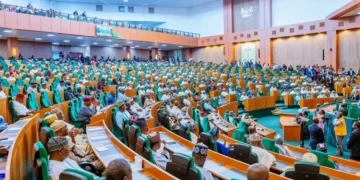

























ABUJA — Deputy Speaker of the House of Representatives, Benjamin Kalu, has urged lawmakers to conduct a thorough investigation into the activities of the controversial Presidential Foreign Intervention Promotion Council (PFIPC), revealing that he was among those allegedly deceived into believing the organisation was a legitimate government agency.
Speaking during Wednesday’s plenary while supporting a motion calling for a probe into the council’s activities, Kalu recounted how he unknowingly received and met with the council’s Director-General, Adeniyi Adeyemi, after his office was presented with what appeared to be an official communication bearing the Presidency’s insignia.
Describing the development as embarrassing, the deputy speaker said the incident exposed the boldness with which individuals could impersonate government institutions.
“I rise this morning to support the motion that has been properly moved by my friend and brother from Plateau State. It is quite embarrassing that people have the kind of boldness exhibited, moving around with what is not in existence, carrying themselves as if they are a legal entity,” Kalu said.
He disclosed that on May 2, 2025, his office received a letter on a letterhead carrying the Presidency’s logo and identifying the sender as the Director-General of both the Presidential Economic Advisory Council and the Presidential Foreign Intervention Promotion Council.
According to him, although some aspects of the correspondence raised suspicion, the document contained seemingly authentic details, including an office address at the Federal Secretariat Complex, Abuja, and the website, pfipc.gov.ng, which gave it an appearance of legitimacy.
“When I saw this, I looked down at the letterhead. I saw the Federal Secretariat Complex, Phase 3, 2nd Floor, Central Business District. I also saw the website, pfipc.gov.ng. It was a bit confusing for me. Some of the information looked credible, some did not,” he stated.
Kalu said he instructed members of his staff to verify the address before approving the meeting.
“I sent my team to go and verify the existence of this organisation at the said address. They came back confirming that this organisation was in the said location. I then gave approval for them to come and have the interaction they had written for,” he explained.
He said the group had requested a meeting to discuss constitutional amendment, economic governance, legislative priorities and possible collaboration with the National Assembly to attract foreign investment.
However, Kalu noted that the discussion took an unexpected turn.
“They said they wanted to discuss the 10th House of Representatives Constitution Amendment process and its implications for economic governance, legislative priorities that can enhance investor confidence, and areas of collaboration between the National Assembly and the Council to drive foreign investment.
“When they came and started engaging, the issues they mentioned in the letter were not what they engaged on. They did not talk about the Constitution that we were amending. They were more about photo taking,” he said.
The deputy speaker said the experience demonstrated that official-looking documents and government addresses could no longer be accepted as proof of legitimacy without proper verification.
“This goes on to show that a beautiful letterhead that has the Presidency is no longer confirmation that an agency is legal. It goes to show that an address that shows Federal Secretariat does not mean that that particular agency is legal,” he said.
He urged members of the House to support the motion and exercise the legislature’s constitutional oversight powers to uncover how the alleged agency operated.
“It is our duty, based on Sections 88 and 89 of the Constitution, to dig deeper into this matter. I urge members to support this motion for the House to show Nigerians that we are in support of transparency and accountability in governance,” Kalu added.
The PFIPC became the subject of nationwide controversy after it emerged as one of the beneficiaries of allocations in the 2026 Appropriation Act despite the Presidency maintaining that no such agency exists under the Federal Government.
The controversy deepened after the National Assembly passed the budget containing allocations to the council, prompting questions over how an agency later disowned by the Presidency found its way into the federal spending plan.
The Presidency subsequently distanced itself from the council, insisting that President Bola Tinubu neither approved its establishment nor appointed anyone to head it.
Following the development, the Chief of Staff to the President, Femi Gbajabiamila, petitioned security agencies over the alleged impersonation of the Presidency and the use of forged government documents, triggering investigations by the Nigeria Police Force and other security agencies.
Adeyemi was later arrested and arraigned on allegations bordering on forgery, impersonation and related offences, although he has consistently maintained that all documents in his possession were legitimately obtained.
Amid growing public concern over the controversial budget allocation, President Tinubu also directed the Independent Corrupt Practices and Other Related Offences Commission (ICPC) to investigate how the council was inserted into the 2026 Appropriation Act despite not being recognised by the Federal Government.
The President further ordered that all those found responsible for the alleged budget insertion be identified and prosecuted in accordance with the law.