





















Picture credit: ChinaAid.
Chinese authorities have detained church leaders, worshippers and several children after raiding a Sunday service at one of the country’s best-known house churches, drawing fresh criticism from international human rights groups over what they describe as an escalating crackdown on religious freedom.
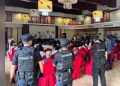
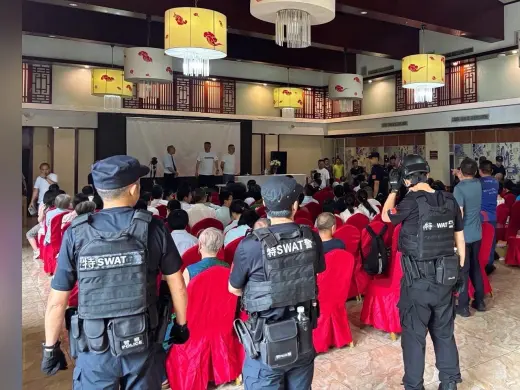
According to Christian human rights organisation ChinaAid, approximately 50 to 60 police officers and government officials stormed a worship gathering of the Early Rain Covenant Church on Sunday morning in Jiangyou City, Sichuan Province.
The congregation had been meeting in a hotel conference room when authorities entered the venue at about 11 a.m. local time. Witnesses said officials collected identification details from those attending before transporting believers by bus and police vehicles to local police stations for questioning.
Among those reportedly taken into custody were church elders Yan Hong and Wu Wuqing, as well as church members Liu Yingxu, Nie Bo, Li Benli and Ah-Xin. Reports also indicated that several children present at the service were affected by the operation.
The raid is the latest incident involving the Early Rain Covenant Church, one of China’s most prominent independent Christian congregations. Church representatives said more than 30 members were taken away for interrogation, while two church leaders remained in detention following the operation.
Images and videos shared by the church reportedly showed worshippers surrounded by Special Weapons and Tactical Unit (SWAT) officers during the raid.
Reacting to the incident, Amnesty International accused the Chinese government of intensifying efforts to suppress independent religious activity and strengthen state control over religious worship.
“The detention of church leaders from the Early Rain Covenant Church is the latest example of the Chinese government’s efforts to crack down on independent religious activity and enforce state control over belief and worship,” said Sarah Brooks, Amnesty International’s Deputy Regional Director.
Brooks said authorities have increasingly relied on surveillance, raids and prosecutions under anti-cult and national security laws to target individuals peacefully exercising their right to freedom of religion.
She noted that members of the Early Rain Covenant Church have faced years of harassment and intimidation, tracing the current wave of pressure to the imprisonment of the church’s founding pastor, Wang Yi, in 2019.
Founded in 2005, the Early Rain Covenant Church is one of China’s largest and most influential “house churches”—Christian congregations that operate outside the state-approved religious framework. In December 2018, authorities carried out a large-scale crackdown on the church, detaining more than 100 members. Wang Yi was later convicted of “inciting subversion of state power” and “illegal business operations” and sentenced to nine years in prison.
Human rights organisations say the latest detentions reflect a broader campaign by Beijing to tighten oversight of religious organisations. Amnesty International pointed to new regulations introduced in September 2025, including the Religious Personnel Online Conduct Rules, which expanded restrictions on religious activities and required religious leaders to demonstrate support for the Chinese Communist Party.
The organisation also referenced a nationwide operation launched in October 2025 against the unofficial Zion Church network, during which nearly 30 pastors and church members were detained across several cities.
Amnesty International has called on Chinese authorities to immediately release the detained church leaders, end what it describes as the persecution of religious groups, and uphold international human rights standards protecting freedom of thought, conscience and religion.
The Chinese government has consistently defended its religious policies, maintaining that regulations are necessary to preserve social stability, prevent extremism and ensure compliance with national laws.
The latest raid is expected to fuel further international scrutiny of China’s human rights record and its treatment of independent religious communities.