





















By Our Reporter
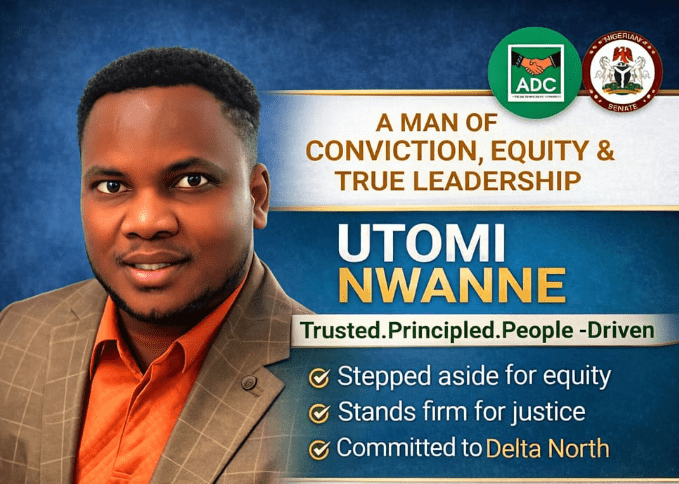
In the evolving political landscape of Delta North politics, one argument is fast gaining momentum: equity, balance, fairness, and credible leadership demand a paradigm shift — and many believe that shift points firmly toward Ika Federal Constituency and the rising profile of Utomi Nwanne, a chieftain of African Democratic Congress(ADC).
For decades, representation within Delta North has rotated unevenly among its three federal constituencies. Ndokwa/Ukwani held the senatorial seat for 12 years under Patrick Osakwe. Aniocha/Oshimili is on track to complete its own 12-year stretch, spanning the tenures of Peter Nwabuoshi, who passed recently and was laid to rest in his Ogwashi – Uku residence amid glowing tributes in February this year and Ned Nwoko, the incumbent occupant of thr seat in the 10th senate. In stark contrast, Ika has had just four years of representation, through Ifeanyi Okowa.
This glaring disparity is now central to calls for fairness. Political observers and stakeholders argue that if zoning and rotation are to remain credible pillars of Delta politics, then Ika’s turn is not just reasonable — it is necessary and even inevitable.
At the core of this conversation gaining traction is Utomi Nwanne, a figure whose political trajectory has drawn attention across party lines in Anioma. Having contested under the Labour Party(LP) in 2023 with a robust presence, he emerged as a prominent voice within the Ika political land space before aligning with the African Democratic Congress(ADC) . His continued influence within the Obidient Movement — inspired by former Governor of Anambra State, Peter Obi — underscores his appeal among younger voters and reform-minded constituents.
Supporters are quick to point to a defining moment in his career: despite reportedly possessing the structure to reclaim a legislative seat, he stepped aside in what allies and observers describe as a rare act of political restraint and maturity, prioritizing equity over personal ambition. In a political culture often criticized for winner-takes-all competition, that decision has become a cornerstone of his public image today, a phenomenon that is equally fostering soaring political capital on his side.
Nwanne’s profile blends activism, entrepreneurship, and academic achievement, including a PhD. His grassroots engagement — particularly with youth, women, sports, and students — has further strengthened his reputation as a community-focused leader.
Although, some question whether Ika, having produced a governor for eight years in Senator Ifeanyi Okowa, should again seek senatorial dominance. Proponents counter with a broader and stronger equity argument: should one constituency’s past governorship exclude it indefinitely from future representation, while others maintain extended control of the Senate seat?
These questions strike at the heart of Delta North’s political future — a future that will be shaped not just by personalities, but by how the region defines fairness and a sense of inclusiveness.
As the next electoral cycle beckons, Utomi Nwanne’s candidacy is increasingly framed not merely as an individual ambition, but as a test case for equity-driven politics in Delta State. Many are in agreement that equity argument should resonate across all units of Delta North.
What is clear, however, is that the call for balance is growing louder — and Ika is making its case and Utomi Nwanne is the best foot forward for the senatorial district in 2027.