






















Jamaica received the largest amount of enslaved people from the biafra region than anywhere else in the diaspora because they could withstand the excessive workload of the sugar plantations
By Abdullahi Hamza
In 930 B.C., the 10 tribes – Asher, Dan, Ephraim, Gad, Issachar, Manasseh, Naphtali, Reuben, Simeon, and Zebulun—all sons or grandsons of Jacob, formed the independent Kingdom of Israel in the north and the two other tribes, Judah and Benjamin, set up the Kingdom of Judah in the south.
The were the ten tribes that inhabited the kingdom of Israel and whose members were exiled by Sargon II, King of Assyria (r.721-705 BC) after the Assyrian conquest (722 B.C.) of Samaria, capital of Israel, under Shalmaneser V (d. 722 B.C.), Sargon’s predecessor (2 Kings 17:1-6).
The ultimate fate of these people is unknown and is the subject of speculation by historians and biblical scholars. Such speculation has led to theories that the tribes emigrated to prehistoric North and South America; that they became Nestorian Christians in Asia or became the ancestors of various Hindu castes . Various other theories have located the tribe in Abyssinia (Ethiopia), Afghanistan, China, and Japan. One Jewish writer, Eldad ben Mahli (fl. 9th century.A.D.) wrote a book on fabulous tales recounting his experiences with descendants of tribes who he claimed, were leading a Utopian existence in an African river valley.
The Igbo race, (together with Pashtuns of Afghanistan and Pakistan; Kashmiri Jews; Bnei Menashe; Bene Ephraim; Beta Israel of Ethiopia) claim to be descendants of one of these lost tribes.
The Igbo, based in southern Nigeria make up around 18 per cent of Nigeria’s population. Their traditional homeland straddles the Niger River in the south-east and is one of the most densely populated areas of the African continent. Igbo are predominantly Christian.
In their tradition, the Igbo who claim to be Jews descend from Gad, one of the sons of the biblical patriarch Jacob, and a leader of one of the 10 lost tribes of Israel.
While Igbo Jews ( Igbo converts to Judaism), claim that they are the descendants of the ancient Israelites, others say they lack the historical evidence which would prove their descent from such a community, and they also lack evidence of a continuous practice of Judaism which should predate colonial contact
Jewish Voice Ministries said they traveled to Nigeria to investigate claims that the Igbo people are descendants of ancient Israelites.
Some Igbo believe that the term “Igbo” is a bastardized version of the word “Hebrew” and point to many cultural similarities between Igbo traditions and Judaism.
DNA tests were conducted on a number of Igbo males who constituted themselves to be called the Redeemed Israel Community of Nigeria (RICON).
“We conducted DNA tests on 124 males identified by RICON (as representative of the Igbo community).”
They were sent to a trusted DNA lab in the United States. They were then compared to the worldwide data repository of Jewish samples amassed over the past 17 years. This repository includes the data sets of Dr. Michael Hammer, Ph.D. from the University of Arizona’s Anthropology department, along with the sample collection of Dr. Doron Behar, M.D., Ph.D. from Israel. These two scholars are the authors of all the relevant scientific papers on the DNA analysis concerning the Jewish people published over the past 20 years.
After a careful comparison, the lab was not able to find any connection to the samples we collected. Jewish populations from around the world are found in 9 discrete subsets of humanity. These are in the following scientific groups: E1b, G, J1, J2, Q, R1a, R1b, Q and T. The entire sample set collected from the 124 Igbo males are from a different branch, commonly known as E1a, an African branch of the tree, like the E1b mentioned above. However, while the Jewish E1b group is from North Africa (Arab) populations, the samples from the Igbo tribe are from E1a, which is restricted to sub-Saharan African populations.”
“The purpose of the tests was to provide them with testing and the pursuit of truth in terms of historical identity,” said a spokesman for Jewish Voice Ministries. “The DNA did not support their claim to be an ancient people of Israel, but we still consider them our brothers through common faith in the Messiah Yeshua.”
I believe rather than a genetic connection the Igbo tend to share characteristic traits with Jews. Jews, the world over are known for their intelligence, thriftiness, enterprise, pride and domination in any sector they choose to encounter. A Jew, in a classroom, nearly always comes out tops, due to an uncanny native intelligence. The same applies to the Igbo. They posses an enterprising spirit akin to the Jew which seems to flourish in the worst nooks and crannies. Anywhere a Jew is found, money is to be made. The same goes for the Igbo. They both share similar attributes. Many colonised or marginalised groups develop strong mercantile and professional skills as a means of survival and advancement — this is a sociological phenomenon, not a genetic marker of Lost Tribe status.
Over the centuries Jews were social pariahs in the nations they found themselves yet distinguished themselves in other fields even becoming the main hub of many an economy. Igbo share this attribute in Nigeria, though denied acceptance they have come to control a substantial part of the economy by mastering the professions, arts, sports, finance, entrepreneurship, industry &c.
The Igbo, known for their well proportioned comeliness were the subjects of massive enslavement in the Caribbeans. Due to their macho sturdiness Igbo people constituted a large portion of the African population of enslaved people in Jamaica. Jamaica received the largest amount of enslaved people from the biafra region than anywhere else in the diaspora because they could withstand the excessive workload of the sugar plantations. It is no wonder we see some of the best A list athletes of the world emanate from the West Indies. This, I believe is where the similarities begin and end.
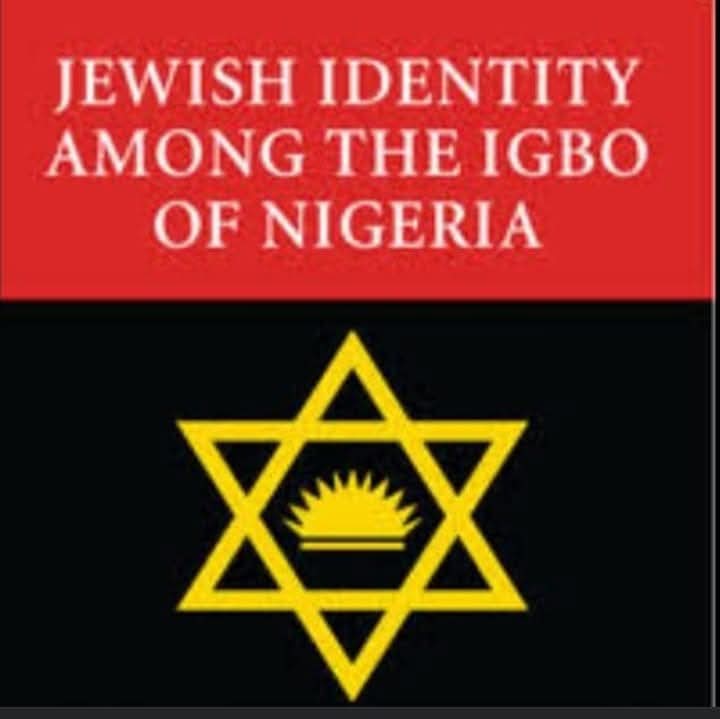
•Picture credit: Daniel Elis’ book cover.
•Opinions, positions or thoughts expressed here are personal and strictly of the writer/author and do not represent the views of The Daily Crucible.