























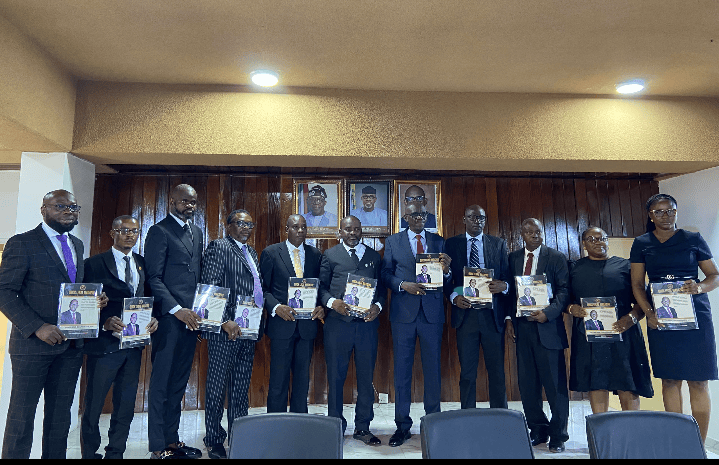
Legal-Lead Publications Ltd., publishers of Quick Legal Magazine, has honoured the Ogun State Attorney-General and Commissioner for Justice, Oluwasina Olanrewaju Ogungbade, SAN, dedicating the fourth edition of the magazine to his contributions to law, justice administration and public service in the state.
The special edition was unveiled on Wednesday at the Ministry of Justice Conference Room, Attorney-General’s Office, Oke-Mosan, Abeokuta, at an event attended by members of the legal profession, government officials and other stakeholders in the justice sector.
According to the publisher and Editor-in-Chief. Moruff O. Balogun, the recognition reflects Ogungbade’s activities since he assumed office in November 2021, particularly in justice-sector reform, legal policy, public prosecution, protection of property rights and efforts to strengthen the legal environment for citizens and investors.
Ogungbade was called to the Nigerian Bar in January 2001 after studying law at Obafemi Awolowo University and attending the Nigerian Law School.
Before his appointment as Attorney-General, he practised with prominent Nigerian law firms, including Ebun-Olu Adegboruwa & Co., the chambers of Chief G.O.K. Ajayi, SAN, and those of Chief Afe Babalola, SAN.
His appointment as Ogun State Attorney-General coincided with his elevation to the rank of Senior Advocate of Nigeria.
In an earlier interview with The Guardian, Ogungbade described the office of Attorney-General as one whose responsibilities extend beyond defending government interests, stressing the need to balance governmental objectives with the wider public interest and the administration of justice.
That approach has featured prominently in several initiatives associated with his tenure.
Land Grabbing Remains a Major Justice-Sector Focus
The fight against land grabbing has been one of the prominent issues addressed by the Ogun Ministry of Justice under Ogungbade.
The Attorney-General has previously explained that the state established a specialised Land Grabbing Task Force in response to challenges involving illegal acquisition and forceful takeover of property.
A Judicial Commission of Inquiry on Land Matters was also established to examine issues surrounding land allocation, documentation and suspected illegal transactions.
The issue carries particular significance in Ogun, which has experienced rapid industrialisation, urbanisation and property development.
The Ministry has continued to issue public warnings and intervene in disputes involving alleged illegal acquisition and dealings in government-acquired land.
In April 2025, for instance, the Ministry warned members of the public against purchasing government-acquired land from suspected land grabbers and raised concerns over an allegedly improperly obtained customary court judgment being used in a land dispute.
The interventions have placed land grabbing within a broader justice and public-policy context involving property rights, public safety and investor confidence.
Four Bills Target Emerging Criminal Justice Challenges
One of the latest legislative initiatives associated with Ogungbade’s stewardship is the development of four executive bills approved by the Ogun State Executive Council in July 2026.
They are the Group Liability for Offences of Violence, Extortion and Secret Societies (GLOVES) Bill; Victims’ Rights Bill; Human Sacrifice Prevention and Prohibition Bill; and Missing Persons Bill.
The proposed legislation seeks to address a range of security and criminal justice concerns, including cultism, organised violence, extortion, ritual killings and challenges surrounding missing-person investigations.
Under the proposed GLOVES legislation, members of unlawful or proscribed groups could face joint liability for offences committed by members in furtherance of the group’s objectives.
The Victims’ Rights Bill seeks to establish a structured framework for protecting and supporting victims throughout the criminal justice process.
Similarly, the proposed Human Sacrifice Prevention and Prohibition Bill is aimed at providing a dedicated legal framework against ritual killings and human sacrifice, while the Missing Persons Bill seeks to establish clearer statutory procedures for handling disappearance cases.
Together, the proposals represent an attempt to expand the state’s legal response to emerging forms of criminality.
Victims’ Rights Gain Greater Attention.
Victims of crime have also featured prominently in the justice reforms associated with the Ogun Ministry of Justice.
In an earlier interview, Ogungbade said the ministry was working towards a more comprehensive approach to victims of sexual offences, including attention to their medical, psychosocial and legal needs.
The proposed Victims’ Rights Bill would give that approach a statutory foundation, providing a framework covering various stages of the justice process, including investigation, bail proceedings, prosecution and incarceration.
Ogungbade’s tenure has also focused on improving access to justice and the efficiency of the justice system.
During his screening for appointment in 2021, he pledged to pursue measures aimed at improving access to justice and decongesting correctional facilities, including the use of plea bargaining where appropriate.
His office has subsequently worked with law-enforcement agencies on prosecution-focused investigations and legal advice, while the ministry has explored measures to reduce delays in criminal proceedings.
Technology has increasingly become part of that reform agenda.
In 2026, Ogun State advanced digital justice initiatives, including virtual hearings and the deployment of e-agents, while Ogungbade disclosed that the state was in the pilot phase of an E-Affidavit programme designed to modernise justice processes.
The state has also approved the construction of a Court of Appeal complex in Abeokuta, an initiative intended to strengthen access to appellate justice within the state.
Ministry Warns Against Criminalising Civil Disputes
Another notable aspect of the Attorney-General’s public interventions has been his position on the proper use of criminal justice mechanisms.
In February 2026, the Ogun State Ministry of Justice warned against the practice of taking disputes involving contracts, tenancy, domestic relationships and land ownership to the police where such matters are fundamentally civil in nature.
Ogungbade argued that criminal justice mechanisms should not be deployed as instruments of intimidation or leverage in private disputes.
The position underscores the ministry’s emphasis on ensuring that disputes are handled through appropriate legal channels and that constitutional safeguards are respected.
A Wider Justice Agenda
Beyond individual policies and legislative proposals, Ogungbade’s tenure has brought a broad range of issues under the attention of the Ministry of Justice.
These include land disputes, criminal justice reform, victims’ rights, cultism, ritual killings, missing persons, human trafficking, digital justice, public prosecution and access to justice.
In September 2026, the Attorney-General also called for stronger investigative and prosecutorial capacity in the fight against human trafficking while participating in a capacity-building programme involving security, legal, welfare, civil-society and media stakeholders.
The developments reflect the increasingly broad role of the modern Attorney-General—not only as government counsel, but also as a participant in legal policy, justice-sector reform and institutional development.
For Legal-Lead Publications, the decision to dedicate the fourth edition of Quick Legal Magazine to Ogungbade comes against the backdrop of several reforms touching on the protection of lives and property, access to justice and the legal environment for economic activity in Ogun State.
The publication provides an opportunity to document developments within the state’s justice sector and examine the role of the Attorney-General’s office in responding to contemporary legal and social challenges.
It also highlights the wider responsibilities attached to public legal office, where decisions can affect government, courts, law-enforcement agencies, businesses and individual citizens.
As Ogun State continues to experience industrial, commercial and property growth, the strength of its legal institutions remains central to dispute resolution, protection of rights and confidence in the rule of law.
The fourth edition of Quick Legal Magazine, unveiled in honour of Ogungbade, is therefore both a commemorative publication and a record of a period of significant legal and institutional activity in Ogun State.
From the fight against land grabbing and the protection of victims’ rights to proposed legislation addressing cultism, organised violence, ritual killings and missing persons, the initiatives associated with the Ministry of Justice demonstrate the range of contemporary challenges confronting the state’s legal system.
For Legal-Lead Publications Ltd., the honour is an acknowledgement of the Attorney-General’s role in these developments and an opportunity to place his tenure within the broader story of justice administration in Ogun State.
The occasion also offers the legal community an opportunity to reflect on the wider purpose of legal practice in public service: strengthening institutions, protecting rights, promoting justice and ensuring that the law remains responsive to the needs of society.