























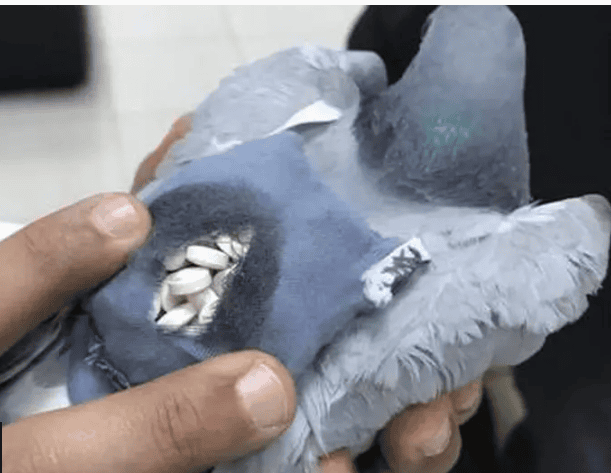
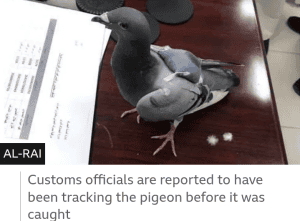
Customs officials in Kuwait have caught a pigeon allegedly being used to smuggle drugs, after discovering 178 pills hidden in a miniature backpack attached to the bird’s back.
According to Kuwaiti newspaper Al-Rai, the pigeon was intercepted near the customs building in Abdali, close to Kuwait’s border with Iraq.
The pills were reportedly found inside a small fabric pouch attached to the bird. An Al-Rai journalist told the BBC that the substance was believed to be ketamine, an anaesthetic that is also illegally used as a recreational drug.
Abdullah Fahmi told the BBC that customs officials were already aware of reports that pigeons were being used to transport drugs.
However, the incident was reportedly the first time officials had caught a pigeon in the act.
Reports also indicated that authorities had been tracking the bird before its capture.
Although the incident in Kuwait attracted attention because of the unusual method, pigeons have previously been linked to drug-smuggling attempts in other countries.
In 2015, prison guards in Costa Rica caught a pigeon carrying cocaine and cannabis in a zipped pouch attached to its body.
Similarly, in 2011, police in Colombia discovered a pigeon that could not fly over a high prison wall because of the weight of a package of cocaine and marijuana strapped to it.
Pigeons have been used to carry messages for centuries, dating back to Roman times. Their remarkable homing ability allows them to return to familiar locations over long distances.
Racing pigeons, in particular, can find their way back to their lofts from hundreds of kilometres away, making them capable of travelling substantial distances.
The bird intercepted in Kuwait highlights how smugglers have reportedly attempted to exploit these natural abilities to transport illegal substances.