















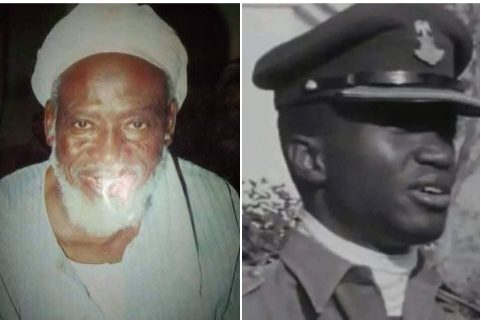
By Sheikh Abubakar Gumi
”At about four o’clock on Friday morning, my phone rang. When I picked it up, it was the Northern Minister of Education, Alhaji Isa Kaita. He told me that the soldiers had carried out a coup, and that the Sardauna’s house had been attacked. He informed me that all high-ranking government officials had gone into hiding.
He mentioned that he had spoken with Hassan Katsina, but Hassan told him there was nothing he could do at that moment. Hassan said he was currently in a meeting with the rebellious soldiers. Isa Kaita then told me that I should go to the Sardauna’s house to see for myself what was happening.
After I prepared and prayed the Subh (dawn) prayer, I set out for the Sardauna’s house. When I arrived, I found the house in total shambles. There were clear signs that heavy weapons had been used to destroy the building. Smoke was still billowing out when I arrived. A few soldiers stood there with rifles in their hands; everywhere was silent. I passed them and made my way inside. As I entered, I came across the body of the Premier lying on the ground in the house’s parking area.
I immediately ordered that the body be taken to the house of the king in the Sarki quarters. Both the Sardauna and his senior wife, Hafsat, had been killed.
After we finished the funeral preparations and the sun began to rise, I led the funeral prayer (Janaza) for all the deceased. I was well aware that a great loss had occurred, and it would be very difficult to find anyone like him in the near future.
On my way back home from the Sardauna’s funeral, I passed groups of people who had gathered, mourning what had happened. Once things settled down slightly, I prepared for work as usual on the day I was to return to my office. While in my office that morning, a vehicle full of soldiers drove into the premises. Some of the soldiers got out and asked for my office. When they entered, they gave me a respectful greeting and said they had been sent to bring me to their boss, Nzeogwu, who wanted to see me.
I was forced to join them in their vehicle, but I was allowed to have one of my staff follow us in my car so he could bring me back. I got up and followed them without resistance. I instructed my driver to follow us so he could return with me after the meeting. We arrived at the military barracks where Nzeogwu was staying. I saw many soldiers guarding the barracks, each with a rifle slung over his shoulder.
After we parked and got out of the car, we entered the office. Not a word was exchanged between me and those soldiers. When they brought me to where Nzeogwu was, he received me cheerfully. I sat on a chair, and he began speaking in a soft voice.
What he wanted to know was: ‘Where did we hide the weapons we bought?’ This question shocked me deeply. In my entire life, I had never even seen Nzeogwu, nor had I ever had any relationship with him. I had thought he called me to offer condolences for the loss of the Sardauna or to show some regret for what he had done. I certainly didn’t expect words of apology or remorse, especially as I noticed he seemed proud of his actions.
What surprised me further was that those who took up arms to carry out a coup were only now trying to gather evidence or justifications for overthrowing the government.
He finished speaking before I answered. I sought further clarification from him. He told me that according to the reports he received, we had purchased a large quantity of weapons and brought them into the country, specifically from Middle Eastern countries, particularly Egypt. He claimed our intention was to launch a Jihad against non-Muslims; that was why he wanted me to tell him where the weapons were hidden.
When it was time to answer his question, I assured him that this was the first time I was hearing such a thing. I confirmed that I was speaking as the Sardauna’s advisor on Islamic affairs, and I emphasized that the Sardauna never traveled to any Arab country as Premier without me. I told him I had never heard him discuss weapons in any Arab country, let alone buy and bring them into Nigeria with the intent to fight non-Muslims.”