




















By Jonas Jakobsen
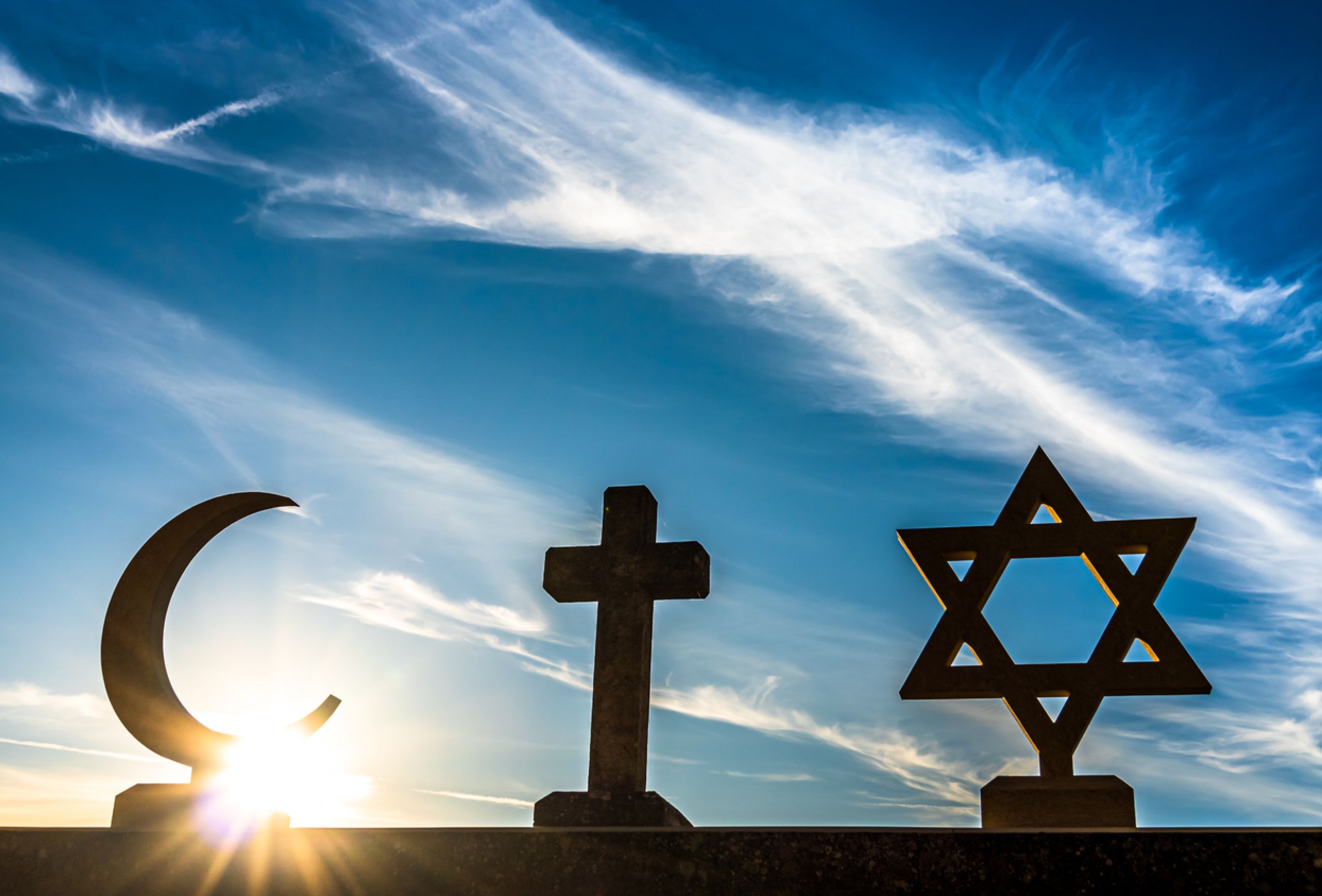
We used to take it for granted that religious arguments should be kept out of political debates. But from fervently Christian Trump supporters to religious members of Europe’s far right and Modi’s Hindu nationalists, religion is back in politics. Philosopher Jonas Jakobsen argues we must stop this rise of religious contamination in the political sphere if we want to hold onto our democracies.
Donald Trump’s return to political prominence has coincided with the resurgence of religion as a weapon of identity politics. In the United States, Christian nationalism has become a rallying cry, presenting “true American” identity as synonymous with a particular brand of evangelical conservatism. In Europe, far-right populists increasingly invoke “Christian heritage” not as a faith but as a cultural boundary marker, often against Muslim minorities. Across the globe, from Narendra Modi’s Hindu nationalism to Recep Tayyip Erdoğan’s instrumental use of Islam, religion is being politicized as a badge of belonging and exclusion.
This phenomenon reveals a challenge of our time: religion can still be a source of moral vision and solidarity, yet it is also easily deployed as a marker of division. The challenge for democracy is not how to banish religion from politics, but how to articulate fair terms for its presence in public life. In an age where populists turn faith into a tribal identity, the idea of secularism—sometimes dismissed by critics as rigid or outdated—must be reclaimed.
A good place to start is John Rawls’ classic defense of “public reason” as an ideal for political deliberation in democratic societies, based on inclusive and mutually shareable reasons. Rawls called such reasons “political”. I defend Rawls’ ideal against critics who claim that it imposes an unbearable psychological burden on religious citizens, and that it gives non-believers an advantage in political debates.
At the same time, I argue, Rawls overlooked the strategic use of secular reasons for religious political purposes, as well as the polarizing force of religious identity beyond the state and its institutions, including the media landscape. Ultimately, I thus align with Rawls in defending the need to prioritize the separation of church and state in modern multicultural democracies for real inclusivity, but I believe we must go a step further by ensuring its real, not just rhetorical, application, as I explain below. Liberal democracies can only survive if political discourse at all levels engages with our shared secular heritage.
Rawlsian public reason and its critics
Rawls argued in Political Liberalism that a conception of justice for democratic societies must remain neutral in controversies about the good life, man’s purpose on earth, ultimate truth, ethical virtue, and more, restricting itself to basic political principles that can be affirmed by opposing religious, philosophical, and moral doctrines. Among such principles are well-known liberal rights such as freedom of thought and conscience, freedom of association, the rights and liberties covered by the rule of law, and political liberties: the right to vote, run for office, and take part in political decision-making on fair terms. The affirmation by opposed cultural and religious groups of these principles in some politically specified (say, constitutional) form is described by Rawls as an “overlapping consensus.”
Public reason, then, is an ideal of how lawmakers and public officials should justify political decisions to one another when trying to reach an overlapping consensus, namely by the use of political reasons that appeal to citizens as citizens, regardless of their personal religion, philosophy, or worldview.
An overlapping consensus, however, does not require religious believers to suppress or abandon their religious faith. The principles of secularism, equality and religious liberty may themselves be grounded on religious faith. For example, Texas lawmaker James Talarico (Democrat), a devout Christian, recently went on Joe Rogan’s podcast criticizing a new law requiring the Ten Commandments to be displayed in public school classrooms in Texas. Talarico’s defense of the separation of church and state is based on his faith, including Jesus’ teachings about neighborly love understood as a message of inclusivity. In Rawlsian terms, there is nothing wrong with lawmakers giving religious reasons for political views, as long as they are willing to supplement these reasons with proper political reasons. Talarico does this by appealing to the Constitution and its secular principles of freedom and equality for all citizens.
Critics of Rawls, however, have long argued that the expectation to supplement religious reasons (say, reasons based on scripture or revelation) with political ones (say, reasons based on human rights, constitutional principles, or shared democratic values) imposes an unjustified psychological burden on religious citizens and their representatives. This is sometimes referred to as the “split identity objection” to Rawlsian political liberalism, as articulated by authors such as Nicholas Wolterstorff, Jürgen Habermas, and Christopher Eberle. The objection is based on the claim that (some) religious members of the political community are simply unable to make any kind of distinction between their religious identity and their political viewpoints. For them, using a strictly secular vocabulary would imply splitting their identity into two different parts, a religious and a secular one, thus threatening their personal integrity. The ideal of public reason, so goes the argument, is too demanding and imposes an unjustified burden specifically on religious lawmakers.
___
What this tells us is that secular reasons are not necessarily alien or external to the identity of religious believers. Most, if not all, political positions inspired by religion can be expressed in secular terms.
___
In fact, however, it is difficult to find a political standpoint that religious lawmakers or spokespersons want to defend but cannot without relying exclusively on the doctrines of a specific faith. For example, controversial issues such as abortion, homosexuality, affirmative action, or periods reserved for prayer or meditation in schools are easily approached within the framework of secular argumentation. Take abortion as an example. Can the anti-abortionist not express her authentic stance in non-religious terms? According to philosopher and legal scholar Jeremy Waldron, Christian opponents of abortion tend not to base their arguments on divine revelation:
The argument against abortion, such as it is, is mainly a natural law argument based on the apparent continuity of fetal development and it is perfectly intelligible to a secular moral sensibility. The religious aspect is just the disciplined insistence on taking the continuity of human life (both in and outside the womb) seriously in light of what biblical faith tells us about the preciousness of human life generally.
In other words, arguing that “life begins at conception” or that “all human life is sacred” does not constitute a specifically religious argument: There is no reference to revealed doctrines, holy prophets, or sacred scriptures, and no appeal to membership in a specific community of faith. What this tells us is that secular reasons are not necessarily alien or external to the identity of religious believers. Most, if not all, political positions inspired by religion can be expressed in secular terms.
The problem with Rawls’ approach, therefore, is not that it imposes an unjust psychological burden on religious lawmakers and public officials. Rather, the problem is that it fails to specify what kinds of political reasons are compatible with liberal freedom, equality, and impartiality. More specifically, it fails to address cases where seemingly neutral or secular reasons are used strategically to promote religious identity politics.
Consider again the law in Texas requiring public schools to display the Ten Commandments, mentioned above. Many defenders of the law frame their reasoning in civic, historical, and educational terms—thus sounding secular—while much of the symbolism, and of course the choice of document, are rooted in a specific religious tradition. The arguments are crafted to appear neutral, for example by emphasizing the moral universality of prohibitions against killing and stealing, but they clearly draw from a particular religious heritage.
By imposing a specific religious doctrine on all public schoolers, defenders of the law fail to recognize the multi-faith and pluralistic constellation of the American citizenry and the constitutional right to freedom of conscience. They fail to respect each pupil as a free and equal citizen with the capacity to make up her own mind about religious matters and how they relate to morality. They deny the right to be educated without being told that there is a God, which God there is, or that faith in God is required to act morally.
Viewed in the context of this and other misuses of religious faith for political purposes, Rawlsian secularism is certainly worth defending. But the problem with religiously motivated argumentation is not necessarily its form—i.e. its use of religious revelation or scripture—but often its content, which may be disguised in a secular or neutral form. This is a challenge that Rawlsian public reason never addresses.
___
If political debate is dominated by claims that can only be accepted within a particular faith or worldview, those who do not share that framework are excluded from full participation.
___
A second limitation of Rawls’ approach is its narrow focus on the state and its institutions, neglecting how religious sensibilities form and sometimes distort political opinion formation in civil society and the political public sphere more broadly. Rawls formulates his “duty of civility” —the duty to supplement religious reasons with proper political ones—as a duty for lawmakers and public officials, not for ordinary citizens, influencers, opinion leaders, or participants in public debates.
But why should this duty apply only to lawmakers and state officials? If a religious spokesperson insists on national television that a particular law should be enacted solely on the basis of religious doctrine, without offering any non-religious justification, she implicitly suggests that those who do not share her faith are nevertheless bound by it. In doing so, she signals a willingness to impose her faith on others through politics and law. This is incompatible with the kind of basic respect that is required in a liberal democracy, where citizens are expected to recognize one another as equals, regardless of identity or belief.
The ethical duty of civility, therefore, also applies in the public sphere more broadly, whenever we, as citizens, participate in debates about the laws and institutions that frame our common lives. Public deliberation is unlikely to generate solidarity and mutual understanding if it is saturated with sectarian appeals. If political debate is dominated by claims that can only be accepted within a particular faith or worldview, those who do not share that framework are excluded from full participation. This weakens trust and undermines the sense of belonging that democratic life depends on. To avoid this, citizens should use reasons that others, regardless of their convictions, can at least understand and evaluate.
•Jonas Jakobsen | Jonas Jakobsen is associate professor of political philosophy at UiT – The Arctic University of Norway.
•Opinions, positions or thoughts expressed here are personal and strictly of the writer/author and do not represent the views of The Daily Crucible.