






















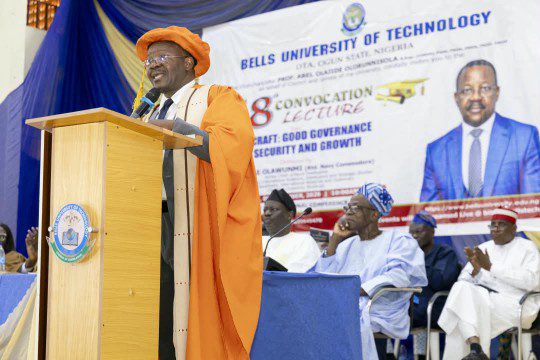
Retired Navy Commodore, Dr Kunle Olawunmi, has challenged Nigeria’s political leadership to stop shifting the burden of institutional failures onto ordinary citizens, insisting that government must be held accountable for the protection, welfare and security of the people.
Olawunmi, who delivered the 18th Convocation Lecture of Bells University of Science and Technology, Ota, Ogun State, on Friday, warned that the resilience and endurance of Nigerians must not become a convenient excuse for government institutions to abdicate their responsibilities.
Speaking on the theme, “Statecraft: Good Governance for Security and Sovereign Growth,” the Associate Professor of Global Counter-Terrorism, maintained that governance must be measured not by public declarations, budgetary allocations or ceremonial project commissioning, but by tangible results that improve people’s lives.
“Government must protect life, administer justice and enable enterprise. Nigeria must not turn the endurance of its citizens into an excuse for institutional failure,” he declared.
Olawunmi argued that public expenditure must translate into functional services, noting that the commissioning of a health centre, for instance, means little without adequate personnel, medicines, equipment and sustained maintenance.
According to him, every public institution must have clearly defined responsibilities, identifiable officials answerable for performance and accessible remedies for citizens when services fail.
“A budget allocation begins a responsibility. It does not complete it,” he stressed.
The retired naval officer also turned attention to Nigeria’s security architecture, insisting that intelligence gathering must lead to timely and lawful action if the country is to overcome its persistent security challenges.
He maintained that passing credible security warnings from one government agency to another without ensuring that somebody with the authority to act responds appropriately does not amount to effective intelligence management.
Olawunmi further called for an institutional culture that protects professionals who raise legitimate concerns, investigates misconduct without political interference and rewards competence rather than connections.
He warned that when public officials and institutions punish honesty or shield wrongdoing because of influence, they undermine the foundations of national development.
“A country that punishes honesty teaches dishonesty,” he cautioned.
On economic governance, he urged political leaders to demonstrate greater willingness to explain policies that impose hardship on citizens, provide relief for those bearing the heaviest burden and review decisions when evidence shows that they are not working.
“Admitting an error can restore trust. Insisting on an error can destroy it,” he said.
The international relations and strategic studies scholar also argued that Nigeria’s quest for sovereign economic growth would remain elusive without dependable electricity, secure access to farms, functional roads and predictable government policies that encourage enterprise.
Beyond acquiring infrastructure, he said, the country must develop the technical capacity to evaluate contracts, operate sophisticated equipment and maintain facilities procured with public resources.
He described the sustainability of public institutions and projects beyond individual administrations as a fundamental test of responsible leadership.
“The true test of statesmanship is what survives the statesman,” he declared.
Turning to the graduating students, Olawunmi urged them not to confuse the appearance of success with the acquisition of genuine professional competence.
He challenged the graduates to deepen their knowledge, seek experienced mentors and cultivate the discipline required to deliver results in their chosen professions.
According to him, good intentions and impressive public profiles cannot compensate for professional incompetence.
“A photograph cannot substitute for a professional record,” he warned.
He also urged them to establish personal ethical boundaries before confronting the pressures of professional life, particularly against falsifying records, endorsing work they have not properly inspected or compromising standards for personal advantage.
He advised graduates confronted with unethical demands to document their concerns, seek credible professional counsel and utilise established channels for reporting misconduct.
“Before you sign, ask whether you would accept that risk for someone you love,” he counselled.
Beyond the workplace, Olawunmi said graduates must also embrace responsible citizenship by verifying information before sharing it, scrutinising the records of public office seekers and questioning how public resources are utilised.
He cautioned against defending wrongdoing simply because the perpetrators share one’s ethnic background, religion, community or political allegiance.
In what he described as a practical challenge to the graduating students, the convocation lecturer urged each of them to undertake three commitments within their first three months after graduation: identify a professional skill to improve, find a mentor and select a societal problem they can help address.
He encouraged them to engage the people affected by such problems, collaborate with others and measure whether their interventions produce sustainable improvements.
“Within a year, be able to point to something that works better because you helped,” he challenged them.
Olawunmi equally called on employers to create meaningful entry-level opportunities for young professionals, provide adequate supervision, pay fairly and protect employees who demonstrate the courage to speak honestly.
He added that Nigerians who pursue professional opportunities abroad should remain connected to national development through mentorship, collaboration and investment.
In his concluding remarks, he urged government and the older generation to build institutions worthy of the ambitions and efforts of young Nigerians, while challenging the graduates to contribute their quota towards making those institutions better.
“We should leave you institutions worthy of your effort. You should prepare to make them better. Let that be our promise between the generations,” he said.
The lecture was delivered as part of activities marking the 18th Convocation Ceremony of Bells University of Science and Technology, Ota.