
















The National Chairman of the Igbo Agenda Dialogue (IAD), Chief Chekwas Okorie, has urged President Bola Tinubu to grant unconditional release to the detained leader of the Indigenous People of Biafra (IPOB), Mazi Nnamdi Kanu, warning that failure to do so could have devastating political consequences for the ruling All Progressives Congress (APC) in the 2027 general elections.
Okorie, in a statement made available to Sunday Sun, also called for the release of other Igbo people he described as prisoners of conscience, arguing that Kanu’s continued incarceration had become a major source of resentment among the Igbo in Nigeria and the diaspora.
He advised Tinubu to seize the opportunity provided by the ongoing electioneering season to announce Kanu’s release, insisting that any campaign promises or political overtures to the South-East would amount to little without addressing the IPOB leader’s detention.
The IAD chairman warned that ignoring the demand could carry serious electoral consequences for the President and the APC in 2027.
Okorie traced the agitation for Biafra to the formation of the Movement for the Actualisation of the Sovereign State of Biafra (MASSOB) by Chief Ralph Uwazurike in 1999 and the subsequent emergence of IPOB, led by Kanu, in 2012.
He attributed the separatist agitations to what he described as years of political exclusion, marginalisation and discriminatory policies against the people of the former Eastern Region following the Nigerian Civil War, which ended in 1970.
According to him, the failure of successive governments to address the grievances of the Igbo has reinforced the perception that the war against the former Republic of Biafra continued through other means, despite the Federal Government’s declaration of a no-victor, no-vanquished policy.
He, however, accused successive APC administrations of adopting predominantly military approaches in dealing with the Biafra agitation, in contrast with what he described as the non-kinetic approaches used by Nigerian governments to manage similar agitations in other parts of the country.
Okorie cited the agitations for Yoruba self-determination, the Niger Delta struggle and the activities of Boko Haram and the Islamic State West Africa Province (ISWAP) as examples of other separatist or insurgent movements that had confronted the Nigerian state.
He alleged that Igbo land had been subjected to prolonged security operations and described the treatment of the region as that of an occupied territory. He also alleged that several young Igbo men and women had been killed in the course of the security operations.
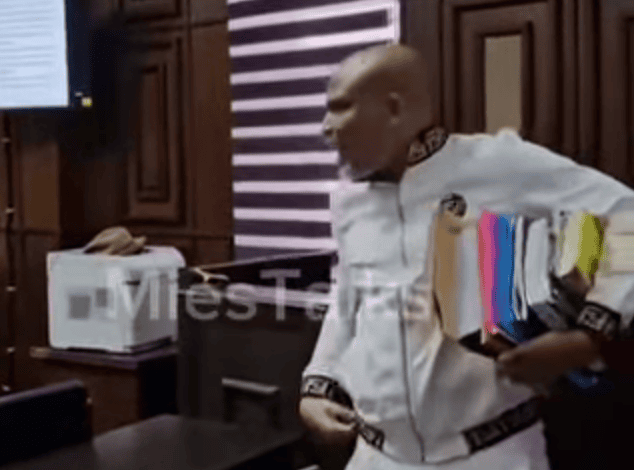
Reviewing Kanu’s legal travails, Okorie recalled that the IPOB leader was arrested after being returned to Nigeria from Kenya in June 2021 in what he described as an extraordinary rendition.
He said the Court of Appeal discharged and acquitted Kanu on October 13, 2022, but the Supreme Court overturned the decision on December 15, 2023, and ordered that the case be returned to the Federal High Court for further proceedings.
Kanu was subsequently sentenced to life imprisonment by the Federal High Court in Abuja on November 20, 2025, and transferred to a correctional facility in Sokoto State.
Okorie expressed concern over the continued detention of other Igbo people allegedly held for agitating for self-determination, arguing that their treatment was inconsistent with the rehabilitation and reintegration programmes extended to some other categories of offenders.
He said appeals by prominent Igbo leaders to former President Muhammadu Buhari and his successor, Tinubu, for Kanu’s release had so far yielded no result.
He particularly referenced appeals by the President-General of Ohanaeze Ndigbo Worldwide, Senator John Azuta-Mbata, who had publicly urged Tinubu to intervene.
According to Okorie, Azuta-Mbata captured the depth of Igbo resentment when he declared that the entire Igbo nation was in prison for as long as Kanu remained incarcerated.
He argued that Kanu had become a symbol of how Igbo-related grievances and concerns were treated in Nigeria, making his continued imprisonment a sensitive political and emotional issue for the people.
Okorie maintained that the President had the constitutional power to exercise his prerogative of mercy to secure Kanu’s freedom, alongside that of other detainees.
He therefore urged Tinubu to make an unconditional release announcement before the end of the year, expressing the hope that Kanu and other detained Igbo agitators would be reunited with their families on or before December 31, 2026.
He said such a decision would demonstrate political goodwill, promote national reconciliation and help address the lingering sense of alienation among the Igbo.